Sufjan Stevens’ Songs for Christmas boxset includes a memoir essay about how the smell of a burning spatula sent him tumbling into old Christmas memories and, eventually, something like a spiritual revelation—“a tragic-comic-sentimental shock that was simultaneously mundane and supernatural.”
In the vision Stevens describes, the smell of melting plastic becomes a portal to the whole universe, past and present, and “at the very center of the universe I saw the Christ Child … This was the mysterious Incarnation of God. It feels about right that Stevens would treat Christmas like both a theological mystery and a craft-store accident.
This anecdote is the Rosetta Stone for Stevens’ beloved Christmas albums, music that captures the holiday spirit in its simplicity and grandiosity, its cosmic significance and intimate resonance, and most importantly, its chilly melancholy and holly jolly euphoria. His song “That Was the Worst Christmas Ever!” recounts a childhood memory in which his father, in a fit of rage, threw Christmas presents into the fireplace. That song sits right after his rendition of “O Holy Night” and right before “Ding! Dong!”
There you have it: the splendor of the Christ child, the pain of old holiday memories, the general lunacy of the season. Stevens understands that it’s not really Christmas without all three. And that strange alchemy—sacred, sorrowful, slapstick—is something Charlie Brown understands too.
Stevens and Charlie Brown have a lot in common: white boys with a huge cultural footprint who have nevertheless become associated with Christmas, attended by an air of fragile melancholy and great music. Their contributions to the holiday season seem cut from the same cloth—nostalgic, glum, charmingly low budget. Both have unwittingly found themselves packaged into the same slab of Yuletide slop that their work ostensibly stands in opposition to, and yet both, by some miracle, resist being totally subsumed by the jaws of Christmas consumerism. Songs for Christmas and A Charlie Brown Christmas are too strange to really fit the blueprint. More power to them.
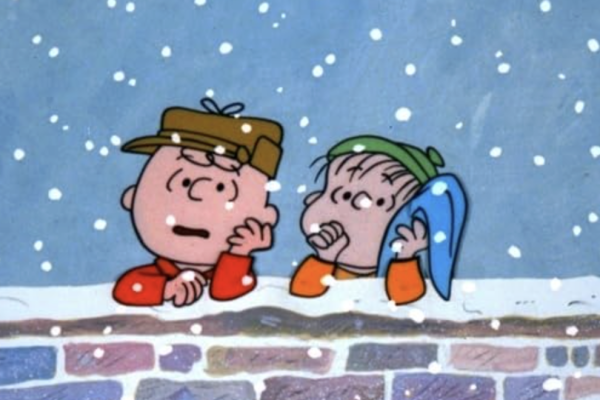
A Charlie Brown Christmas turns 60 this year. It remains as good as it gets—perfect in a way that very, very few pieces of entertainment could ever be. Its imperfections—the cheapness of the animation, the halting prosody of the child voice actors—only add to its immaculate vibes. Most children’s entertainment is disposable, and some slowly unveils its wisdom as you age. But A Charlie Brown Christmas appears fully formed from the first viewing, its insights immediately available to every viewer, regardless of age.
READ MORE: Cross Marks on the Stable Door
The ramshackle production lore of A Charlie Brown Christmas heightens its delightful mythos. Peanuts creator Charles Schulz had briefly worked with TV producer Lee Mendelson in the early 1960s on a documentary about the comic strip. That documentary never achieved a real release, but its existence prompted interest in bringing Schulz’s characters to the screen. At the time, Coca-Cola was eager to cement itself as the holiday’s corporate patron, and Mendelson pitched the company on an animated Peanuts Christmas special for CBS, a barebones idea he later recalled as “winter scenes, a school play, a scene to be read from the Bible, and a soundtrack combining jazz and traditional music.” CBS wasn’t thrilled about the Bible part, but Schulz put his foot down—for him, the Luke 2 recitation was the hinge of the whole project—and the company relented, with a catch: Schulz and Co. only had six months to put the special together. They used almost all of it. A Charlie Brown Christmas was completed just 10 days before its premiere.
That expedited timeline led to some cut corners, like the runtime being reduced from an hour to 30 minutes and the Peanuts kids’ famously janky dance moves. One area where they refused any shortcuts, of course, was the soundtrack. Mendelson had tapped Vince Guaraldi to write music for the shelved Peanuts documentary, and he’d liked what he heard. The Vince Guaraldi Trio was brought in to record a mix of original jazz numbers and classic carols for the TV special, and the band delivered holiday-season staples that are now fixtures in just about everyone’s Christmas rotation. “Christmas Time Is Here” and “Linus and Lucy” are as much a part of the cast as Snoopy and Sally, adding poignance to Charlie’s blahs and verve to the ice-skating sequences. If Schulz’s script is the movie’s heart and the animation is its skin and bones, then the Vince Guaraldi Trio provided A Charlie Brown Christmas with its improbably cool and timeless spirit.
Time is an important part of the Peanuts ethos, with the kids seeming both stuck in the past and outside of it altogether. They approach life with a world-weary innocence, too old to really believe in the “Magic of Christmas” anymore, too young to give up on it entirely. It’s striking today to see how much time the movie spends lingering in Charlie’s sadness, how cold and mean his circumstances really are. Mendelson recalls Schulz telling the production team that the movie should feature a Christmas Tree with Charlie Brown’s energy, and the animation team delivered on that beautifully. But that infamous, dinky little Christmas tree could be anyone’s energy—provided they’ve ever had a Christmas that didn’t live up to the high bar of a golden, not-quite-real yesteryear.
A Charlie Brown Christmas is now both a meditation on nostalgia and an avatar of it. Charlie Brown and Snoopy are as nostalgic as they come, appearing on countless cheap Christmas ornaments and mugs, inflated in front yards and splayed across wrapping paper—an ode to bygone years. Yet all that merch only points back to the origin story of a blockhead with holiday blues living in the shadow of a dawning suspicion that the best Christmases are behind him.
But then, in its final act, Charlie Brown has his own revelation. Linus delivers a True Meaning of Christmas masterclass, reciting Luke 2 from the stage, and Charlie Brown is able to have an all-time great Christmas once he stops trying so hard and recenters his focus on the story of Mary, Joseph, and Jesus in Bethlehem.
This is where Charlie Brown’s Christmas intersects with Sufjan Stevens’, in that both are jolted by a sudden vision of the universe—that same “tragic-comic-sentimental shock”—which their place in the Christmas canon now delivers to the rest of us. A Charlie Brown Christmas understands the Christmas blues, and it neither wallows in them nor smothers them in a confectionary blitz. It enters the doldrums, and at the very center finds the Christ Child, an infant baby, helplessly crying, wrapped in swaddling clothes. Maybe that’s why both Sufjan Stevens and Charlie Brown feel indispensable this time of year: They follow the ache all the way to its source and discover, to their own surprise, that the center still holds.
Stevens and Charlie Brown have a lot in common: white boys with a huge cultural footprint who have nevertheless become associated with Christmas, attended by an air of fragile melancholy and great music.
Got something to say about what you're reading? We value your feedback!