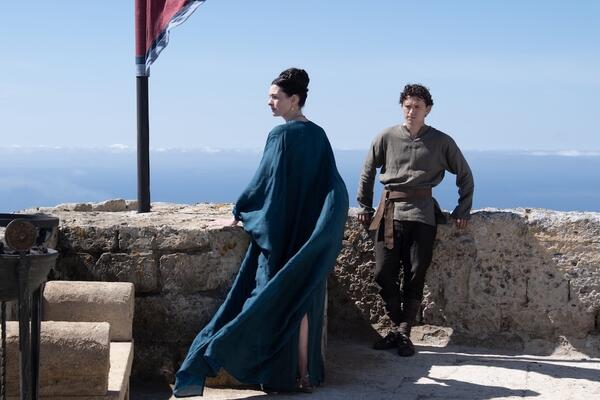
Last week, we were proud to publish Georgia Coley’s review of Christopher Nolan’s newest epic: The Odyssey.
In it, Georgia notes that the film’s frequent use of “Zeus’ Law” has a lot in common with the biblical Golden Rule. Just like the ancient Greeks were careful to treat all strangers with kindness because they might be gods in disguise, Christians are called to take care of the poor, because Jesus said he would be manifest in “the least of these.” As she wrote, “The core sin at the center of the fall of Troy isn’t just the violation of social code; it’s the desecration of the sacredness of the human person.”
As it turns out, Georgia isn’t the only person with some observations about The Odyssey. Her piece generated a lot of responses from our readers, some who agreed with the review and some who didn’t. We are sharing some of those responses here to spark more conversation and thought.
Theologically remarkable
I have yet to see the film, though I’ve read a number of critiques. This piece is theologically remarkable, truly so. Thanks to Georgia Coley and to Sojourners. —Bill Wylie-Kellerman, Detroit, Mich.
Reflect on who we have become
My wife and I saw The Odyssey last night. I appreciated reading your reflections. However, you did not conclude the piece with an explicit return to the title. Is the “original sin” the lack of shame, lack of hospitality/breaking Zeus’ law, an “apple eating” event (the Trojan horse) destined to unravel a mythical Golden Age of Greece—perhaps all of it? (When was America “great”?)
There never has been a purely good society. Europeans, including my Spanish ancestors, brought to these lands a backdrop of war, conquest, and hatred of peoples they deemed less than. The U.S. unfolded from the original sin of eliminating Native peoples, our way of life, and all that we held sacred. Were Native people totally innocent in their, at times, violent interactions with each other, and against the colonizers/settlers? No, but they were not honored. In my days as a member of the Catholic Church and now an Episcopal parish, I’ve experienced the weekly opportunity to recall and lament recent and past individual and systemic words, actions, and policies that have broken the human family. The “original sins” need to be remembered often, because we forget, and then we need to resolve to “sin no more” and seek forgiveness to move forward. True leaders in the U.S. need to name the “Trojan horses” used against Native peoples and others and then create opportunities together to move beyond the past. In doing so, can we, under the Divine's loving inspiration, choose to create a new world from the best of the founding ideals and values and ones we now claim beginning with feelings of shame as we reflect on who we have become. —Daniel Mondragon, Arvada, Colo.
So very true
Masterfully written. And, all so very true. I saw the movie as entertainment and hadn’t pulled together all these profound thoughts. Thank you for boiling it down for me in clear, intelligent words. —Micaela McLean, Kingston, Wash.
Filmed on stolen land
We should be boycotting the “blockbuster” film The Odyssey, which was filmed on stolen land, without the permission of the people who live there. It has raked in tons of money already. Where were you when this film was promoted to warn people about boycotting for this reason? There are other independent filmmakers with ethics and important messages. Why not support them and amplify their voices? —Cindy, Kansas
Only covenant can sustain a civilization
Reading about Christopher Nolan’s The Odyssey, I found myself thinking less about which modern nation violates “Zeus’ Law” and more about the deeper principle behind it. The Greeks called it xenia: the sacred obligations of hospitality, trust, and protection extended even to the stranger. Long before Homer composed The Odyssey, the ancient Indo-Iranian world had already given expression to an even broader vision through Mithra—guardian of covenant, truth, promise, trust, and the sacred obligations that make civilization itself possible. Hospitality is one expression of that covenant; Mithra encompasses the moral architecture upon which enduring societies depend.
If we invoke these ancient ideals, we should apply them consistently—not only to our adversaries, but also to ourselves and to every government. That includes the United States. Every nation enters into a covenant with its own people—a promise to uphold truth, protect human dignity, and govern in service of the common good. Whenever that covenant is weakened through deception, injustice, or the erosion of trust, the moral foundations of society begin to fray. No nation is exempt from this ancient measure. It is precisely because I believe this principle applies universally that, as an Iranian-born Zoroastrian, I cannot help but think first of the Iranian people.
The tragedy of today’s Iran is not simply geopolitical. It is that the Islamic Republic has systematically broken the covenant with its own people. It has replaced trust with fear, truth with propaganda, hospitality with suspicion, and dignity with repression. A government that betrays its own citizens has already violated one of humanity’s oldest civilizational laws. Perhaps the most devastating Trojan Horse in modern Iranian history was not a diplomatic negotiation or a military deception. It was the 1979 Revolution itself. Wrapped in the language of justice, freedom, spirituality, and independence, it invited millions of Iranians to open the gates of their own civilization in good faith. What entered instead was a regime that steadily dismantled the very covenant it had promised to restore. If the Trojan Horse symbolizes betrayal disguised as salvation, then the deepest betrayal in modern Iran has not been between states. It has been between a government and its own people.
Perhaps this is the enduring lesson of The Odyssey. Civilizations are not judged only by how they treat strangers. They are judged first by whether they remain faithful to the sacred bonds that hold a people together. When covenant is broken, no amount of military power, political ideology, or religious rhetoric can prevent decline.
The Iranian people deserve to live under a covenant worthy of Mithra—a society where truth is honored, promises matter, strangers are welcomed, differences are not feared, and no citizen need dread the knock at the door.
Power can compel obedience. Only covenant can sustain a civilization. —Sousan Abadian, Washington, D.C.
And what say ye? If you have a response to a Sojourners article, we’d love to hear it; use the “send message” button below.
“Perhaps this is the enduring lesson of The Odyssey. Civilizations are ... judged first by whether they remain faithful to the sacred bonds that hold a people together.” —Sousan Abadian, Washington, D.C.
Did this article have an impact on you? Tell us how! Whether you’re moved to take action, have a question, or want to share a comment (good or bad), we value your feedback!