If I were to look around at the most powerful people and movements in American society right now, the clearest trait I could ascribe to them would be “shamelessness,” particularly in the face of cruelty.
Poisonous and vitriolic words fly freely in ways that would have made leaders and diplomats of a previous generation blush. Vast atrocities are perpetuated daily, and the people committing them quip and meme and joke as though they find the whole endeavor one big game of “trolling” anyone who still cares. This death of shame has been felt across the world; it has manifested in brazen ethnic cleansing and genocide, in legislation targeting immigrants and LGBTQ+ people, and in authoritarian leaders increasingly following the mold of President Donald Trump’s “no filter” strongman rhetoric worldwide.
It’s easy to wonder: How did we get here? Wasn’t there a time when such actions would have provoked greater shame, because people believed—or at least, outwardly lived by—some kind of moral law or principle about how we treat other human beings?
It’s into this chaotic and seemingly lawless landscape that Christopher Nolan’s take on The Odyssey has arrived. Running thematically parallel to 2023’s Oppenheimer, this Nolan story reveals how seemingly self-contained decisions made in the fog of conflict can reshape an entire culture: How, he asks, does a nation or a society begin to lose its very soul? And can it be regained? The answer is equal parts bleak and hopeful.
The Odyssey, not unlike today, takes place during a period of rapid societal change and decline within a powerful empire: the end of the Bronze Age. “We’re part of the greatest civilization ever known,” Telemachus (Tom Holland) remarks at the beginning of the film. His mother, Penelope (Anne Hathaway), responds: “The structure is nothing without people’s respect for its meaning.” This pivot point between eras—the precipice of a powerful civilization coming to an end—is present in Homer’s original text, though this latest contemporary adaptation expands its resonance by imagining how, exactly, that decline was born. In Nolan’s world, the key instigator of societal collapse is the Greek conquest of Troy. But it’s not merely the invasion that leaves the greatest impact—it’s the method by which it was achieved: the Trojan Horse.
One way that Nolan’s take on The Odyssey attempts to flesh out the themes of the original text is by repeatedly articulating a concept the film dubs “Zeus’ Law”—the Greek principle otherwise known as xenia (or “guest-friendship”), which mandates a reciprocal relationship between a host and guest, with everyone treating strangers and sojourners with generous hospitality lest they be gods in disguise. It’s a theological ethic of welcome that finds parallel roots among Christian thought, with the author of Hebrews making reference to a similar idea: “Do not neglect to show hospitality to strangers, for thereby some have entertained angels unawares.” And in Nolan’s version, the principle is reinterpreted in a way that runs even more parallel to Christ’s teachings; Penelope says quite directly that the essence of Zeus’ Law is the Golden Rule: “Treat others as you would be treated.”
This is where the Trojan Horse comes in. In one of the penultimate moments of the film, Odysseus (Matt Damon) revisits the sacking of Troy—portrayed earlier in the narrative as a glorious victory built on cunning trickery—and sees the death and destruction wrought by his own army with eyes unclouded. In a graphic sequence, we watch Odysseus’s men (many of whom we’ve found somewhat sympathetic throughout the film) raid the city and kill all in their wake, including women and other innocents. And at the center of this brutal bloodbath—the key to its success—is the deceptive trick of the Trojan Horse. Odysseus says, “We left them a gift, an offering of peace, that they took into their home. We violated all that’s ever sacred between people. It turned a fight into a hunt . . . One man’s trick to break Zeus’ Law forever.”
The notion that the Trojan Horse was in violation of xenia—Zeus’ Law—is not one that is traditionally taken from the original text of The Odyssey. But this is the excitement and creativity of a thoughtful adaptation: By engineering one small change in perspective, Nolan reframes the entire story’s contemporary implications. Regardless of the ethics of the Trojan Horse itself, Nolan is interested in the way that men making seemingly pragmatic, clever, and momentarily justifiable decisions can unintentionally cause profound ripples in the fabric of society for generations. Sure, maybe the deception of the Trojan Horse as a peace offering was a clever way to infiltrate Troy in the short-term. But what happens when your desire to win the battle erodes all social mores of hospitality, reciprocity, and trust between cultures?
From the moment of Troy’s destruction onward, there is little hospitality or trust to be found in the film’s post-Trojan Horse culture. While Odysseus boldly assumes that beings like the Cyclops or Circe will treat his men with respect because of Zeus’ Law, he quickly begins to find that Zeus’ Law is coming undone across the world. Nearly every inhabitant of every island that Odysseus’s crew visits on their journey home tries to kill them, and treats them as hostile invaders—a precedent Odysseus eventually realizes has been set by themselves, the original conquering “Sea People” that travellers say will bring doom to their civilization.
Is there always a singular, self-contained pivot point that instigates moral degradation? Even in The Odyssey, it’s not quite that simple: the Trojan Horse may be an act of deception that violates xenia, but it also follows an original breakage of the same code when the Trojan prince, Paris, kidnapped Helen of Troy in the first place. Nolan’s film muddies the waters even further by suggesting that Agamemnon would have liked to invade Troy for economic and strategic reasons to begin with; the removal of Helen just gave him decent enough justification for it. Nothing ever exists in a vacuum. What Nolan proposes, however, is that wherever the source “originally” stems from, some singular actions and events can drastically erode virtue in a society—regardless of their pragmatic intention.
READ MORE: Everyone In The Death of Robin Hood Is Praying for Something Different
Watching the sacking of Troy and its tragic aftermath as Zeus’ Law fell apart onscreen, I couldn’t help but think about the ways that American culture—throughout much of our history, but noticeably in the last decade—has experienced similar erosion in virtue. The rejection of strangers and foreigners, the undercutting of objective truth, the rendering of all opposition as inherently traitorous. I’m hardly the first to observe that the genocide in Gaza has felt like the recent pinnacle of this moral disintegration, and the fact that both Democrat and Republican politicians have repeatedly justified and continued to fund the violence has left a profound moral stain on both parties.
What’s more, the consequences of these evils—and the permission slip to commit them—are not self-contained. What Christopher Nolan posits in The Odyssey is that what is sanctified in one situation cannot help but spread like wildfire. It’s part of why many have compared the Trojan Horse in the film to the dropping of the atomic bomb in Oppenheimer—another event sanctified by the American empire that drastically reshaped the international moral imagination and window of permissibility. And the moral ripples of that singular decision continue: This past February, the late Lindsey Graham said of Gaza, “Just flatten it. We flattened Berlin. We flattened Tokyo.” The ghost of the atomic bomb haunts and infects our moral imagination now, and what we allow today will do the same.
In Nolan’s adaptation, Odysseus reflects, “To burn the walls of Troy was to burn the world-entire”—including his own home. That American politicians willingly enabled a genocide of the Palestinian people would be foul enough, but what has been sanctioned in Palestine has not stayed there either. The same artificial intelligence surveillance companies and drone technologies that have been deployed against Palestinians in Gaza are now being deployed against American citizens. The same cavalier tendency to portray an entire population as potential terrorists has come to be applied liberally to whoever the administration wishes to target next. Eventually, violence anywhere comes back home to roost.
A spoiler for Nolan's adaptation of The Odyssey follows.
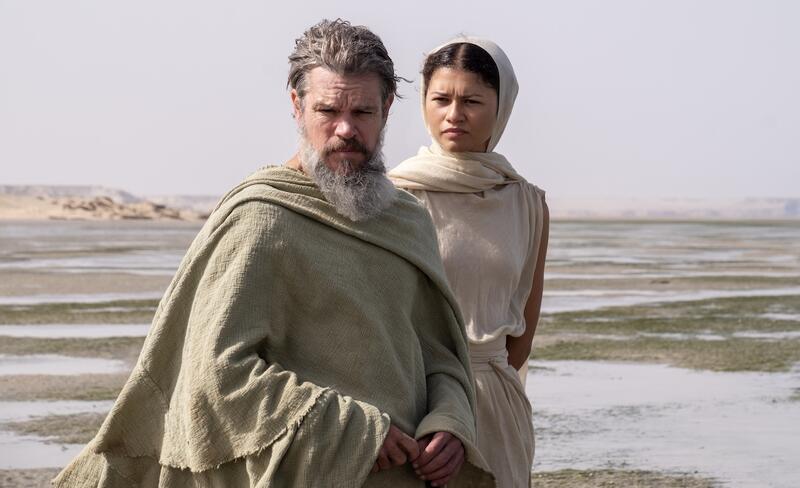
One of the most striking images in Nolan’s take on the fall of Troy is the Greek soldiers’ brutal execution of a priestess of Athena, played by Zendaya. Odysseus is haunted by the image of her face staring back at him, cheeks covered in tears as she bears her fate. And when Athena begins to visit him (whether the real goddess or a representation of his conscience), she takes the form of this priestess, reminding him of the sin that has been committed against her. In the moment the priestess is executed, the film cuts to the beheading of Athena’s statue in the temple. The impact is clear: In a world where anyone might be a god in disguise, to deceive and murder the innocent (in defiance of xenia) may be the same as murdering Athena herself. The core sin at the center of the fall of Troy isn’t just the violation of social code; it’s the desecration of the sacredness of the human person.
matt-damon-zendaya-odyssey.jpg
Greek xenia is based on the idea that people are deserving of respect because they could theoretically be gods in disguise. The Christian framework of human dignity has similar echoes, but it takes it one step further: We shouldn’t just welcome and dignify strangers because they could be gods, we should welcome them because every person is an image of God already. Similar to The Odyssey, Christians believe that desecrating that divine image can have profound consequences for human beings and the world at large.
I find hope, however, in the Christian understanding of moral impact. Jesus says, “The kingdom of heaven is like a mustard seed, which a man took and planted in his field. Though it is the smallest of all seeds, yet when it grows, it is the largest of garden plants and becomes a tree, so that the birds come and perch in its branches” (Matthew 13:31-32). Paul likewise asks his listeners in 1 Corinthians 5:6, “Don’t you know that a tiny grain of yeast makes a whole batch of dough rise?”
It is grimly true that our singular acts of moral violation, compromise, and dehumanization—or the choice to ignore such acts—can influence and shift an entire culture for generations to come. But the inverse is also true: Our smallest acts of moral conviction and care for the human person made in the image of God, abiding by xenia and beyond, can have similarly profound ripples in eternity.
The most hopeful reflection Christopher Nolan can muster at the end of his take on The Odyssey is that someday, “a new dawn will break over the darkened world, when our mistakes will once again be forgotten.” It’s a simultaneously difficult and poignant truth: that darkness is never forever, but even when we escape it, the lessons we’ve learned from our gravest stumbles will be ignored.
It may be that we’re living through such a moment now, unaware of the enduring consequences of our best and worst choices, and how they will continue to reshape the world. Still, I was struck by the deeper prophetic truth of the film’s final statement: Someday, the dawn will break, and all will be made new. And like Odysseus, the leader of the house will return—welcoming the humblest beggar, wielding justice like a well-strung bow, and offering mercy to all who lay down their arms before him.
Similar to The Odyssey, Christians believe that desecrating that divine image can have profound consequences for human beings and the world at large.

Georgia Coley is a documentary filmmaker and culture writer living in Nashville. She writes about the intersection of trans experience and theology at her Substack, Georgia In Her Mind.
Did this article have an impact on you? Tell us how! Whether you’re moved to take action, have a question, or want to share a comment (good or bad), we value your feedback!