“Stranger danger!” This was a popular thing kids were taught to say in the ’90s. I think that my parents’ motivations for teaching me this phrase were primarily for my protection, but looking back, I think the phrase also portended some of the paranoia that we, as a Western society, have uncritically embraced. Now, “strangers,” which can also be read as “foreigners,” are not just dangers, but “criminals” or even “terrorists,” according to the current administration.
There’s no evidence that being a foreigner or an immigrant makes one predisposed to acts of “terrorism.” Undocumented immigrants may be strangers to some Americans, but to many of us, they are just our coworkers, friends, and family—and there’s no evidence they commit crimes at a greater rate than U.S. citizens. In fact, the opposite has proven to be true.
But while anti-stranger rhetoric and policies have captured much of the West’s imagination, there is another current of Western thought that insists it’s good and right to embrace the stranger. Where does this magnanimous societal impulse towards strangers come from? Can we trace it back to Greek philosophers? No. What about human DNA, or evolutionary biology? No and no. Bart D. Ehrman, who is an agnostic New Testament scholar, thinks he knows the answer: the teachings of Jesus.
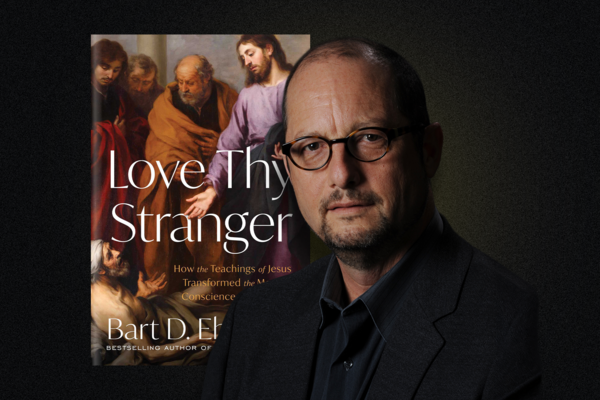
In his newest book, Love Thy Stranger, Ehrman argues that “the impulse to help strangers in need is embedded in our Western moral conscience because of the teachings of Jesus.” For those who’ve typecast Ehrman as an opponent of Christianity, this logic may be surprising. But I think that readers who approach this book with an open mind will see that Ehrman makes a compelling case—using historical research, personal anecdotes, and wit—that Jesus’ teachings about how to treat the stranger among us made positive impacts on Western society.
This is not to say that Ehrman writes uncritically about Christianity, or that his newest book is an apology for the Christian faith. On the contrary, in Love Thy Stranger, he criticizes Christians for historical transgressions, such as slavery, and current xenophobic attitudes that have gained popularity at the highest levels of our government.
In my conversation with Ehrman, we spoke about the real reasons for Jesus’ crucifixion, the unlikelihood that he was raised from the dead, Christians who believe empathy is “toxic,” and why we both feel comfortable identifying as “Christian atheists.”
This interview has been edited for length and clarity.
Josiah R. Daniels, Sojourners: Your newest book is Love Thy Stranger, which just recently came out on March 24. You write the following in the book: “In these times of power and dominance, it may be useful for all of us, whatever our religious commitments (or noncommitments), to consider the ethical principles that lay at the root of our civilization, and to consider what it would mean to love a neighbor, even if the neighbor is a stranger.” Why do you think it is so important to consider what it might mean to love those who are strangers to us?
Bart Ehrman: The thesis of the book is that we, most of us living in the West today—whatever our religious commitments are, or no commitments are—most of us feel an inclination to help people when we hear about disasters somewhere. For example, you hear about a hurricane, or you hear about an earthquake, or you hear about the devastation of war, you hear about starvation, and at least you send a check. Or maybe locally, you decide you ought to volunteer at the soup kitchen or something. You have this inclination, and the inclination is to help people you don’t know. And the thing is, it’s usually people you will never know, and you may not like well if you did know. So, my question in the book is, why do we have that inclination?
I argue we actually get it from the teachings of Jesus. When Christianity took over the Roman world, the ethics of helping those in need, whoever they were, was really important. It became common sense. So much so that today, it just happens to us. We don’t even think about it. We feel like doing it. It’s not that everybody does, but people feel like it.
READ MORE: 22 Bible Verses on Welcoming Immigrants
We’re living at a time when a lot of people in our environment, in the American Christian world, still profess allegiance to Jesus but clearly act in ways that are contrary to this teaching. They don’t care about the stranger.“It’s in our DNA to care for our family and our friends and people in our community. But outsiders, no.” But Jesus insisted, yes, and it is clear as day.
That ain’t happening a lot, or at least not as much as it should.
What do you make of the Christians, people like Albert Mohler, who have started to say that empathy is sinful?
Toxic, really, toxic empathy? It has just gotten to a very crazy level. That people who call themselves Christians endorse precisely the opposite of the Christian message.
All you have to do is read Matthew 25, the sheep and the goats. The people who get into the Kingdom of God are not believers in Jesus. They’re not Jews. They’re not Christians. These are people who’ve never seen Jesus. They’re people who have fed the hungry, given something to drink to the thirsty. They’ve clothed those without clothing. They’ve visited the lonely, they’ve done things for people in need, and Jesus welcomes them into the kingdom.
And so how can you say that empathy is not the Christian message? It’s the entire Christian message. At least it’s the message of Jesus. If it’s not the message of those Christians, then stop calling yourselves followers of Jesus, in my opinion.
You write the following in Love Thy Stranger: “Many Christians will defend the faith by saying that none of this represents ‘true Christianity.’ They are right that none of it is true to the teachings of Jesus, but they are wrong to say it is not Christianity. It is Christianity. These are things done in the name of Christ by his followers against those who have not believed in him or have not held the right beliefs about him or were different in some other way.” I completely agree with this. For those of us who still identify as Christians, how can we shift the conversation away from defining what is and is not “true Christianity,” and devote our attention to the moral potential of Jesus’ teachings?
The things that I’m talking about that people say, “Yeah, it’s not really Christianity,” involve the dark side of Christianity throughout history. And I think that it’s a mistake for Christians to turn their back on these realities.
The disapproval, leading to the dislike, leading to the hatred of Jews, goes back actually into the New Testament period, and it leads to pogroms throughout the Middle Ages, entire villages being slaughtered in the name of Christ, and down to our current situation with antisemitism. During the Crusades, there were massive slaughters of people because they were Muslims, leading to the Islamophobia of today. The Inquisitions, where people who believe the wrong thing are tortured to death, in the name of Christ.
Justifications of war. Justifications of slavery. Oppression of women. It’s a very long list. Oftentimes, these things are justified in the name of Christ. And that just ain’t right. I am no longer a Christian, but I can say that if somebody believes in those things, I don’t think they’re following the teachings of Jesus. In fact, I know they’re not.
READ MORE: Kings Start Wars. Christians Stop Them
So your question is, what do people like you, who do not support such things, who actually have social agendas to help people instead of harming them, do? I think what you do is you practice that. Most people are not gonna follow Jesus literally and sell everything and give it to the poor. OK. Fair enough. But you could be concerned about the poor, and you could devote yourself to helping them somehow.
I think sometimes your critics want to miscast you as the angry agnostic, who does not find anything within the Christian tradition to be useful. That’s not how I read you. And in Love Thy Stranger, one of the things you emphasize is that there are some really positive things that Christianity has contributed to the West.
Indeed. It is a little frustrating for me to hear people say that about me. Certainly not what I feel. I have no arguments against Christianity, in theory, as a religion. And a lot of people who practice Christianity are just—my hat’s off to them, and I just completely admire them. I’m not out to kill Christianity or something. I would say that a lot of my work is opposed to fundamentalism.
I think, in many ways, you and I would agree about Jesus and the unlikelihood of there being a God, but I still call myself a Christian. You no longer do. Why?
I do try to follow the teachings of Jesus. Obviously, not literally to the full extent that I should. I’m not a great follower of Jesus. The term Christian is just a term and it means different things to different people, obviously. I think there are people who can absolutely claim to be bona fide Christians. So people have different understandings of Christian and everybody’s gotta define what they mean by it. I sometimes call myself a Christian atheist.
Yes. I relate to that strongly.
The reason I don’t classify myself as a Christian is that, in my opinion, I can’t really consider myself a Christian if I don’t believe there’s a God. I’m not arguing that means you have to be non-Christian. I’m just saying that, for me, with my background, to call myself a Christian and not even believe in God is something I can’t do. But I can call myself a Christian atheist, I think.
When I refer to myself as a Christian atheist, basically what I mean is that the thing that is most compelling to me about Christianity is, in fact, Jesus.
That’s right. I think you can be a follower. It seems there are a lot of people who disagree, of course, but I think you certainly can be a follower of Jesus and not be a theist. Obviously, Christianity is rooted in a belief in God at some level. But if Christian means a follower of Jesus, why couldn’t it mean that?
You write about this in How Jesus Became God, but walk me through why there should be serious doubts about the legitimacy of Jesus bodily raising from the dead.
Two big issues: One, in the evangelical circles I came up out of, it was said that you could demonstrate historically that it’s probable that Jesus rose from the dead.
And so that for me, that is a question of history. What can historians demonstrate and what can they not demonstrate? And I am firmly of the opinion that even if a miracle like that did happen, there is no way you can show it happened. Historians can only establish the likely events of the past. And there are some things that are more probable than others. It really is probable that my UNC Tar Heels got beaten in the first round of the men’s March Madness Tournament.
I was going to bring this up if you didn’t.
It’s demonstrable. It happened. And so, in theory, it may not have happened, right? In theory, there could be a kind of conspiracy that they actually did win. In theory. But it’s so highly unlikely.
So if you’ve got an event in the past that has, say, a number of explanations, like Jesus rising from the dead, can historians show that happened? How do you establish probabilities? You can’t do it on the basis of statistics. How likely is it that a human being has been raised from the dead? It violates the laws of nature. It never happened before. Even for Christians, it hasn’t happened since.
Secondly, what arguments would you have against Jesus being raised from the dead? You could argue things about how confused the sources are, how contradictory the sources are between themselves. We have no contemporary accounts. The first account we have with this was written 25 or 30 years later by Paul, who is not one of his [original] followers. And the entire testimony is that Paul said he saw it. That’s it. Then you get the gospel stories that have the basic story. Very similar, but there are contradictions that are among these sources, which were written 50, 60, 70 years later.
If somebody dies, and not like a near-death experience or seems to die or goes into a coma, but actually dies and then comes back, that is a violation of the laws of physics. The reason these are called laws is that they’ve never been demonstrated as ever having been broken. What is the likelihood that happened? Not just if you’re a historian trying to figure out what happened, but just personally, do you think that’s really what probably happened? It’s not what I think probably happened.
People will often say to me, “Oh, if you don’t believe in the resurrection, why are you a Christian?” And I think that this gets to something that you and I have been talking about, but I just want to focus on it here: Even if Jesus didn’t rise from the dead, my main concern is his material commitment to this earth. In my opinion, there’s no less of an urgency to what he taught today than there was when he was alive.
I agree. Of course, every generation thinks it’s the worst, and it couldn’t get worse than this. And yeah, it probably can get worse. It definitely can get worse than this, but this is a really good time for people to start taking seriously Jesus’ commandments about how to behave in this world when there are so many human-made disasters and so many natural disasters that we’re not tending to.
Why was Jesus crucified?
It’s clear as day why he’s crucified, and the gospels all agree on this. They all agree that the Romans crucified him for calling himself the king of the Jews. Period. And I think it’s plausible that Jesus did think he was going to be appointed the king of the Jews, that is, the Messiah.
I think it’s plausible that Jesus thought that when the day of Judgment came, God would make him the ruler of this coming kingdom. Jesus meant this in an apocalyptic sense: The end’s coming soon, God’s gonna intervene, destroy the forces of evil, and set up a good kingdom. And it is in that context that he says, I’ll be the king, the Messiah. When the Roman governor hears that somebody is claiming to be the king of the Jews, he doesn’t care about Jewish theology or apocalyptic reasoning. If somebody claims to be a king when Rome is the ruler of the land, it means they’ve gotta overthrow the Romans.
The Romans have an easy solution to that kind of thing. And they put it into practice regularly: They’d just crucify him. This is just what you did. And you do it publicly. You don’t cut their head off or something. You actually make it painful, and you do it in public, and you nail them to a cross and let them stay on the cross for a few days, screaming, and then see how many insurrectionists there are who wanna make this kind of claim. And that was absolutely the Roman policy. And so when Pilate heard that Jesus was calling himself the king of the Jews, or even if he—I’m not sure there’s even a trial, frankly. But if there’s a troublemaker who’s just kinda a lower-class peasant, just crucify him.
When I understood the more political circumstances surrounding Jesus’ death, that made me think to myself, “Who today would be labeled an insurrectionist, who today would be labeled someone who should be marked for crucifixion or imprisonment in some way?” There’s a lot of talk about “domestic terrorism.” A lot of talk about “foreigners” and people who are “poisoning the blood of our nation.”
In some ways, these gospels could not be more relevant than they are today. If you simply ask what kind of people does Jesus associate with? Yes, he associates with outcasts, with people who are not liked by society, who are marginalized by society. If you ask, what would Jesus think about immigration policy? If Jesus agreed with the Old Testament, the Hebrew Bible says to love your neighbor as yourself, which means to love your fellow Israelite and anybody who immigrates into Israel. You have to treat anybody who immigrates into the land the same way you treat a citizen. That’s explicitly laid out. And so it’s not that the Bible answers our modern political situations, ’cause they are very complicated. The war that we’re in now, the immigration issue, abortion issues, there are no simple answers to these things. But if you’re gonna start using the Bible for these things, you should at least see what the Bible says about them.
Love Thy Stranger tries to show what the moral universe was like in the days of Jesus, in Greek and Roman circles, and Jewish circles.
I try to show that he certainly had a different view. And his followers, after his death, most of them did not literally follow his extreme demands, but they kept this basic rule: The people who are in need are the ones you need to help. Not just your family, not just your friends. You need to help anyone in need. It doesn’t matter what their race is, their ethnicity, their nation, their religion. If they are in need, God’s will is that you help them. And that idea exploded into Christian discourse. I’m not a Christian. I’m not writing an apology for Christianity. But Christians invented public hospitals; they invented orphanages; they invented old people’s homes; they invented private charities dealing with hunger and homelessness; they invented governmental assistance to the poor. These are Christian inventions. That’s not just rhetoric. You can prove it historically. My book is trying to show that.
“How can you say that empathy is not the Christian message? It’s the entire Christian message. At least it’s the message of Jesus. If it’s not the message of those Christians, then stop calling yourselves followers of Jesus.” —Bart D. Ehrman

Did this article have an impact on you? Tell us how! Whether you’re moved to take action, have a question, or want to share a comment (good or bad), we value your feedback!