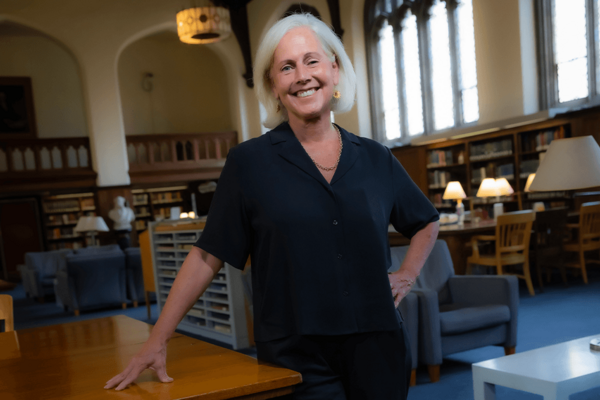
Rev. Serene Jones is looking forward to waking up naturally, without an alarm clock. After 18 years as president of Union Theological Seminary, Jones announced last summer that she would be stepping down after the current school year.
Jones is the first woman to serve as Union’s president and will take a sabbatical before returning to teaching full time. She hopes to do some writing, some late-night movie watching, and plenty of resting. Looking back on her tenure at Union, she said she’s most proud of how the school has committed to modern expressions of historic values and cemented its financial future.
Long a bastion of progressive faith, Union’s students and faculty have a legacy of heavy involvement in social justice organizing. During her tenure, Jones helped foster that legacy through the elections of Presidents Barack Obama and Donald Trump, protests over police brutality, the Black Lives Matter uprising, and COVID-19. She was president when the school’s board of trustees voted to divest from fossil fuels and when the school declared itself a “sanctuary seminary” in line with the Sanctuary Movement. In recent months, Jones and other campus presidents have had to navigate a Trump administration increasingly aiming to target students and institutions of higher education.
While she has helped stabilize the school’s finances and expand its reach into training non-Christian students, her time has not been without criticism. One part of the financial stabilization was selling the school’s air rights, so that developers could build luxury condominiums—a move protested at the time by students and faculty. Union has a partnership with Columbia University, and as the latter became the center of media attention for campus protests against Israel’s war in Gaza, Union at times drew the attention of right-wing activists, provocateurs, and news outlets.
In a December 2025 interview with Sojourners, Jones spoke about the success she’s seen in the last 18 years, how the school is processing the current Religious Right and second Trump administration, and Union’s commitment to doing the right thing regardless of the cost.
This interview was edited for length and clarity.
Mitchell Atencio, Sojourners: When you look back at the last 18 years, what do you feel most proud of having accomplished?
Well, the biggest answer is that Union is a healthy and thriving community of learning and teaching. When I first arrived, of course it has an illustrious history, but financially it was struggling. Its enrollments were struggling along with its finances, and that’s no longer the case. I’m very proud of the fact that we’re close to having no deferred maintenance. We were in a position where we were very close to having to leave the premises because the exterior was so unstable and the interior pipes were breaking and the steeple had fallen off the roof and the roof was leaking. It was becoming uninhabitable. Now we’re in the process of nearing the completion of the renovation of the campus. Our enrollments are growing.
At a programmatic level we’ve started four new programs, including one in a carceral institution. In terms of the curriculum, we’ve gone from being a primarily Christian, Protestant based seminary to one that now has tracks in Buddhism, Islam, and a number of courses in Indigenous, earth-based religions.
The orientation of the school, its partners, its degree programs, its physical plant have all been transformed. I feel like I fixed the house and then built a really big table and invited a lot of new people in.
How does Union’s expansion into other religions comport with its history and emphasis as having been a Christian seminary?
Union was founded in 1836—I now say it’s close enough that it’s almost 200 years old—with the explicit mission of training clergy who are responsive to the concerns and needs of the world. Since its inception, it’s been very involved in the life of New York City.
Initially that was primarily manifest in the training of Protestant clergy. Over the years that has expanded to include not just Protestant, but Roman Catholic. It also has expanded to include a number of students who are not religiously affiliated.
READ MORE: 5 Imperatives for Seminaries Under Authoritarianism
This next step is just a further expansion of being responsive to the concerns and needs of the world by recognizing that we live in an interreligious world, and any spiritual leaders we train to engage the world need to have a comprehensive, engaged understanding of different religious traditions.
I know you all divested from fossil fuels over your tenure. When did that begin, how long was the process, and why divest?
We were the first school in the U.S., as far as I know, to do it. The movement to do it was led by the chair of our investment committee—we manage our own endowment—his name was Mike Johnston; he’s since passed away.
He, along with the entire investment committee, felt very strongly that it was immoral to be extracting oil from the Earth when already we have enough oil to live off as long as we could conceive of living, and we needed to make the change to non-fossil fuel types of energy. From the time he first suggested it to the time the board first voted on it was about 6 months. It was unanimous vote of the board, and it was not controversial at all.
There was a time period where fossil fuels were not doing well on the market, and it did not hurt our portfolio at all to have divested. But in recent years it has. There are financial consequences to making socially responsible decisions, and we have felt those.
Is there any controversy now, as it does hurt the portfolio?
No. Because we did the right thing. We haven’t changed our minds about the ethics of it.
You said there’s a cost, financially, to upholding those values. Is there a benefit to modeling the courage you hope students will have in the world?
I do think it reflects a prophetic mission in the world, but we did it because we believed it was the right thing. We would have done it even if nobody had known we did it. It was the right thing to do. We didn’t do it just to be cool. We actually thought it was the right thing to do.
Why was selling Union’s air rights the right thing to do? There was a lot of criticism in 2016 when the plan was announced. You sold the air rights to luxury condo developers. There were students and faculty who opposed it, and right now the cheapest condo is $1.3 million.
Like all of the decisions, it was not an easy decision to make. But in the case of selling the air rights, we really had no other option. We had over a hundred million dollars of deferred maintenance and a city breathing down our neck that was about to shut us down. It was really a question of: Do we sell the air rights or do we close the school?
For us, thinking forward and for future generations—like with fossil fuels—for this school to be here 50 years from now, for students to be able to study and learn, was critically important.
One of the things that happened in the process of all this that is rarely spoken about is when we originally signed the contract to sell the air rights it was for affordable housing. Then-Gov. Andrew Cuomo was in a fight with Mayor Bill DeBlasio, and the state cut all funding for affordable housing. We were left with either no building project and hence no school or with the developer building at cost.
We almost pulled out, and then we were able to convince the developer that we were working with—because we were so committed to affordable housing—to create a community fund of $5 million that was available to address affordable housing issues in the neighborhood. Proportionally, that fund is the largest fund that New York City has ever created out of a development project from the developer to support affordable housing or community housing.
NYCity News Service reported that of that money, $1 million went to tenant protection, legal services, the community trust you talked about; and the other $4 million went to student internships, lunch series, public lectures, and administrative costs. What’s the status of that money?
$1.8 of it went to the community and $3.2 of it has yet to be transferred to Union. It doesn’t happen until the building breaks even, and it hasn’t done that yet, so we have yet to receive the bulk of the money. It’s contractually obligated, but we don’t have the money yet.
You said you almost pulled out of the deal when the affordable housing portion fell through. What were the alternatives that you were considering?
Well, we almost pulled out of the deal and then we realized that there was not a single developer in New York City that we could work with that wasn’t under the same constraints as the developer we were working with. We did a lot of investigating to see what options we had. We didn’t pull out because there was no alternative.
Let’s talk about the sort of pressures Union is under during the second Trump administration. Broadly, what are the tools or values a seminary education needs to provide students dealing with today’s political climate?
It needs the values that, in an always shifting form, Union has always given its students: capacity to respond to the needs of the world and to do so with integrity, courage, and wisdom. That is literally in our mission statement.
Translated, that means students who come to Union learn what it means to speak and act in ways that are never perfect because none of us are perfect—and with humility and a sense of one’s own limitations and community limitations—but nonetheless has the courage to act with integrity when it comes to the common good, when it comes to those who are underrepresented, those who do not get a seat at the table.
What does it mean to provide those seats at the table? What does it mean to have a community that engages in diverse conversations and takes the voices of many seriously? Increasingly, it means that students need to learn the arts of restorative justice and conflict resolution. Students need to know, dramatically, what does it mean to care for their own needs of spirit and soul, so they don’t get burned out. The burnout rates are so incredibly high among clergy, be you Buddhist, Christian, or unaffiliated. If you’re in any kind of ministry, you’re going to fry your heart and your brain along the way.
How are students processing this past year of the Trump administration?
One, they’re involved in a lot of organizing around the city. They’re working with other college and graduate students in the area as well as organizing efforts across New York City.
Secondly, particularly if you’re an international student, or if you’re in any way a vulnerable student—and mind you we have a lot of former felons—they are scared s---less.
A third thing, our students are hungry. We have a food pantry; there’s a lot of good food pantries in the area. All the controversy around SNAP was very hard on our students. I don’t think people realize the degree of food insecurity that most students in this country live with.
What has Union been doing since President Trump took office particularly to live out its values?
We try to be present; we’re working very hard with international students to make sure they are as protected as we can protect them; We’re working hard to get food for our students so they’re not hungry; we do not penalize students for activist engagement—we do make them do their work.
We’ve done basic workshops on Know Your Rights if you’re stopped by ICE. We work with Make the Road, the Sanctuary Movement.
As you know, Morningside Heights was the center of so much conflict and controversy around Israel and Gaza. Many of the schools in the neighborhood, to varying degrees, took measures to shut their campuses down and bring in police presence. Union has a policy of no police on campus unless it’s a serious crime, and we continue to hold true to that. Instead of closing our doors, we opened our doors and invited in many of the students and professors who had been excluded from their campuses. We have an open-door policy and no, or limited, police presence.
Secondly, we’re now in the second year of a 40-year-old program that we just received from New York Theological Seminary, where we offer the only masters that’s offered into prisons in the United States, in Sing Sing and Bedford Hills. We also inherited the alumni association of those who had been in that program over the last 40 years, so there are literally thousands of graduates. We are both teaching inside—faculty and students are inside [the correctional facilities]—but we also have a large community of graduates who are now on the outside who are doing the work of mentoring, engaging in critique of, and fierce prophetic engagement with the whole carceral system. We refer to Sing Sing and Bedford Hills as our North Campus.
On that first point, for people who are not familiar, Union is financially independent from Columbia University, but you all have shared spaces and some shared resources.
We share no resources. Our library building Union owns, and Columbia manages and owns the collection. They completely own the collection and we own the building. And we lease two other buildings to them. Our endowments are completely separate. Our governance is separate. Apart from lease agreements we get no money from Columbia.
[Union’s website, in part, describes its partnership like this: “Union and Columbia share an MDiv/MSSW dual degree program with the Columbia University School of Social Work and cross-registration with Columbia’s Graduate School of Arts and Sciences and School of International and Public Affairs. The Burke Library at Union is part of the Columbia Libraries system. Union students can access physical and virtual resources, such as library services from Columbia Libraries, health services from Columbia Health, Dodge Fitness Center, and a wide array of student and University programming and other benefits.”]
For those spaces, the library and the two buildings you lease, how does that relate to the policy you were talking about regarding not allowing law enforcement on campus and having it be an open-door campus safe for others?
They have control over those spaces. They have long-term leases. We’ve never had the police come into the library, and you have to go through our building to get to the library, and we wouldn’t let the police in, so no. The other ones are separate entrances, so we have no control of what they do there.
Do you have any concerns about that, given the settlements Columbia has reached with the Trump administration?
I don’t understand.
Because you all work closely together, and Columbia has reached settlements with the Trump administration that will impose rules on student protest, campus protest, student discipline, and so on, I wondered if that might affect Union’s spaces or students.
Well, it hasn’t so far. It hasn’t changed our policies. We continue to write a steady stream of op-eds engaging the Trump administration and the Religious Right. We’re very public about our progressive position and disagreement with major decisions on the Religious Right and from the Trump administration. So far we’ve had no explicit pushback.
I know Immigration and Customs Enforcement has been in New York. How has that affected upholding your status as a “sanctuary seminary”?
We are in ongoing conversation about all dimensions of the Trump administration. We are a sanctuary seminary. And we don’t talk publicly about what that means.
You don’t talk publicly about what it means to be a sanctuary seminary?
It would cease to be a safe space, in terms of what our discussions are and how we would respond.
I just had questions about it because it’s been something I’ve reported on. I was told there were situations where law enforcement might be invited on campus, and I’d hoped to better understand that policy.
You probably know, if you’ve been investigating sanctuary, that if they come with a subpoena, there’s not much you can do.
Sure, a judicial warrant. But you referenced emergency situations and that’s what I was curious about. I can understand in 2022 saying ,“We don’t allow law enforcement on campus except for emergency situations,” but I wondered if that might change given how the Trump administration could use the pretext of an emergency to try and gain access to a campus.
Nothing has changed. Just to be clear, I feel a responsibility, at any moment in time, for those who seek sanctuary at Union to not talk about our sanctuary status. It’s a serious issue, and I’m not trying to be obstreperous, but you won’t let me talk off the record, so. I’m trying to protect people.
Where does that idea come from, that its best to not talk about it if you’re trying to protect people?
It comes from all the people we work with in the sanctuary movement. There are general principles, but then there’s the actual activity of providing sanctuary to people.
I was asking about the logistics of it because I know a lot of students are aware of the sanctuary seminary status—
We’re not trying to hide our status. It’s to whether and how and what that means at any given moment, we can’t talk about that.
—and the general impression is that you don’t allow law enforcement on campus. When I did more research, I learned there are instances where you would allow law enforcement, without a judicial warrant, on campus. And I’ve been curious, as a reporter, how you’re thinking through the specifics of that.
If there was a murder—serious crimes. We’re talking about serious crimes. We wouldn’t prevent law enforcement from entering campus. We haven’t had any murders. I’m just saying it would be disingenuous for us to say under no condition, because you can imagine conditions in which we would be obligated to allow law enforcement to come on campus.
“If you’re in any kind of ministry, you’re going to fry your heart and your brain along the way.” —Rev. Serene Jones

Did this article have an impact on you? Tell us how! Whether you’re moved to take action, have a question, or want to share a comment (good or bad), we value your feedback!