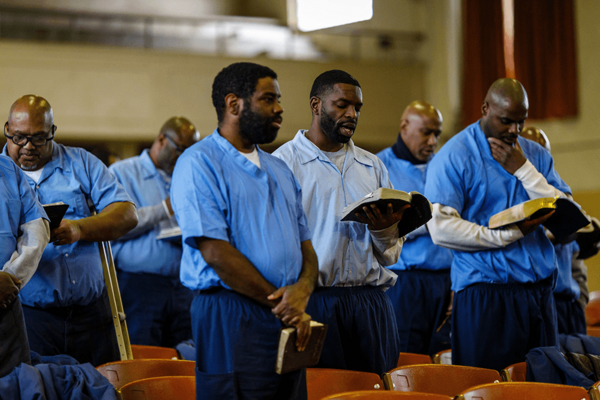
While each of the nearly 2 million incarcerated people in the U.S. has their own story, they all share one experience: losing access to their neighbors on the outside.
The majority will be released after their sentences are served, but an atrophied social life and the stigma of incarceration mean they face a long uphill battle to take care of themselves, much less fully rejoin society. Christians have long stepped into this gap, many seeking to live out Jesus’ parable in Matthew 25 and visit those in prison. In the era of mass incarceration, religious volunteers visit incarcerated people to bridge the gap between them and life outside.
In March, Families Against Mandatory Minimums, a nonprofit devoted to fighting unjust prison policies, launched its “Visit a Prison” campaign, urging lawmakers and faith groups to visit their local prisons, including a guide for people interested in getting involved with incarceration ministry.
Katrina Baugh, the senior policy director at FAMM, said the effort is aimed at caring for the incarcerated and promoting transparency within the facilities.
Any individual or house of worship can work with their local prison or jail to arrange visits, and regular visits can considerably improve an incarcerated person’s odds of successful re-entry. The approach still has limits, though, and doing it well may mean confronting how the walls of incarceration isolate people on both sides.
Matthew Charles, the state legislative affairs manager for FAMM, said receiving visits from volunteers of faith during incarceration lands much differently to someone inside than scheduling a talk with the staff chaplain.
“"[It helps] in showing brotherly love,” Charles said. “[Volunteers] take the time out of their schedule to actually get on the visitation list and go up there and sit and visit with them. That's called mentorship to me. That’s called building a relationship and doing the groundwork, discipling.”
Studies show that roughly 40% of people released from prison or jail return to incarceration within three years, also known as recidivism. Research published in The Prison Journal indicates that regular visits from community volunteers can reduce the risk of recidivism by 25% to 30%. Faith programs have also been consistently linked to lower rates of reoffense. Regular visitation from community volunteers of faith may have a unique potential to bring people into the social fold.
Visits can also take many forms, Baugh said. Some volunteers do a Bible study, some are simply open for conversation, while some share their skills. She coached incarcerated people in debate classes.
After his own release from prison, Scott Morgan began participating in jail ministry. Visitations, he said, help establish hope. After his release, Morgan volunteered with Koinonia House Ministries for a year, visiting the Cook County jail in Illinois once a week.
“I was eight hours away from home [while incarcerated], so it meant a lot when people showed up because I know it took a lot to get there,” Morgan said.
Morgan also started the Mersades Ann Foundation, an Illinois-based nonprofit supporting children affected by parental incarceration. The foundation addresses the well-documented detriments of incarceration on family stability, with families of incarcerated people being nearly 2.5 times as likely as other families to experience turbulence in their relationships.
“"We’re conditioned in the world to do everything on our own. Some of these guys from the street, they really just depend on their street smarts and their hustle,” he said. “They’ve just been conditioned to rely on self, and ourselves will always let us down.”
Brass tacks: What’s needed
The best outright advice for starting detention ministry visits, multiple sources told Sojourners, is to join a group or church that is already doing it. While the list of materials needed to start visiting a local jail or prison is relatively short (transportation, a willingness to provide personal information to facility staff, sometimes a Social Security number), the volunteers themselves have homework. Sometimes a ministry may require volunteers to take training sensitizing them to the repercussions of the prison system and personal trauma in people's lives.
Pastor Eric Dorsey of Community Christian Church leads the Community Freedom Ministry and frequently trains prison ministry volunteers. He said good preparation for the work includes an understanding of the economic and political role that incarceration plays in society.
“Understanding the systems of incarceration are super important,” Dorsey said. “Economics, politics, and racism—there’s a direct correlation between those things and how our incarceration systems work, both public and private institutions.”
Incarceration often includes forced labor, as the 13th Amendment, ratified in 1865, abolished slavery except as punishment for a crime. Federally, the Bureau of Prisons requires all medically able, incarcerated people to work. Dorsey wants visitors to know that incarceration is a “huge business.” The majority of incarcerated people in state and federal prisons are working with little or no pay, sometimes in dangerous conditions.
The limitations
Volunteers from a faith background have the capacity, at varying levels, to meet multiple key requirements surrounding a recently released person’s reintegration. They can link the person back to society by welcoming them into their own circle, anchor them with institutional resources, or possibly support a sense of personal meaning. There are times, though, when the work can run into roadblocks.
Jails and prisons can go into lockdown at any time or deny entry unexpectedly, even if volunteers have fully complied with paperwork and procedure. Financial contraints are also a challenge for faith institutions. In seeking to provide someone with what they need for a successful re-entry, money for things like consistent housing or medical care can run short.
Prison and jail ministries often struggle to attract volunteers, in part due to the stigma associated with people in prison, according to Morgan.
“‘What’s so and so going to think if I tell him I’m involved in a jail ministry? Dang, jail is not for people that don’t live in the ghetto,’” Morgan said. “The high school where my sons go to, their best friends, their dad’s doing six years. This impacts no matter where we’re at. So I just think that's the biggest hiccup around here is that people worry too much about what their neighbor's gonna think. But the thing is, if you do it, maybe your neighbor will get involved with you. That’s how we break these cycles.”
The stigma surrounding incarceration drives people’s behavior both inside prison and outside of it. To skip confronting that stigma risks actively dehumanizing and harming the people incarcerated, especially among people with limited direct experience with the carceral system, Dorsey said.
“So even those that say I want to go and help … It’s kind of like earning Christian brownie points for bringing Jesus to people that really need it desperately,” he said. “That’s the mentality that can be very dangerous, because you can speak from a very condescending way where you don’t understand the background, you don’t understand what these people have been through.”
“We can go into prisons, we can meet people, we can treat them as human beings, listen to what’s going, pray with them, learn from them, teach them what we have to offer, establish lifelong friendships with them, but that itself does not set them free.”
Even in the best of circumstances, prison and jail ministries still run headfirst into the reality that incarceration creates social vulnerabilities.
“It is just not possible for the human spirit to flourish while a person is living in a cage,” Baugh said. “We can go into prisons, we can meet people, we can treat them as human beings, listen to what’s going, pray with them, learn from them, teach them what we have to offer, establish lifelong friendships with them, but that itself does not set them free.”
Baugh encouraged visitors to build relationships by being curious to understand the ways that someone personally makes meaning in the world. Visitors also ought to remain consistent in the relationship after release.
“I think you have to approach it wanting genuine relationships and recognizing that in any relationship, it is a give and take. You may have things to offer people inside, and they will also definitely have things to offer you. Go in because you want to build community,” Baugh said. “They’re full human beings—who are often getting released. When that happens, be there.”

Tate Young is a reporter in Washington state. They were a news cohort journalist for the 2025 Sojourners Journalism Cohort.
Did this article have an impact on you? Tell us how! Whether you’re moved to take action, have a question, or want to share a comment (good or bad), we value your feedback!