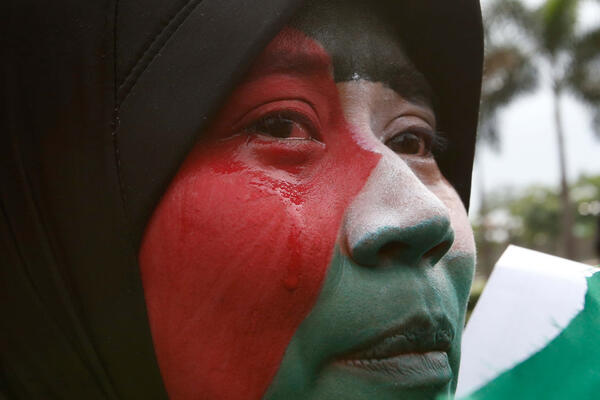
On April 19, the Armed Forces of the Philippines killed 19 individuals and forcibly displaced more than 653 residents in Negros Occidental, an island in the southern Philippines. The AFP defended their operation as necessary “to confront armed groups that threaten local communities,” while activist group Bagong Alyansang Makabayan (New Patriotic Alliance) contends that the attack constituted “indiscriminate firing and strafing.” For Bagong Alyansang Makabayan, it is another example of the Manila government’s fascist violence against the poor and unarmed civilians.
On April 20, a day later, the Israel Defense Forces launched airstrikes, killing five Palestinians in Gaza and leaving many others wounded. The Peace Research Institute Oslo reports that at least 75,200 people have been murdered by Israeli forces since October 2023. Indeed, while separated by thousands of miles, there is an intimacy that binds Palestine and the southern Philippines together—an intimacy forged through the destructive imperialism of the United States.
A strong anti-imperialist tradition runs through much of Christianity, positioning the gospel as antithetical to empire. Writing as a political prisoner of the Marcos dictatorship in his 1984 book, How Long?: Prison Reflections from the Philippines, Karl Gaspar, a Filipino theologian from the region of Mindanao, contends, “As Jesus went through torture in the process of expressing his willingness to redeem humanity so we too must be ready to go through such a dehumanizing experience as we join in the struggle for the liberation of our people.”
Gaspar was imprisoned for two years for his resistance to the regime. During those years, he described his political and moral convictions as stemming from the reality that Jesus always sides with those who, under empire, suffer “in the collage…of blood and tears.” This conviction also extended to the problem of U.S. empire. In October 1988, Gaspar noted the growing presence of U.S. military bases across the Philippines, arguing that, for justice to be actualized, it was critical that these bases be shut down.
The region of Mindanao, in the southern Philippines, is not peripheral to U.S. empire-building but plays a key role in its colonial aspirations. New scholarship has rightly highlighted the Philippines as a critical site of political, economic, and military interest in the American quest for dominance in the Pacific Rim. One place where this empire-building is happening rapidly is Mindanao, the place Gaspar calls home and where many Indigenous Mindanawons remain in the struggle for self-determination.
Mindanawon peoples have resisted outside rule since the 16th century, first against Spanish colonization and later against American military occupation. When Spain was defeated by the U.S. in 1898, colonial rule did not end; it merely changed hands. Under U.S. control, Mindanawon territories were subdued, reorganized, and incorporated into an imperial project to which they had never consented. It was to become “a new West.”
International relations scholar Hemalia Kusumadewi has called Mindanawons the “subaltern of the subaltern,” that is, the colonized of the colonized. While Filipinos have certainly experienced colonization under multiple empires, the centralization of political and economic power in Manila has positioned the Philippine state as a U.S.-backed colonial actor against Mindanao.
Mindanao and its long colonial history reveal the severity and global reach of U.S. empire. For Christians committed to the struggle against empire, we cannot afford to look away from what Mindanao exposes. The same imperialism that wounds Mindanawons also wounds Native Hawaiians, Pasifika peoples, and Palestinians, requiring resistance from multiple locations across the world. This is the difficulty of empire as a global structure today: Its violence is so widely dispersed that the people fighting it are scattered across the globe, and international solidarity among these people is historically what empire has sought to prevent.
It is within this global web of imperialism that pastors, theologians, and radicals from two geographically distant contexts—Mindanao and Palestine—have come to describe the struggle over land, life, and dignity in anti-imperial terms, finding shared inspiration in the life and ministry of Jesus of Nazareth.
U.S. domination in the Philippines
The mission to abolish empire motivates many Mindanawons who continue to stand against the militarism of the Manila government. This is not a recent or isolated development, but a centuries-long struggle over land and freedom produced by successive colonial regimes.
Mindanao continues to be a site of Indigenous struggle against the colonial forces that subdue its people. What appears today as an internal conflict is, in fact, the afterlife of U.S. colonial rule: an imperial war that the Philippines has inherited and continues to wage on behalf of the U.S.
Even today, the U.S. military operates in Mindanao, seeking to terraform it into a site for U.S. political-economic dominance in the Pacific, especially against growing Chinese power in the region. For instance, the Pentagon recently solicited contractors for a Defense Fuel Support Point in Davao, Mindanao, capable of storing 41 million gallons of naval and aviation fuel—strategically positioned away from Chinese-facing ports. Likewise, the U.S. committed $80 million in 2023 to infrastructure investments at five Philippine bases, including Lumbia Air Base in Mindanao, as part of the expanded Enhanced Defense Cooperation Agreement. In 2026, the Manila government is poised to receive $2.5 billion through a U.S. defense bill to “safeguard the territorial sovereignty of the Philippines,” according to the bill. Defense journalist Aaron-Matthew Lariosa writes that the bill marks “Washington’s most intensive defense investment into the Philippines since the Cold War.”
There is no doubt that Mindanawon lands are being incorporated into U.S. imperial infrastructure in real time, largely without the consent of the people who live there.
The web of colonial violence
The Mindanawon struggle is not merely a “conflict.” Rather, it is a deep anti-imperial struggle over home and land shaped by long histories of domination.
What comes into focus is how questions of justice are entangled with the global reach of empire—an imperial order that operates through dispersed yet interconnected sites of power. This imperial architecture links places that might otherwise appear unrelated, such as Mindanao and Palestine, binding them within the same web of colonial violence. The connection runs deeper than analogy: Historians have documented that before Palestine became a site of resettlement for European Jewish refugees after the Holocaust, Mindanao was initially proposed as the site of resettlement—a colonial “solution” that would have displaced one Indigenous people to resolve the dispossession of another. This is precisely what is now taking place in Palestine.
READ MORE: Praying the Imprecatory Psalms in the Age of Empire
Another point of connection is between the militaries of the two countries. In 2019, both the Israeli and Philippine militaries held their first joint “counterterrorism training engagement.” Through such programs, the IDF providesresources and training to “hone and improve the antiterror skills of [AFP] troops,” particularly against “rebel groups on the island of Mindanao.” Former AFP chief Macairog Alberto acknowledges what he perceived to be the benefit of such an alliance between the IDF and the AFP, stating, “Terrorism is a complex threat that requires international cooperation and the continuous exchange of knowledge and information.”
Such cooperation unfolded amid the ongoing seizure of Mindanawon and Palestinian lands by the Philippine and Israeli governments, respectively, both backed by U.S. empire. Ultimately, this land seizure is an example of settler colonialism, wherein Indigenous peoples are eliminated from their lands to be replaced by the more powerful settler society.
From Mindanao to Palestine
Similar patterns of settler colonialism appear in the context of Mindanao. Muslim Mindanawon civic leader Guiamel Alim has described how long-standing prejudices against Muslims in Mindanao persist in public discourse (93% of Muslims in the Philippines reside in Mindanao). There are institutionalized stereotypes that portray Muslim Mindanawons as untrustworthy and undeserving of freedom. As Alim observes, these fears negatively impact the Muslim Mindanawons, casting them as enemies instead of people with a right to land and dignity.
Against this backdrop, Filipino theologian Jerson B. Narciso frames the Mindanawon struggle as a context shaped by a long colonial history—one in which he identifies “a direct link between the theoretical concept of God as Liberator and Defender of the poor and the political, economic, and social injustice in Mindanao.”
God can be encountered within the Mindanawon and Palestinian contexts as people struggle against this global military network of imperial violence. The purpose of theology is to give colonized people—from Mindanao to Palestine to communities across the world—the faith and tools they need to practice decolonization.
The purpose of theology is to give colonized people—from Mindanao to Palestine to communities across the world—the faith and tools they need to practice decolonization.
As Palestinian theologian Mitri Raheb argues in his book Decolonizing Palestine, “theologians must be very careful not to supply the colonizer with the ideological tools to support their oppression.” Decolonization is the proper response to colonialism, translating our theologies of liberation into radical political action. Decolonization is the foundation for the abolition of the imperial structures that undergird the global violence facing Palestinians, Mindanawons, and all those subjected to imperial violence.
Liberation is not yet here, and so the struggle continues. Many have suffered, yet they continue to bear witness to an alternative world where empire is no more. The question before us is not simply whether we have eyes to see or ears to hear, but whether we have bodies ready to embrace the cost of discipleship in this time of decolonization.

Yanan (he/him) is a writer from the Philippines who serves as editorial director at the Center for Barth Studies, where he guides initiatives that examine Christian faith and practice through the lens of progressive politics.
Did this article have an impact on you? Tell us how! Whether you’re moved to take action, have a question, or want to share a comment (good or bad), we value your feedback!