In 1 Kings 19, God appears to the prophet Elijah. At this point in the biblical story, Elijah is the last remaining prophet who follows God, and many in the nation of Israel have stopped listening. There are several people who would like to kill Elijah, and he’s desperate. If anyone could hope in a divine power to defeat his enemies, it’s Elijah. “Now there was a great wind, so strong that it was splitting mountains and breaking rocks in pieces,” the Bible says.
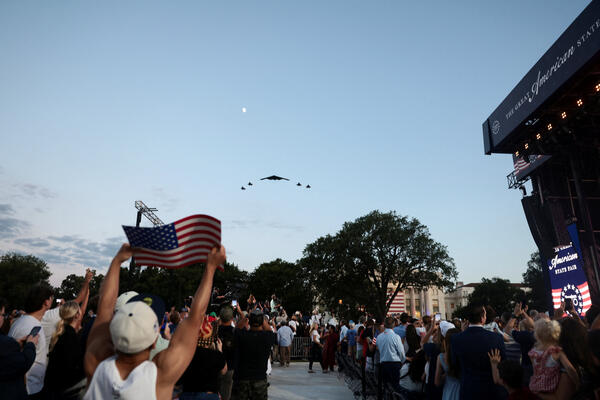
Reading that description, I’m reminded of how it felt to watch the Fourth of July airshow in Battle Creek, Mich., two years ago. My brothers and I were in folding chairs under the summer sun, eyes squinting skyward to follow the aerial acrobats, parachutists, and sky painters above us. Undoubtedly, though, the biggest moment of the day was going to be a demonstration flight of the Lockheed Martin F-35 Lightning II, currently the world’s most advanced fighter aircraft.
When the dagger-like shape first appeared on the horizon, everyone turned to follow its approach. Nobody needed to. Seconds later, the plane and its pilot were overhead, and then past us, leaving an extended sonic boom trailing. The way that jet ripped the sky open felt like a biblical maelstrom. Imagine the way your sternum feels in a parade when the bass drum passes by, and you’ll have a sense for what a close flyover is like. Later in the show, a crew piloting an A-10 “Warthog” joined the F-35 for a simulated bomb drop, where ground crews detonated pre-positioned explosives in sync with another flyover.
Watching the theatrics, I was torn. On the one hand, I was impressed by the technical knowledge and skilled labor that went into creating machines that can move thousands of pounds of metal through the air faster than sound. I was also grateful that Americans in uniform have such capable platforms that will ostensibly help bring them home alive.
But at the same time, the rush of excitement at seeing something so fast, loud, and dangerous was mingled with real fear. Even though it was already hot, the temperature rose by a noticeable amount during the explosives demonstration. I couldn’t watch the air shimmer from across the field without thinking about how many people around the world have lost their lives in similar fireballs. The only reason I could feel admiration for those planes at all was because I knew I was very unlikely to ever be in the sights of one of their laser-guided bombs.
READ MORE: Celebrating America Without Losing Our Soul
Since moving to Washington, D.C., almost a year ago, flyovers have become part of the backdrop of everyday life. The jets are usually slowing or banking after a run over the White House by the time they go over my neighborhood, but the unmistakable sound cuts through my Zoom meetings and momentarily brings me right back to that field in Battle Creek. What might have once impressed me, however, is now an uncomfortable reminder of who’s ordering the show. In the past few months alone, jets like the ones that soar over my house killed innocent fishermen in the Caribbean and dropped bombs on schoolchildren in Iran. No matter how hard some might look for justifications, there’s no honor in acts like these.
In college, I took an art history course where we spent time studying the sublime, a movement where 19th-century Romantic artists would capture awe-inspiring moments from nature on canvas, reminding their audiences of human limits and the world beyond them. Popular subjects of paintings from this period include volcanoes mid-eruption, wild lightning storms over water, or the views from mountain peaks.
Painters like Jacques Tavernier visited the wild landscapes of Hawaii, trying to convey how fear and beauty can be interconnected. Caspar David Friedrich’s famous “Wanderer Above the Sea of Fog” captures the smallness of humanity facing nature. These artists were building on the philosophical idea of the sublime, which emphasizes the ability that vast, powerful things in the natural world have to leave us overwhelmed and awestruck. Such a feeling captures how I felt on that Fourth of July. When I see the chaotic spectacle of UFC cage fights in front of the White House or hear Secretary of Defense Pete Hegseth pray for “overwhelming violence” against America’s perceived enemies, I wonder if our nation’s leaders are trying to infuse their cause with a similar grandiosity.
Confusing bravado for real greatness certainly isn’t new. As theologian Ched Myers notes, many of Jesus’ contemporaries expected what we now call the Triumphal Entry into Jerusalem to be the opening moments of a longed-for military overthrow of Rome.
The crowd’s acclaim for Jesus echoes the words of Psalm 118, which biblical commentator Mitchell Dahood called “a king’s hymn of thanksgiving for delivery from death and for a military victory.” The people wave palm branches in celebration, mirroring crowds from 200 years prior, at the time of the Maccabean Revolt. Just as in Jesus' day, the Jews of that time were being ruled by a foreign empire. After years of fighting, a victorious Simon Maccabeus marched into the center of Jerusalem at the head of an army. They arrived in the city “with praise and palm branches, and with harps and cymbals and stringed instruments, and with hymns and songs” (1 Maccabees 13).
It’s easy to see how the people in Jesus’ time would hope for something similar from the Galilean teacher who just might finally be the Messiah. If anyone can push out the Romans for good, it’s Jesus. But instead of a warhorse, Jesus chooses the colt of a donkey as his mount. Rather than to take an earthly throne, Jesus rides into Jerusalem to face execution.
All throughout the Bible, the same subversion repeats itself. Back on the mountaintop in 1 Kings, I’m sure Elijah was overawed at the raw power he witnessed in the storm. The biblical author, however, is quick to flip expectations of God’s nature, saying, “The Lord was not in the wind.” (v. 11)
Driving home the point, Elijah then witnesses an earthquake and a raging fire. But God wasn’t found there either. After a moment of silence, God appears as a calm voice, steadying Elijah for the work ahead.
I think of this unexpectedly subtle divine revelation when I hear the roar of jet engines overhead. Human technology, in the military and every other sector, is flashier and more enticing than ever. The temptation to worship speed and power has grown too. When faced with new “gods of wood and stone” (Deuteronomy 4:28,) my prayer is that we don’t bow before those who say human strength rules. A faithful response to such idolatry means choosing to worship the God revealed as a suffering servant and a still, small voice.
instead of a warhorse, Jesus chooses the colt of a donkey as his mount. Rather than to take an earthly throne, Jesus rides into Jerusalem to face execution.

Did this article have an impact on you? Tell us how! Whether you’re moved to take action, have a question, or want to share a comment (good or bad), we value your feedback!