I’m a Christian. Here’s Why I Still Call Myself ‘Queer’

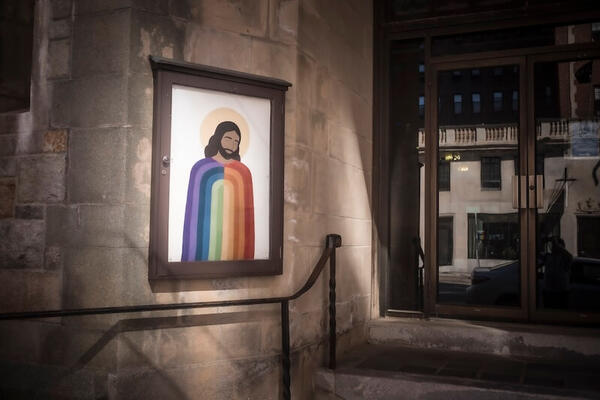
At the entrance to a Portland church, a representation of Christ dressed in LGBTQ+ colors, during the Pride parade in Portland, Maine, on June 15, 2024.

Last Tuesday, on the final day of Pride Month, Matthew Vines of The Reformation Project published an opinion piece for The New York Times called “I’m Gay, Not Queer. It Matters.” In it, he argues that in a national landscape growing increasingly hostile toward LGBTQ+ people, our movement would be better served by pivoting away from the word “queer”—both because of its umbrella quality, which “lacks clear limiting principles,” and because of its “adversarial charge” that implies we are, by nature, subversive and anti-normative. “Because the word ‘queer’ can describe any departure from social norms,” Vines argues, “it becomes an open door through which almost anyone can walk.” Because of what Vines reads as an overly expansive nature within the queer category, the public’s trust and understanding of the core parameters of what it means to be gay are being eroded. Vines asserts, instead, that his own self-acceptance came from acknowledging that “there is nothing inherently radical or subversive about being gay.” As such, he does not wish to be described as queer, with all the unwanted implications it brings.

Vines’ essay is neither vitriolic nor bigoted, and it is thoughtfully constructed, undoubtedly formed from his personal experiences. He clearly values theological rigor, which I appreciate and relate to. And I admire how he takes seriously the way the language and terms we use, when thoughtlessly applied, can become meaningless or unhelpful.

But as a trans Christian who often describes myself as queer, I found Vines’ perspective misguided on multiple fronts. For one thing, I’ve personally experienced queerness as a vital point of common language for both myself and many people I know, particularly those with complicated feelings around gender and sexuality who are still on the journey of figuring themselves out. In the midst of that wrestling, I’ve often watched “queer” become a safe shelter for those who don’t have all the answers. In its expansiveness, it has shown me how common and universal such feelings can be. Isn’t that what we want? I do have honest questions sometimes about, as Vines puts it, the “limiting principles” that define queerness as a construct, too. But I don’t think a New York Times op-ed during Pride Month, where the only impression for a queer audience will be the voice of a self-appointed moderator coming down from on high, is the kindest or most productive place to have that conversation. The fact that the essay attributes the societal rejection of LGBTQ+ people primarily to the fallout of our own unpalatable word choices—all while completely ignoring the massive wave of political propaganda and vitriol working against us—feels particularly tone-deaf.

I’ve often watched “queer” become a safe shelter for those who don’t have all the answers. In its expansiveness, it has shown me how common and universal such feelings can be.

Despite all of this, I couldn’t help but resonate with the feelings and fears—around belonging, group identity, and the church’s understanding of LGBTQ+ people—that likely pushed Vines to write this piece. In many ways, Vines’ essay was not unlike something I would write if I gave in to my most self-protective impulses.

Given his incredibly valuable work reaching across the aisle with The Reformation Project, I’m sure Vines knows this truth better than almost anyone: It is challenging to exist as an LGBTQ+ Christian in non-affirming spaces. Like him, I am still involved in many of them. Often in these spaces, it feels as though before you can even make introductions and attempt to be known as the singular story you are, you have to answer for the actions and values of a broader movement far beyond your experience or control. This is the paradox of being a minority: the actions of anyone in the group are never just their actions, but presumed to reflect on the movement as a whole.

In this environment of frequent rejection, camaraderie and kinship among other people like you can be a comfort. Allies are encouraging. But paradoxically, when I’m in non-affirming spaces, I tend to find my self-protectiveness most heightened when another queer person enters the fold—especially someone who is quite different from me in personality or worldview. I want to be friendly, but my anxiety tells me that we may be lumped together and judged as a single unit, assumed to be largely the same in thought and mind and experience, regardless of how different our stories might be.

In the face of these fears and insecurities, my personal susceptibility is to get defensive. “We are not the same,” I want to say. Or worse: “We’re not all like that, I promise!” Like Matthew Vines, I want the church to know that queer people are not inherently morally relativistic hedonists; so many lead lives of principle and conviction and even deep theological thought. I’m desperate to feel understood and for my own story to be judged on its own merits. These are reasonable, deeply human yearnings—but ones that could easily manifest in throwing other people under the bus.

And then there’s an even worse impulse that begins to surface: gatekeeping. I tell myself that there are those who are true members of my group, like me. But others who are different from me? They’re just posers, interlopers, thoughtless strangers who walked in the door without knowing what it means or how to behave. As a trans woman, I feel this way most strongly when I encounter trans people who haven’t experienced the lifetime of wrestling with gender dysphoria that I have. In my worst moments, an irritated voice in my head rashly concludes that they’ve just jumped on the identity bandwagon without understanding it the way I do.

READ MORE: In  ‘Leviticus,’ Conversion Therapy Comes Straight From Hell

But usually, that’s when my spirit quietly reminds me of something: “They just jumped on the identity bandwagon without understanding it the way that I do” is exactly the argument that many transphobic cisgender women make about trans women as a whole. To them, no matter the individual trans woman and how well we act or how long we’ve experienced these feelings, we are all posers and interlopers expanding the circle of acceptance beyond reason. Do I really want to be part of that same impulse—an impulse that guards the castle walls aggressively and extends no hospitality?

This is what happens when an oppressed group (whether cisgender women, trans women, or queer people in general) has been taught that their rights and privileges are conditional on good behavior: We instinctively start searching for ways to draw lines among ourselves, to self-police from the inside to make sure one person doesn’t spoil it for everyone else, to believe in a world of scarcities and zero sums.

And this is my truest conviction: If we are people of faith hailing from an upside-down kingdom—a kingdom of eternal abundance and unity in diversity—we have to be part of a different and more gracious reality than that.

When I reflect on my ultimate fears in non-affirming church spaces, so many of them come down to being misunderstood. Misunderstanding is, to begin with, painful and difficult on its own terms. It just feels dissonant and alienating. But even beyond that, as a queer Christian, it’s easy to believe that being misunderstood might ruin any possible chances at dignity I might have otherwise been afforded.

It’s not wrong to want to make yourself known, to attempt to speak with clarity, to reach out for connection. But seeking understanding from everyone as the highest good can only take you so far, especially in a world where many in power will be determined to misunderstand, regardless of how you modulate your message and tone to suit their fragile preferences. Jesus grasped this better than anyone; even when he was given the chance to make the case for his innocence before the religious and imperial authorities of his day, he didn’t try to explain himself (Matthew 27:11-14).

Here’s what I’ve learned: to claim and own a group identity is, by its very nature, to risk misunderstanding—to be lumped in with people very different from yourself. And as unfair as it may be that minority groups are so often judged by those perceived as the “most extreme” within them, the alternative is often choosing complete individual buffering from solidarity or common responsibility. For some, this means shedding the group label altogether to avoid such confusion.

Matthew Vines has publicly shed the label of “queer” because he does not want to be associated with the potential views and lifestyles of others who claim it, or the stereotypes conjured by it. Others I know refuse to call themselves “evangelical” or even “Christian” because of the harm perpetrated by people bearing those labels. These are all intimate decisions, and I understand what would lead a person to make them, at least on a personal level.

But in my case, for the same reason that I have refused to relinquish the label of “Christian,” I refuse to relinquish the label of “queer.” I’ve said for years now that I view the broader church as my dysfunctional family, and these days, I usually view the queer community the same way. Claiming a certain group as family may mean that other people make the wrong assumptions about me. It may be that sometimes I surprise them with the fact that my perspective is different from what they anticipated. But I know myself, and I know where my self-protectiveness leads. I know that growth, for me, looks like choosing solidarity even when it risks misunderstanding.

I know that growth, for me, looks like choosing solidarity even when it risks misunderstanding.

I don’t think it’s wrong to acknowledge that minority groups still have vast diversities within them, that not everyone shares the same ideology, and that Christians are often countercultural even within the other groups they inhabit. As such, I believe Vines is perfectly within his rights to express that his “affirming” theological ethic may not always affirm everything that any given queer person believes. But to argue that because there is a diversity of opinion, participation in a group identity is therefore useless is another thing entirely.

It’s easy to say, as the kids often quip these days, “Not my circus, not my monkeys.” But sometimes, you have to realize that, especially in the eyes of an empire, you are part of the circus—whether you like it or not. It doesn’t mean you have to like all the other performers. But the alternative is starting your own competing sideshow where a single monkey does tricks to prove to the audience that it’s not like the others. I want to be part of a more colorful cast than that.