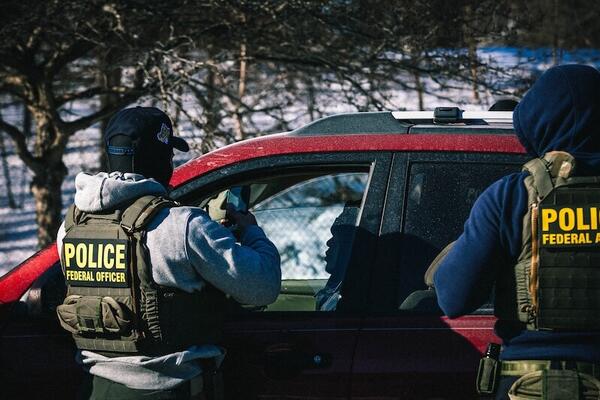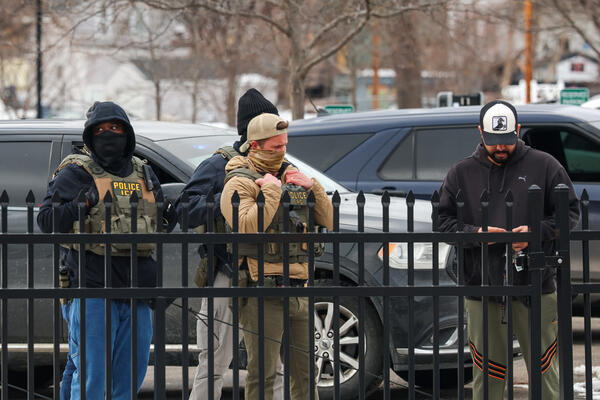
Across the country, thousands of men and women wake before dawn, put on a neck gaiter, sunglasses, and a baseball cap, and drive to work to separate families. They do this in the name of “law and order,” a phrase that sounds sturdy enough to be moral, and vague enough to hide what it requires. Under the current administration, that looks like intensified immigration crackdowns and scapegoating immigrants as the source of the country’s problems. It’s part of a long American tradition of fusing public safety rhetoric with racist and xenophobic policies. “Law and order” has always depended on certain people carrying out actions the rest of the public prefers to ignore.
And yet, conscience is a stubborn thing. For example, minister and activist Michael Woolf has said that he has made police officers cry when asking them to consider the injustice that goes on in the Immigration and Customs Enforcement processing facility in Broadview, Ill. No paycheck or bonus, no matter how large, fully silences one’s conscience. It lingers in the quiet drive home, in the late-night scroll, in the glance at one’s own children at bedtime. Systems of repression rely on loyalty, fear, and isolation to keep people in line. But as violence by Department of Homeland Security agents escalates, I can’t shake the sense that doubt is growing within the ranks. What many of these agents lack is not awareness, but a public permission structure to act on that part of themselves that knows something is wrong.
I’ve been thinking about this for months. People I know have joined these agencies. Others I care about defend them. In my rawest moments, I don’t want to engage with either and would rather just cut them off completely. Many in my circles feel the same. Why argue? Why try to delegitimize something that is so clearly harmful? Not only does abandoning people who have joined or defended the federal immigration crackdown feel cold, but it also feels dangerous. Cutting them off means exiling them deeper into a radicalized, well-funded, and heavily armed paramilitary force that has shown virtually no regard for public accountability.
People I know have joined these agencies. Others I care about defend them. In my rawest moments, I don’t want to engage with either and would rather just cut them off completely.
That tension led to a deeper question: What makes someone admit that the system they serve is causing harm? At Homeboy Industries, Fr. Greg Boyle has spent decades accompanying people as they leave these kinds of cycles of violence. Founded in Los Angeles more than three decades ago, Homeboy has grown into the largest gang intervention, rehabilitation, and reentry program in the world. It’s helped thousands of men and women step away from violence, incarceration, and harm, and into lives rooted in wholeness and belonging. As the late Pope Francis observed in his 2013 exhortation, “Evangelii Gaudium,” we have created a throwaway culture wherein we are quick to discard people once they cross certain lines. Homeboy offers a model of accountability and transformation at scale. I asked Boyle what it takes to actually make someone leave a violent system. “It takes what it takes,” he says of gang recovery. “You can’t manufacture it. You can’t convince people.”
READ MORE: ICE Must Be Abolished. Can Truth and Reconciliation Follow?
Boyle doesn’t approach these issues as a political problem, but as a question of health and wholeness. In his experience, you can’t argue someone into healing or shame them into clarity. But what you can do is create the conditions where healing becomes more easily accessible. People don’t embrace cruelty because they are strong. They do so because something in them is wounded. “They’re not running to something,” he told me. “They’re running from something.” Harmful systems recruit from trauma, fear, and compromised access to one’s own goodness. Seeing it this way helps us name it more precisely. Violence is still violence. Cruelty is still cruelty. It’s not strength or patriotism or “law and order.” For Boyle, joining violent and cruel systems is a symptom of unhealed woundedness, not proof that a person is beyond return.
Woundedness is not an abstract idea, though. I feel it when I see the nakedly cruel tweets from DHS or the surreal TV ads that frame rounding up my family as heroic. What unsettles me even more is seeing young, first-gen Latinos like me embrace that script and carry it out against their own communities. We’ve already seen where that leads. In Alex Pretti’s killing, the two agents identified as the shooters were both Latinos from South Texas. When I see that kind of harm escalating, something in me wants to respond with the same hard instinct: protect, counter, strike back. But if violence is the only language available, answering it in the same way only deepens the wound. I’m brought back to the question Boyle asks: “How do we walk each other home to wholeness?” That path is harder. Opposition alone is not enough. We need a way to interrupt the cycle.
The machinery of deportation depends on thousands of people showing up each day and staying silent in the face of injustice. Resistance must continue to mobilize in the streets, but if this is a long struggle (and it is), we must also find a way to thin the ranks inside the machine. That happens when those inside the system hear and act on their own conscience.
The church is uniquely positioned to make that possible. The sacrament of reconciliation is a ritual that offers something not often found in the outside world. Ideally, the church should be a place where someone can tell the painful truth without being shamed or ostracized, and be restored to goodness. Boyle describes the arc of healing as a movement “from anger to sadness to compassion.” Anger often masks sadness; sadness, when accompanied honestly, can open into compassion. Compassion is the key to transformation. That movement can’t be forced, but it can be nurtured.
If clergy were to preach this clearly every Sunday, naming state cruelty without euphemism while simultaneously announcing that a return to compassion is possible, they could create a public permission structure for ICE agents whose consciences are stirring to leave systems of violence. Confession would not function just as a private release valve, but as a turning point. Penance could lead somewhere real: documenting abuses, contacting protected whistleblower channels, refusing unlawful orders, and beginning the costly process of resignation. Accountability would remain central, but it would include support. Without practical backing like legal guidance, job networks, and spiritual accompaniment, the prospect of a viable exit is slim. The church can’t manufacture someone’s awakening. But it must become a sturdy community that encourages and receives defectors.
I won’t pretend that this resolves the tension we’re living in. There are days when cutting people off feels justified, and anger feels clean. But if the state continues recruiting wounded people into brutality, the church should not surrender them to it. Instead, we must become a place of healing and restored conscience that provides real exits for people looking to escape the business of violence, while simultaneously demanding repair.

Colin Martinez Longmore is an opinion writer for the 2026 Sojourners Journalism Cohort.
Did this article have an impact on you? Tell us how! Whether you’re moved to take action, have a question, or want to share a comment (good or bad), we value your feedback!