Opinion

The other day I was eating dinner with my wife in a restaurant in Gallup, N.M., a border town to the Navajo reservation. Gallup was recently named the "Most Patriotic Small Town" in a nationwide contest. Soon after sitting down I noticed that we were seated at a table directly facing a framed poster of the Declaration of Independence.
The irony almost made me laugh.
When our server, who was also Native, came to the table, I asked if I could show him something. I then stood up and pointed out that 30 lines below the famous quote "All men are created equal," the Declaration of Independence refers to Natives as "merciless Indian savages."
The restaurant was filled with Native American customers and employees. And there in plain sight, a poster hanging on the wall was, literally, calling all of us "savages."

The problems of the world can overwhelm us. When we are confronted by the Divine in the cries of human need, we may, like Isaiah, feel unworthy and ill-equipped to respond. However, if we allow this Divine experience to transform our human weakness, we can find the courage and strength to answer that call, as Jean Vanier has, with a bold, “Here I am!” What follows may be more difficult than we can imagine, but we can be confident in the knowledge that the work we do is Holy work.

One of the dominant dogmas of the season seems to be both loud and clear: Our value as human beings is often dictated by our capacity to contribute toward economic growth.
This is what happens when Decemberism crucifies Christmas.
One may define “Decemberism” as a state in which the value of human life is determined exclusively by our personal rates of production and consumption. We notice this condition most often, of course, in December. Decemberism is the predominant religious tradition of the so-called “holiday shopping season,” and the significance of Christmas is consistently crucified as a result. As Victor Lebow states:
“Our enormously productive economy … demands that we make consumption our way of life, that we convert the buying and use of goods into rituals, that we seek our spiritual satisfaction, our ego satisfaction, in consumption … we need things consumed, burned up, replaced and discarded at an ever-accelerating rate.”
In striking contrast to the Christmas ramifications of God’s incarnation, to be a human of any value in our current context is closely connected with supply and demand, even if it all leads to our personal and public self-destruction.

It’s easy for the faith of children to go unnoticed. But here are four spiritual things kids do better than adults:
They Ask Questions:
Nobody asks more — or better — questions than children. “Who?” “What?” “Where?” “When?” and “Why?” are expressions patented by kids everywhere. They’re obnoxiously curious and want to know everything about everything.
They aren’t afraid to ask the most difficult and messy questions. Too often we mistake spiritual maturity for certainty, and lose our thirst for discovery. Kids remind us how to approach God — truthfully, stubbornly, inquisitively, and tirelessly.

It’s sometimes cliché for Christians to warn about the dangers of idolizing wealth and money, but the negative impact it can have on our faith is often more subtle than we realize. Here are a few ways it covertly manipulates our spirituality

Author’s note: If you know me, you’d know that that I think the most important thing (of the things we worship ) is Jesus. And you’d also know that I love Arrested Development, with almost the same type of devotion I typically reserve for God. As a former “professional church lady,” crafting prayers was right in my wheelhouse. So I’ve composed a psalm entirely out of Arrested Development quotes based on the ACTS style of prayer, because it is right, and a good and joyful thing, always and everywhere to give thanks to God. And also … not Aunt Lindsay’s nose.
Oh God. (AD 2:13)
I love you. (AD 1:7)
We all must seek forgiveness. I’ve always tried to lead a clean life. My brother and I were like those Biblical brothers, Gallant and, um … Goofuth. (AD 2:14)
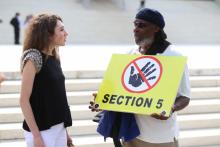
Today is a dark day in our nation’s history. In a 5-4 ruling, the Supreme Court ruled in the case of Shelby County, Alabama v. Holder that Section 4 of the Voting Rights Act is unconstitutional, rendering the 48-year-old legislation impotent to protect citizens from voter suppression. Section 4 lists the states that must obtain “preclearance” from the Department of Justice before instituting changes to their voter laws. In her dissenting opinion, Justice Ruth Bader Ginsburg, said: “Throwing out preclearance when it has worked and is continuing to work to stop discriminatory changes is like throwing away your umbrella in a rainstorm because you are not getting wet.”
Only 48 years ago, on March 7, 1965, men, women, and children absorbed blasts of water, bone-crushing blows from police batons, and profound humiliation as Selma, Ala., police dragged limp black bodies over concrete on the far side of the Edmund Pettus Bridge. They had assembled on that day, which came to be known as “Bloody Sunday,” to march from Selma to Montgomery in protest of voter suppression and intimidation that had plagued the entire South. Ten days later, President Lyndon B. Johnson sent the Voting Rights Act to Congress. The bill passed in the Senate on May 26 by a vote of 77 – 19 and passed in the House on July 9 of that year. President Johnson signed the Act into law with Dr. Martin Luther King, Rosa Parks, and others present on August 6.
Flash forward to Fall 2012. I launched a blog series called “Watch the Vote” because, as of August 2012, 30 states had introduced legislation or enacted laws to hinder voters’ access to voting over the previous year. The Fair Elections Legal Network crafted this map to chart the spread of legal voter suppression initiatives across the nation. Notice, Alabama is one of the states that has recently passed voter restriction law that has not been precleared by the Department of Justice. Its new law, requiring photo ID and proof of citizenship, was set to take effect in 2014 before the Supreme Court ruled last week that Arizona’s voter ID law, which Alabama used as a model for its own, is unconstitutional.
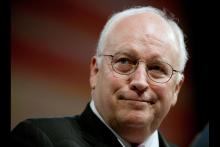
Dick Cheney is a strange creature. For public consumption he is the cool, principled champion of the American people willing to take hard public stands on their behalf.
James Dobson, of Focus on the Family Action, and his senior vice president of government and public policy, Tom Minnery, used their "Focus on the Family" radio show to criticize Barack Obama's understanding of Christian faith. In the show, they describe Obama as "deliberately distorting the Bible," "dragging biblical understanding through the gutter," "willfully trying to confuse people," and having a "fruitcake interpretation of the Constitution."
The clear purpose of the show was to [...]