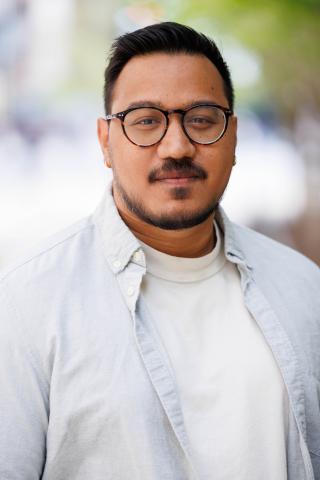
Amar D. Peterman is an Indian American scholar working at the intersection of faith and public life. He is the author of Becoming Neighbors: The Common Good Made Local. You can learn more about his work at amarpeterman.com.
Posts By This Author
No, the Supreme Court Is Not God's Court
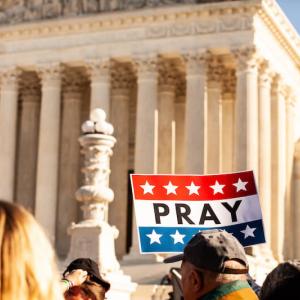
Demonstrators gather outside the supreme court as the justices hear oral arguments in Dobbs v. Jackson Women's Health Organization. Credit: Allison Bailey via Reuters Connect.
Today, Christians are continuing to pursue their political interests while imagining that God is fighting on their side. In the wake of the Court overturning Roe v. Wade, many conservative Christian leaders celebrated the decision as bringing about God’s kingdom on earth. On the other side of the pew, progressive Christians lamented the decision because of the devastating implications it holds for human rights both now and in the future. This leads me back to the question I asked myself in the wake of the Supreme Court rejecting Trump’s bid to eliminate DACA: Is God in control of the Court?
What My LGBTQ Siblings Taught Me About Christian Theology
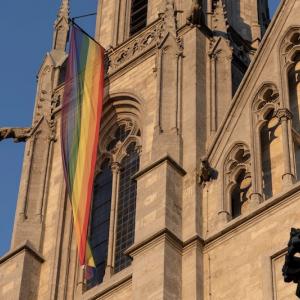
A rainbow flag hangs on a church. Credit: Reuters/Lukas Barth.
Many queer folk bear the scars of wrestling with God in our world today. Rather than running from God, they’ve asked questions, encountering YHWH like Jacob who does not come out of the encounter unscathed. But as Reichel wonderfully articulates, we are not alone in our woundedness. Jesus Christ incarnate also enters God’s creation and is marked by the scars of this wrestling in the divine act of redemption. God is with us, wrestling with us, asking questions of us, and drawing us out of darkness and into a healing light.
Good Friday Does Not Glorify Suffering
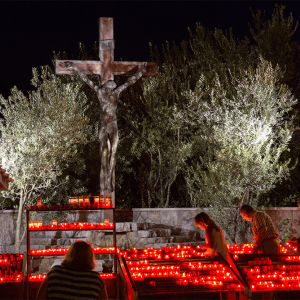
Pilgrims coming to light a candle in front of the cross. Photo: Adam Ján Figeľ / Alamy
Many of the white evangelical churches I have visited and grew up in framed Good Friday as a celebration. I have attended services that centered around dramatic skits or clips of Mel Gibson’s The Passion of the Christ in order to evoke an emotional response. Another service treated Good Friday like a visitation where congregants were encouraged to reflect on their “friend Jesus” and share words of gratitude.
My Disabled Body Proclaims the Gospel
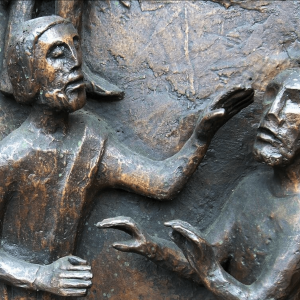
Image of Jesus stretching out his hand to heal a person. Photo credit: sea turtle.
Time after time, these Christians would lay hands on me while I waited in line at Starbucks or the food court at the local mall. They’d try and cast out evil demons, pray that my faith would be strengthened, or command in Jesus’ name that I get up and walk (even though I could already walk). Each time, they would stand back as if they’d just recited the magic words. Each time, with progressively less optimism and greater anger, I’d step forward only to find out I wasn’t healed. Some would accuse me of not having enough faith, but most just apologized and went on with their day. I was left alone. Still limping, still furious.
Marginalized People Need More Than a Seat at the Table

I believe the material histories and needs of marginalized people demand structural change and not merely a “seat at the table.” As ethnic studies professor Jodi Kim summarizes, “one does not have to be cynical to observe that this liberal or corporate multiculturalism, with its politics of symbolic, imagistic, or cultural representation has replaced, rather than complemented, substantive political representation or redistribution of wealth and power.” The language of representation can present progress but in reality, it is the path toward homogenization.
What Mary Didn't Know

Mosaic of the apse semi-dome, Basilica di Santa Maria Maggiore, Rome. Via Alamy.
In a cultural moment where religious deconstruction is being widely discussed, Mary offers us hope. I can only imagine over those nine months the questions, doubt, and frustration Mary felt toward the God who called her to be the mother of the savior of the world. And yet, we can have hope in this: that Mary was favored by God regardless of her doubt.
How the Metaverse Will Pull Us Further Apart
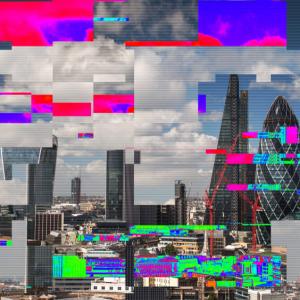
Although it is hard to imagine a world without Facebook, we must look critically at the implications of its widespread use and the powerful companies that control these platforms — and us. Whether by making election interference easier, selling people’s data, fostering social division by populating feeds with malice, greed, and dissension, social media provides an opportune venue for users to live into our depraved human condition. The consequences of this, however, are not contained in the digital world.
The Great American Potluck

As Christians, I believe we must reject the project of the melting pot. In the Bible, the church is not portrayed as an ambiguous, homogeneous entity. Instead, difference and diversity are understood as a strength — as God’s gift to the church (Acts 2).
God of Our Mold and Decay
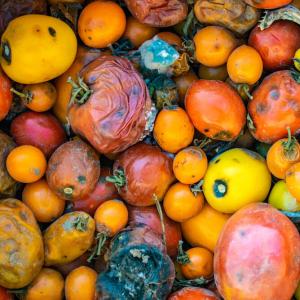
When we do not take care of the earth and allow powerful individuals or companies to plunder the land God has called good (Genesis 1), the people who are disproportionately impacted are the marginalized. This discrepancy between those who benefit and those who suffer highlights the way our society is structured to benefit oppressors at the expense of people who are poor, hungry, and disenfranchised.
There’s No Such Thing as a Colorblind Christianity
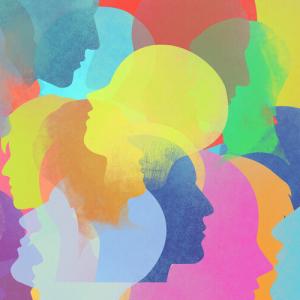
In our pursuit of justice, we must learn from projects like CRT which can illuminate the realities of multiracial communities in which the church ministers. To deny these realities or reject tools that help us perceive correctly, is to dishonor the call to neighbor-love and hospitality we have received.
Navigating a White Evangelical World In This Brown, Indian Body
By Green angel | via Shutterstock
This work of crafting a new narrative for Asian America takes various forms across many locations. It is not linear or systematic, but rather involves the relational work of changing a collective imagination of Asian Americans through both education and experience. Like any story, asserting a new narrative for Asian America requires engaging mind, body, and soul.
A Dark Kid in a Sea of Whiteness
Living an embodied faith asserts meaning upon our bodies both as individuals, and in relationship to one another. This means that the places our non-white bodies inhabit tell a story in itself, just as God enfleshed “entered our lives, calling us from the tomb in which society has sought to confine us.” The shared space of believers living out the Christian faith in diverse, multi-ethnic communities is a witness to our world of the power of Jesus Christ.