Share As A Gift
Share a paywall-free link to this article.
This feature is only available for subscribers.
Start your subscription for as low as $4.95. Already a subscriber?


LAST SUMMER, New York Times columnist Ross Douthat conducted an interview on his podcast with billionaire Palantir Technologies and PayPal co-founder Peter Thiel. In what has now become an infamous exchange, Douthat asked Thiel point-blank, “Should the human race survive?” Reading the transcript of Thiel’s response is the only way to grasp how baffling it was.
Douthat: I think you would prefer the human race to endure, right?
Thiel: Uh—
Douthat: You’re hesitating. Should the human race survive?
Thiel: Well, I don’t know. I would—I would, um—
Douthat: This is a long hesitation!
Thiel: … Yes. … But I also would like us to radically solve these problems. And so it’s always, I don’t know, yeah—transhumanism. The ideal was this radical transformation where your human, natural body gets transformed into an immortal body.
For those already confused: Thiel is a transhumanist, a devout believer that, through embracing technological progress and even merging our biology with machines as the next step in evolution, we will be able to completely conquer aging and death. This soapbox might have been perplexing enough. But the exchange quickly continued to a surprising place.
Thiel: And there’s a critique of, let’s say, the trans people in a sexual context … a transvestite is someone who changes their clothes and cross dresses, and a transsexual is someone where you change your, I don’t know, penis into a vagina. And we can then debate how well those surgeries work, but we want more transformation than that. The critique is not that it’s weird and unnatural, it’s … Man, it’s so pathetically little. And OK, we want more than cross-dressing or changing your sex organs. We want you to be able to change your heart and change your mind and change your whole body. And then orthodox Christianity, by the way—the critique orthodox Christianity has of this, is these things don’t go far enough. That transhumanism is just changing your body, but you also need to transform your soul and you need to transform your whole self.
As soon as Thiel brought transgender people and Christianity into the equation, my ears naturally perked up. Thiel’s understanding and framing of both ideas was disorienting and bizarre—and as a transgender woman and Christ-follower, I was both taken aback and wholly unsurprised at being roped in. Trans folks like me have been a cultural touchstone of heated debate for the last several years, often talked about but rarely platformed enough to have a conversation with. To hear our existence raised as another hypothetical issue on Douthat’s podcast was par for the course. And hearing a critique of transness from a hyperconservative tech bro like Thiel was hardly breaking new ground either.
What was truly interesting territory, however, was that Thiel was describing transgender people not in opposition to his vision of reality, as so many do, but (in a certain sense) as a node within it. In fact, Thiel’s problem with trans people does not seem to be that we’ve gone too far with changing the human body, but that we haven’t nearly gone far enough. And in saying this, he philosophically links transgender experience to the movement of transhumanism. In Thiel’s view, arguably, the existence and acceptance of trans people is a cultural and technological predecessor to his proposed endpoint in the transhumanist movement.
The first time I heard Thiel’s words, I had to look long and hard in the spiritual and philosophical mirror. To be reviled and seen as “counter to the natural order” in the eyes of someone like Thiel would have given me zero pause. Thiel is a hypercapitalist advocate for the Trump administration who has openly stated that he does not believe in democracy. I might have worn his rejection of my identity as a badge of honor. But to realize that Thiel viewed my trans identity as a boxcar on the same train of thought as his desire to transfigure humanity into immortal machines? This was cause for self-reflection, and maybe even reevaluation—both as a believer and as a human being.

Georgia Coley / Photographs by Emily April Allen
I SPENT THE next several months diving into perspectives that echoed Thiel and those that opposed him. I wasn’t conflicted in how I felt about transhumanism, but I wanted to be able to thoughtfully articulate what my line against it would be, particularly as a Christian.
One fellow believer who has adamantly argued against the transhumanist movement in recent years is the acclaimed writer Paul Kingsnorth. A former environmental activist and recent orthodox Christian convert, Kingsnorth’s latest book, Against The Machine, is a broad overview of how he sees modernity as the “unmaking of humanity,” using technology to transcend healthy limitations we once saw as given—perhaps even by God.
I was mixed on the book. Nonetheless, I found many of Kingsnorth’s arguments to have a perceptive grain of truth about the importance of knowing our limits and finding somewhere to draw a line in the sand; they are, to a large extent, the very arguments that I would echo against the overuse of AI, over-industrialization, and Thiel’s ghoulish brand of transhumanism. God, Kingsnorth would argue, clearly created us to be human beings; God called our humanness good. Therefore, we need to find some way to embrace the natural limitations of our God-given humanness and rest in that gift without trying to transcend it and become God ourselves.
But Kingsnorth doesn’t only critique transhumanism. As everything seems obligated to these days, Against the Machine also has a chapter devoted to addressing the “transgender issue.” In it, Kingsnorth makes many of the same arguments I made above: that we are coming to a dangerous place where “biology itself is viewed as a problem to be overcome,” and part of being human is accepting what is natural and given. Kingsnorth argues that by using medicine and technology to alter their bodies, transgender folks “play God” and meddle with given reality, rejecting their human nature and becoming “machines” instead.
As someone who admires many of Kingsnorth’s declarations against a techno-future, this chapter left me feeling homeless. Kingsnorth’s arguments against transhumanism, I felt, were solid and convincing. Yet these arguments brought Kingsnorth to critique not just transhumanism but also the existence of transgender identity as its perceived ideological sibling. Ironically, Thiel and Kingsnorth both believe that my experience as a trans person represents transcending humanness and becoming a machine—even if Thiel finds this desirable and Kingsnorth finds it repulsive. And yet despite what each of them believes, I am trans, Christian, and deeply committed to embracing the gift of my own humanity.
Wrestling through it all, I had to finally ask myself: Is there any compelling difference between my reality as a trans woman and the reality proposed by transhumanism—the modern worldview Kingsnorth broadly calls “the machine”?
WHEN I SET out to write this piece, I spent much time trying to parse out the history, meaning, limits, and implications of technological alteration to the human body. You can read people arguing about chemical, medical, and surgical intervention as far back as the Bible and before. These dynamics have always been a nuance of human life, and we’ve always had messy disagreements about what is “natural” and “unnatural.” How could one ever find a satisfying answer that accounts for every exception?
But eventually I realized something: I was still accepting both Thiel and Kingsnorth’s premise that trans experience is primarily defined by modern technological intervention on the human body. And the more I sat with it, and spoke with other trans folks, the more I came to believe that such intervention on the body is not the primary characteristic of transgender experience. Indeed, it is only somewhat more important in our lives than it is in the lives of anyone else living within modernity.
Modernity is the key word here. One crucial fact that distinguishes trans experience from “the machine” is that gender-nonconforming people have existed much longer than contemporary methods of medical gender-transition have—see two-spirit people in many Native American cultures, the fa’afafine and fa’afatama in the Samoan islands, the hijra community in India, and the countless examples throughout history of individuals who lived across or between the gender categories and norms into which they’d been born. Some of these individuals were even devout believers in Christianity who viewed their subversive lives as unique callings from God.
This rich history means that trans experience has less to do with technology and more to do with the unique and mysterious dance that some people have always been beckoned to join by something beyond ourselves—a conversation with the language of gender and a willingness to communicate differently within that language than others around us.
Georgia Coley / Photographs by Emily April Allen
THE IDEA THAT transness could be distinguished from mere modern technology and medicine may come as a surprise to those who are only familiar with trans experience through headlines. From coverage of Caitlyn Jenner to songs about “sex change operations” in 2024’s Oscar-winning film Emilia Pérez, I’m struck by how much public consciousness centers “getting surgeries” as the very basis of what it means to be trans. As soon as Thiel brought us into the picture, he couldn’t help but crudely rant about “turning a penis into a vagina.” The public’s fixation on these “operations” is strong and perhaps understandable given the profound medical miracle they represent. But when I was a teenager trying to make sense of my trans identity, I always felt profoundly alienated by this obsession. If constant talk of genitalia and surgery was what transness meant, I didn’t want it.
Today, however, I know that the vast majority of trans life is just so much more ordinary than this sensationalized medical view or paranoia about “machines.” For one thing, most trans people do not get multiple surgeries—whether for lack of funds or lack of desire to do so. And yes, trans people often struggle with a sense of dysphoria around their body and sometimes utilize technology and medicine to feel more comfortable in their skin and even safer from discrimination—but cisgender people do this too: Hair transplants, Botox, nose jobs—these are all examples of “gender-affirming care” that cisgender people partake in without a dark night of the soul about whether they are somehow meddling with the cosmic nature of given reality. I’m not being flippant; I think perhaps everyone should take such decisions with more weight and spiritual thoughtfulness.
Because the body does have importance in trans life, most trans people take medical intervention on our bodies much more seriously and thoughtfully than cisgender people tend to do. Especially if we’ve experienced gender dysphoria from an early age, then we have had years to wrestle with the weight and impact that changing our physical bodies might have upon our life. And the regret rates in gender-affirming care—which are much lower than many “ordinary” surgeries society rarely calls into question—reflect this intense discernment.
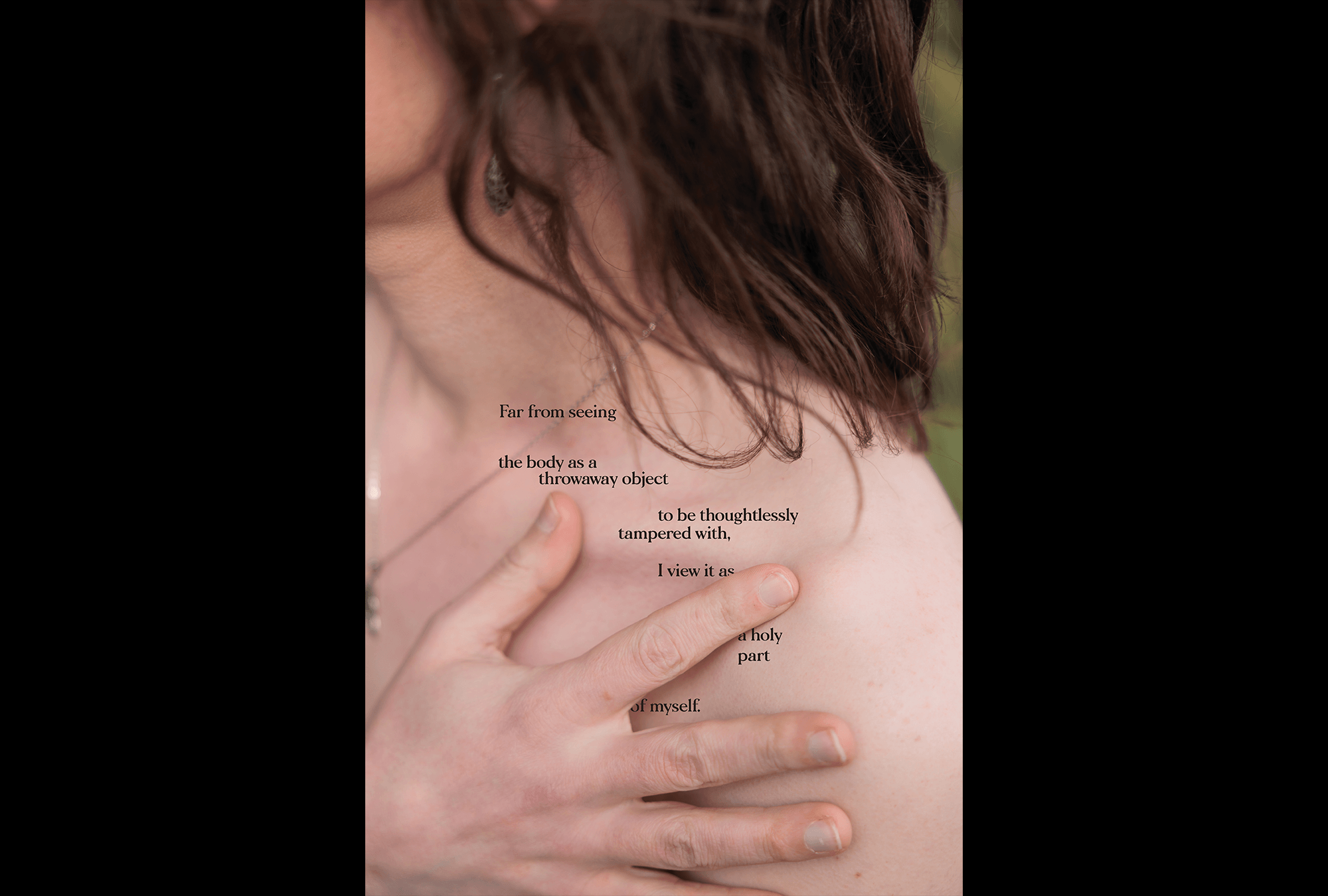
As a trans woman, I’ve always said that if my body is “a temple of the Holy Spirit” (1 Corinthians 6:19), I want it to be one that I can worship within. Far from seeing the body as a throwaway object to be thoughtlessly tampered with, I view it as a holy part of myself that I have been invited into communion and co-creation with. I can’t speak for every trans person, but the ones I’ve met are always navigating what I view as a deeply spiritual tension—a dance of accepting and making peace with the bodies we have and discerning the choices and agency we have been given in relationship to them.
All bodies are a precious gift. But trans people are so much more than our bodies, too. And the more that I’ve experienced what it means to be trans and heard the perspectives of others like me, I’ve come to believe that transness is not primarily characterized by the desire to somehow transcend our humanness—rather, it is characterized by a yearning to be known by others in the way that feels most integrated and intuitive.
For me, this has meant being known and understood within the broad category of “woman”—a rich cultural language and experience that has brought form and substance and joy to my life and allowed me to give and receive love in ways that I never felt capable of doing before. First and foremost, it is a relational reality. And that experience of making decisions to be more honest with oneself and more known by others—even when the process is hard and messy and uncertain—is quite different from a blind worship of technological immortality; it is a universal human experience of humble self-revelation and bravery.
I don’t mean to say that this beautiful thing cannot ever be distorted or done with misguided intention. But at its most spiritually rich, trans experience is a receiving of oneself from rather than a mere enacting of oneself upon. From this perspective, trans experience (and queer experience in general) has a level of acceptance of reality—even when it’s not what you would choose—that transhumanism does not. Transhumanism rejects the body and instead seeks to completely transcend human nature for the sake of “progress” and vain, unmoored immortality. Trans people, meanwhile, often only come to the decision to transition when we have reached the end of our rope with trying everything else and begun to realize that there is something innate about how we interact with the world—and how we were made—that we cannot deny and must instead come to humbly befriend.

Georgia Coley / Photographs by Emily April Allen
THIEL’S UNDERSTANDING OF Christian thought around the body remains, to say the least, disorienting and confused. He rightly gestures toward the profound heart transformation that Christianity asks of its followers—going beyond the physical flesh and reaching deep into the soul. But his transhumanist method of achieving this soul transformation seems to be merely through the technological alteration of biology, embracing human advancement to somehow conquer death. He mentions no need for repentance, grace, or divine salvation. If there’s ever been any argument that someone is “playing God,” in a way that any Christian can challenge, I think this is it; after all, Christ is the only conqueror of death. It is in Christ that we find our refuge and ultimate resurrection, not through seizing the reins ourselves.
Still, when I asked my trans and gender-expansive friends about whether Thiel’s vision of a techno-future where we transcend our bodies and humanness (and even our mortality itself) felt appealing to them, none felt that it was even slightly close to their understanding of what it means to be trans.
“I didn’t transition to somehow transcend my body or death or something, I transitioned because I wanted to be fully present in my body and in my life,” one friend told me. While Peter Thiel’s dream is one of immortality and disembodiment, the trans folks I know are all people who have decided to live well within the bodies they have in this life—not because they want to become machines, but because they want to become fuller human beings.


Georgia Coley is a documentary filmmaker and culture writer living in Nashville. She writes about the intersection of trans experience and theology at her Substack, Georgia In Her Mind.
Did this article have an impact on you? Tell us how! Whether you’re moved to take action, have a question, or want to share a comment (good or bad), we value your feedback!
