I AM OJIBWE ANISHINAABE through my father and German Ukrainian through my mother. I live in what is currently known as the Niagara Region of Canada—a homeland for neither of my peoples, but home to Michi Saagiig Nishnaabeg, who would be cousins to the Ojibwe. We are bush Indians, at home in the forests and wetlands of the northwest. They are the people of the big river mouths and are at home in these more southern places. Of course, north and south are contextual and depend on where you are reading from.
Indigenous writers are prone to identify the places from which we live and write and our connections backward in time and to each other. These things provide context to our words and help you understand how to read them. Readers ought to do this as well. Think about where you are reading from, your own placement in time and geography. How did you get to this place, wherever this place is, that you are reading this magazine and this article? Who lived here before you, and who are the newcomers to it?
Like most of us, I write and speak from within many places, but primarily I think about the generosity of my father’s ancestors in sharing the land, and the subsequent exploitation of that generosity by those who colonized it. I think about the responsibility of newcomers like my mother’s family to be a good and trustworthy presence here. In the book We Are the Middle of Forever, Natalie Diaz, a Mojave and Akimel O’odham poet, said in an interview, “It’s not about blood and it never has been. It’s about how you arrive and build a relationship with the land you’re on. And then once you’re there, it’s also about how you receive others.”
What does it mean to enter the land well and to form relationships? Since we all have entwined legacies, how can we live out these relationships in a way that builds rather than destroys? With that question in mind, we turn to the ancient and prescient biblical story of the Tower of Babel and what this handful of verses about a time generations after Noah and the Flood may teach us about the things we build.
How did you get to this place, wherever this place is, that you are reading this magazine and this article?
Why did they have a common speech?
IN GENESIS 11:1-9, in a world that we’re told speaks one language, we encounter a small story about a group of people who came to Shinar and settled down. They agreed to build a city with a tower that would reach the heavens, to make a name for themselves and keep their community from being scattered across the earth. The Lord, after seeing the tower, said, “Look, they are one people, and they have all one language, and this is only the beginning of what they will do; nothing that they propose to do will now be impossible for them” (verse 6). Muddling their language, God scattered them all over the earth.
It’s odd that the story tells us that the entire world had one language and a common speech. Humans don’t even have completely common speech between generations let alone entire peoples, and this story takes place quite a few generations after Noah. More confusingly, in the previous chapter, the writer makes a point of telling us about the existence of different languages. He or she gives a genealogy of everybody who descended from Noah, then notes that the maritime peoples who descended from Javan had their own languages, as did the sons of Ham, one of whom was Cush, the ancestor of Nimrod who is often associated with this tower.
So why begin the story with a statement about “the whole world” having one language and common speech? Rabbis teach that when something is repeated, there is a reason. So, out of curiosity, I ran the story through a Gen Alpha translator—it rendered this phrase as “one lingo and a single chat.” The chat is where the conversation takes place. One language, one place. Remember how important it is to think about the place from which we read or write? Newer generations may be incomprehensible at times, but they can also offer remarkable clarity.
Another thing to remember is that people wrote these stories down after they returned from exile in Babylon. To be sure, these are old stories, handed down through oral tradition, generation by generation, but they were not written until the people sat down by the river and mourned their home, much like Anishinaabe stories were not written down until boarding schools and relocations meant they were in danger of being forgotten. That’s when people with oral traditions write things down, to preserve them before there aren’t any elders left to tell them.
These were people trying to figure out what went wrong that sent them into exile. They’ve come home and tried to make Israel great again, but it was incomplete; they and their children spoke the language of their captors. This story was written down by people whose parents and grandparents had been marched into exile by an empire where everyone spoke the same language and lived in the same place. The story about Babel changes when you think about it being written down by the captives of such an empire, captives who lived beneath Mesopotamian towers and perhaps helped to build them. This story echoes through the captivity in Egypt and the destruction of walls and towers in the Promised Land.
Think about Indian boarding schools and rules about using English on plantations. Think about all the ways that governments and their agents draw lines around a place and insist on an official language. Then think about the violence they use to make that happen. Think about Christian nationalism and Zionism insisting that a chosen people and a holy land mean a common language and a singular belief to which we must all conform, instead of understanding, as many of my Jewish friends do, that we are all chosen for a purpose and that all land is sacred.
The type of tower that Noah’s descendants were likely building in Shinar, a ziggurat, took decades to build. That takes authority and control: People don’t just do that kind of work over a period of decades while there are other things going on like farming and home repairs and pottery-making—unless somebody has the power to make them do it. Slogans like “Make Shinar Great Again” only go so far. Projects like this take many workers, people who feel compelled to move to cities to find work. European and American history is replete with policies that bankrupt farmers to create a class of landless and masterless men who provide an urban workforce.
Wherever there are resources to be extracted, colonizing powers have displaced, disrupted, and cleared the land, often with missionaries gathering the people into a single place, teaching them a single language, and imposing single belief. Ostentatious structures like palaces, luxury condos, and corporate skyscrapers are towers and monuments that assert power over those who live in or near a place, often named for the architects of Indigenous displacement. When Noah’s descendants rolled east and decided to settle in Shinar, things got settled in a variety of ways, if you get my drift.
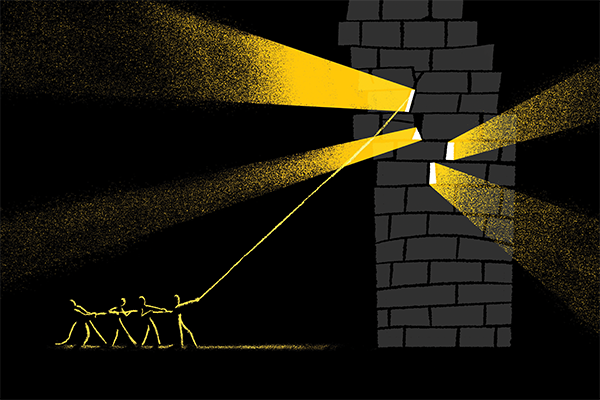
apr26featurekrawec2.png
Why did this make God so mad?
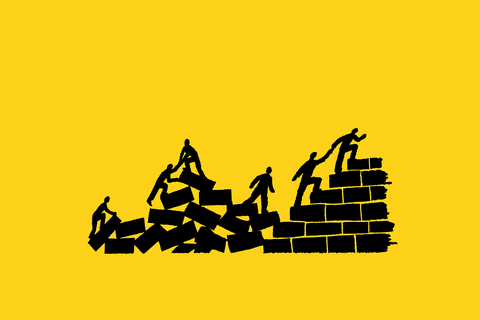
“LET US BUILD ourselves a city with a tower,” the ancient ones said. They wanted to build a monument so everyone would know who they were and where they were. We do this too, building a nation, a church, so that we won’t be scattered. Because we can point at Nimrod (who may or may not have built the tower, but is credited with building Babylon and more), and we can point at Trump and Jeff Bezos and everyone else. We can and we should. But they did not build alone. People may know that they will never be royals, but they believe they will be safe in the white supremacist, Christian nationalist world being built with their cooperation. They believe they will never feel the violence that lands on those who are not the same, whose skin color means they will never be the same no matter what they say or do. People will protect their innocence by denying the harms or reframing them as help or safety.
That, I believe, is what made God so mad: Exploitation and authoritarian control that wages the violence of imposed sameness. Same language, same beliefs, same goals, same everything. It might sound nice until you start to consider the cost of that sameness. This echoes 1 Samuel 8, when the people of Israel say that they want a king to lead them, and God instructs Samuel to warn them about everything the king would do and take from them. But the people respond, “No! We are determined to have a king over us, so that we also may be like other nations and that our king may govern us and go out before us and fight our battles” (verses 19-20).
All of this makes me wonder about our own world, and the things that we are building. In his book The Message, Ta-Nehisi Coates offers a warning to those of us who dream of a better world: We cannot resist the dominant myths of conquest by crafting our own. We can’t resist the towers built by unjust leaders simply by building one of our own. It is not different just because we who resist empire do it, even if we have good intentions. Therefore, we need to ask ourselves questions:
What is the common language we expect people to share?
What are we asking others to give up for this thing we are building?
Who are we building this for?
Are we exploiting or ignoring the trauma of others to gain or hold onto influence or power? Are we denying the harm to others caused by the political choices we make? Are we reassuring ourselves that it serves a greater good, that it’s “for their own good,” that we’ll come back for people left behind in our pursuit of these “goods”?
And who is the king we are following?
The story of Babel is a story of movement, told within a people of movement, with lessons for us who build movements—lessons for all who want to build things to resist being dispersed and separated. But what if we’ve missed the point? What if our power to change the world lies in being scattered rather than building things so we won’t be?
Remember, it is “not about blood and never has been.” It is about how you enter a space and build relationships there.
What if our power to change the world lies in being scattered rather than building things so we won’t be?
What if the destruction of the Tower of Babel was a rebellion? What if it was a refusal to speak the common language, to build a vanity project, to be exploited labor? What if God destroyed the tower through the organized rebellion of the people, and their scattering was a return home rather than a punishment? It’s only a punishment to people who are invested in the tower, not to those who are being exploited for it. Perhaps it wasn’t new languages, perhaps it was a restoration of older languages and the ability to live in their own ways. They didn’t need to take the tower down on their own, because the base was rotten and the structure could not stand. When that became apparent, they took their moment and refused to build any further. They refused to continue crushing the image of God on earth. They insisted on being their authentic selves, refused the token seat at the table of tower design, and left.
What if there is power in our scattering and in the relationships between us that form as the result of our scattering—in the relationships that form as our communities learn to exist in layers instead of borders? We could build a movement of coalitions instead of the allyship that inevitably devolves into white savior tower-building. Each of us is responsible to organize and educate our own communities, who can then come together in coalitions that prioritize the needs of those who are experiencing the greatest harm. We could come together as communities to protect the most vulnerable, just as we are seeing in Minneapolis and Los Angeles and Portland and Chicago. Instead of demanding that others must think like them and live like them if they want to be included, the people in these cities with long histories of Black, Indigenous, and other neighborhood organizing are coming together for a specific purpose without demanding sameness. Solidarity means we find strength and relationship between our communities instead of isolating ourselves in towers, afraid of those who are different.
The human tendency to build our own towers—to demand sameness—within churches and movements and social justice organizations allows the empire to co-opt our dissension by inviting each of us into the “safety” of our respective towers. They use our language and promise that we will be included. You might hate aspects of it or even hate most of it. But it offers you something, something that looks like safety, and so you accept the bad with the good. We don’t need a kinder, more inclusive settler colonialism—a bigger tower built on the same rotten unstable base. A decolonized faith says no to empire consistently, outside and within. Our safety and security cannot come at the expense of anyone else. May we see that ever more clearly.

Patty Krawec lives in Ontario, Canada, and belongs to Lac Seul First Nation. Her most recent book is Bad Indians Book Club: Reading at the Edge of a Thousand Worlds.

Did this article have an impact on you? Tell us how! Whether you’re moved to take action, have a question, or want to share a comment (good or bad), we value your feedback!