AUGUST IS THE month of spider webs. Where I live in Chicago, they erupt and crackle from corners and streetlamps and porches, birthing and killing multitudes. It’s a month of green exploding and beginning to rot, a month of lingering heat and thunderstorms and frayed nerves and migraines, a stickiness that won’t go away. I’m uncomfortably alive.
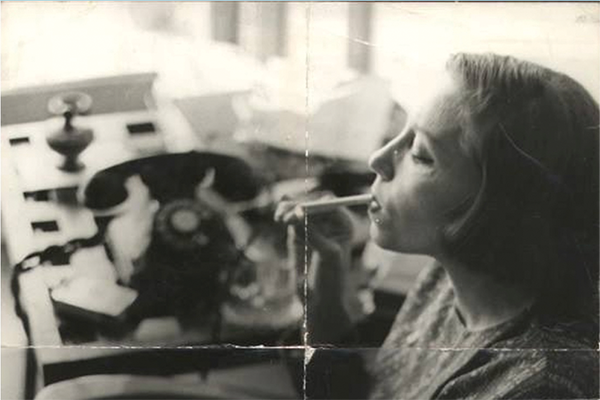
In summer I get the urge to read Clarice Lispector, the Ukrainian-born Brazilian writer who died in 1977. She called herself a “simple housewife,” though her mind and heart were bursting at the seams. This summer I read Água Viva, which to her meant “a thing that bubbles. At the source.” Água Viva is unlike anything I’ve ever read—it’s not really a novel, not really nonfiction, not really poetry. Maybe a “brainstorm” describes it best, a word which, though she wrote in Portuguese, she used in English.
At the very beginning of Água Viva, Lispector writes, “Hallelujah, I shout, hallelujah merging with the darkest human howl of the pain of separation but a shout of diabolic joy. Because no one can hold me back now ... now I want the plasma—I want to eat straight from the placenta.”
Her writing is like biting into the center of a cell, being birthed by words. It’s as if she’s trying to taste the literal flesh of Christ through words, “life raw and bloody and full of saliva,” unmediated by bread. “The world trembles inside my hands,” she wrote.
Last year, I went through the Ignatian Spiritual Exercises over the course of nine months. The Spiritual Exercises are a process of praying and discerning developed by 16th-century St. Ignatius of Loyola. This includes engaging in imaginative prayer, where you place yourself in a scene from scripture and accompany Jesus, letting the details and emotions come alive. A hope of this exercise is to know Jesus more intimately, love him more intensely, and follow him more closely.
Freedom—specifically interior or spiritual freedom—is a central aspect of the Exercises and Ignatian spirituality. Freedom as simplicity, as full dedication and attention to one’s life. Freedom from desiring success over failure, wealth over poverty, a long life over a short life, health over sickness—the freedom of humbly knowing one’s place in the world, knowing oneself as a beloved of God. Freedom is learning to recognize the voice that constantly says: Do not be afraid; I am with you always. And it can’t help but overflow, as Father Dean Brackley wrote: “Solidarity is the social meaning of humility.”
In Lispector’s work, freedom is a constant theme, idea, state, movement: “Freedom? it’s my final refuge, I forced myself to freedom and I bear it not like a talent but with a heroism: I’m heroically free. And I want the flow.”
Her writing is like biting into the center of a cell.
Through practicing the Exercises, freedom has become the bedrock of my life and how I want to live, with radical trust and a not-holding-back love. Lispector’s writing helps me put words to this freedom: “It’s as if the angel of life came to announce the world to me,” she wrote. Amen; my heart is porous and tender.
“I don’t want something already made but something still being tortuously made,” Lispector wrote. “I want to write to you like someone learning.”

Cassidy Klein is a journalist, writer, and editor based in Chicago. Find her work at cassidyrklein.weebly.com.
Did this article have an impact on you? Tell us how! Whether you’re moved to take action, have a question, or want to share a comment (good or bad), we value your feedback!