IN 1973, in the context of the Vietnam War, Episcopal theologian and lawyer William Stringfellow (a Sojourners contributing editor until his death in 1985) published his classic work An Ethic for Christians and Other Aliens in a Strange Land. He wrote: “A nation ... may pursue such a course which so demeans human life and so profits death that it must be said ... that that nation ... is in truth governed by the power of death. ... The biblical story of such a realm is the saga of Babylon [in Revelation]. The extraordinary instance in the present time of the same situation is the United States of America.”
Stringfellow’s analysis was profoundly biblical and remains the most trenchant theological analysis of American life, culture, and politics published in the last half century. As the United States marks 250 years since the signing of the Declaration of Independence, there’s value to engaging Stringfellow’s voice in our current national conversation.
In Ethic, Stringfellow began with the premise that “the biblical topic is politics”—the politics of the principalities and powers versus the politics of the kingdom of God—and argued that American Christians have largely “suppressed the Bible” by ignoring that truth. The all-too-common practice of transforming the Bible into a manual for personal piety and otherworldly salvation, he wrote, “is actually conformity to the world with a vengeance. And ... the most ignominious possible apostasy.”
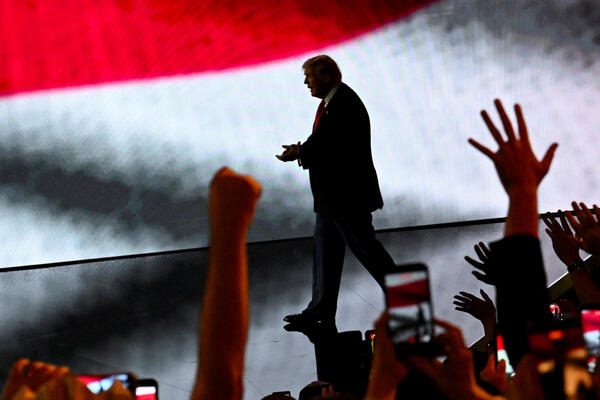
He especially lamented “the habitual malpractice of translating biblical politics as the American story” and decried attempts to co-opt God—the giver of life—to serve the powers of death. This pattern is seen today in President Trump’s 2026 Easter message: “From the Christian patriots who won and secured our liberty on the battlefield and every generation since, the love of Christ has unfailingly guided our Nation through calm waters and dark storms.”
Stringfellow rooted his biblical analysis both in the Fall—which, he claimed, defined the principalities and powers—and in the New Testament book of Revelation. Written against the backdrop of Roman domination and Rome’s demands for complete allegiance, Revelation consistently labels Rome as “Babylon the great,” a euphemism designed to protect its author, John, from certain execution.
John’s message is clear: “Do not fear what you are about to suffer. ... Be faithful until death, and I will give you the crown of life” (Revelation 2:10). Because God alone is Lord, do not bow the knee to Rome or the emperor, even at the risk of death. But Revelation went much further, predicting the utter destruction of Rome and the final triumph of God over all nations of earth. “Fallen, fallen is Babylon the great” (18:2), John wrote. Revelation then turns from this fallen imperial power to proclaim the eternal rule of God who alone is worthy of praise. “Hallelujah! For the Lord God the Almighty reigns. Let us rejoice and exult and give him the glory” (19:6).
For Stringfellow, “the Babylon epic bespeaks the moral character of every nation,” every principality, and every power, including the United States, because the principalities and powers—especially the empires of the world—claim to be sovereign over all. Their claim to sovereignty, ironically, aligns them with the power of death. “All virtues which nations elevate and idolize,” Stringfellow argued, “military prowess, material abundance, technological sophistication, imperial grandeur, high culture, [and] racial pride [among them] ... are ancillary and subservient to the moral presence of death in the nation.”
Accordingly, a Brown University report reveals appalling data. U.S. military operations since 9/11 have killed more than 940,000 people in Afghanistan, Syria, Yemen, Iraq, and Pakistan. Further, “as a result of [those] wars’ destruction of economics, healthcare systems, infrastructure and the environment, an estimated 3.6-3.8 million people died ... bringing the total death toll to at least 4.5-4.7 million and counting.” One must now add the deaths resulting from Trump’s war against Iran. No wonder Stringfellow wrote that “the moral pretenses of Imperial Rome, the millennial claims of Nazism, the arrogance of Marxist dogma, [and] the anxious insistence that America be ‘number one’ among nations are all versions of Babylon’s idolatry.”
In the middle of chaos, celebrate the word.
It follows that the biblical Babylon saga stands in judgment on every version of American exceptionalism, from the Puritans’ claim that they were God’s new Israel in the promised land to the current president’s claim in his 2026 State of the Union address that America will celebrate in its 250th anniversary “two-and-a-half centuries of ... the most incredible and exceptional nation ever to exist on the face of the Earth.”
The U.S. war against Vietnam, with its slaughter of human beings and its raft of lies issued by the U.S. government, was central to Stringfellow’s critique of the American nation. He saw in that war not only the power of death so central to the principalities but also a clear reflection of the Babylonian practice of deception. Stringfellow concluded that a chief strategy of the principalities, in addition to violence, was “distortion, falsehood, manipulation, exaggeration, [and] evasion,” traits that have been especially common during the Trump regime.
Still, Stringfellow argued that “whenever the war can be said to have ended, no essential change will have been wrought in the nation,” simply because the war was but a symptom of the power of death that stands at the heart of every principality and power. Nor was Stringfellow optimistic about America’s churches, which, he wrote, “have more often than not been among the most menial, manipulated, and degraded vassals of the power of death.”
Happily, however, Stringfellow believed there was “an emergent confessing movement in the United States,” found here and there among the churches and parachurch organizations, but especially in America’s jails and prisons where, he said, “communities of mutual help and social concern” had emerged. “Virtually monastic in character,” many prison communities that he observed “were deeply rooted in and informed by Bible study.”
And what is the charge to those who desire to be authentic keepers of God’s Word? Stringfellow wrote: “In the face of death, live humanly. In the middle of chaos, celebrate the Word. Amidst babel, I repeat, speak the truth. ... Know the Word, teach the Word, nurture the Word, preach the Word, defend the Word, incarnate the Word, do the Word, live the Word. And more than that, in the Word of God, expose death and all death’s works and wiles, rebuke lies, cast out demons, exorcise, cleanse the possessed, raise those who are dead in mind and conscience.”
“Is there any American hope?” Stringfellow asked. “The categorical answer is no,” he answered. “This no is the no of resistance to the power of death ... from this no issues the only hope worthy of human beings, because no to death, incarnate in the nation or in any other appearance, means yes to the gift of life.”
Did this article have an impact on you? Tell us how! Whether you’re moved to take action, have a question, or want to share a comment (good or bad), we value your feedback!