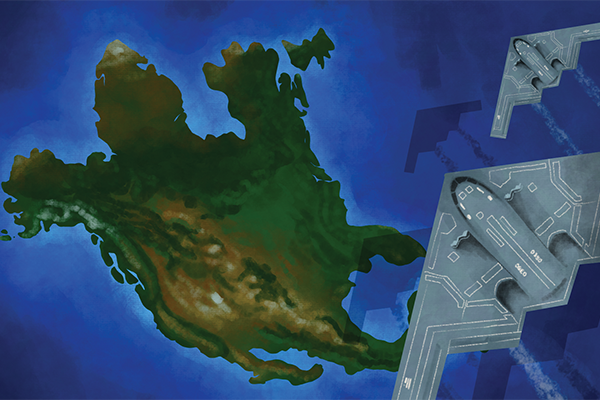
AS A CHICKASAW child, I grew up in the shadow of Tinker Air Force Base in Oklahoma. I fell asleep to the drone of airplane engines and awoke to the sight of bombers, fighter jets, and AWACS (airborne warning and control system) planes in the sky above. I am well acquainted with how militarism permeates every aspect of the daily life of Americans. I recognize the stories used to promote this nation’s heroic “exceptionalism” on the world stage.
This summer, as the United States marks 250 years of independence from British colonial oppression, our screens will fill with U.S. flags, fireworks, and military service members in full dress uniform. These images of patriotism, opportunities to consume rituals of collective belonging, and narratives of freedom and justice are presented as the aspirations of a Christian God and Christian country. Each soldier’s self-sacrifice for the nation is framed as Christ-like and their blood as poured out for our democratic salvation.
This kind of formative narrative of nationhood, a “melting pot,” and deified imperialism is also used to erase non-white bodies and their stories to produce a single fictive history within the same society. For example, the public school system in which I grew up continues to normalize an annual reenactment of the historic Oklahoma Land Run, in which nearly 2 million acres of land located in Indian Territory was sold cheaply to mostly whites for settlement. The portrayal includes children acting as settlers, driving claim stakes into the red earth of the playground. The devastating impact on Native communities, also part of the American story, is not reenacted.
The Fourth of July is not just a single day in the consciousness of the American people; it is enshrined in our experiences and our self-identification.
As a Chickasaw woman, I am doubly aware that my embodied self and personal experience are in contradiction with my experience in U.S. cultural histories and to my access to citizenship and social belonging. After two-and-a-half centuries of continued colonial violence, the Trump administration’s challenge to birthright citizenship, even for the peoples indigenous to North America, further erodes the precariousness of American Indian presence in our lands.
And yet, even though Native peoples have been an ongoing target of domestic military actions—ranging from the attacks of the U.S. Army cavalry on Native communities and forced removal to reservations to recent abductions and detentions by ICE—we continue to serve in the U.S. military. In fact, Native peoples have fought for the U.S. in military service since the founding of the country. As of 2019, Native Americans made up only 1.4% of the U.S. population, yet 1.7% of the U.S. military; we serve at 5 times the national average. Additionally, nearly 20% of Native service members were women, while 15.6% of all other service members were women, according to the National Indian Council on Aging.
This land is more than just a 250-year-old nation. The land is our mother and sustainer—and that relationship goes back to the very foundations of this earth.
Despite the violence of a history of invisibility and eradication, many Native peoples are still driven by complex desires to protect and serve the people of their communities and/or see the military as the only option out of conditions of poverty. Thus, the Fourth of July prompts both scenes of celebration and lament across Turtle Island and in Indigenous communities—dual reckoning with the moral injury of combat and the honor paid to veterans. I cannot speak for all, and I offer these thoughts respectfully, especially toward those who have served in the military.
One principle we can agree on is that this land of Turtle Island is more than just a 250-year-old nation. The land itself is who the Indigenous are—and that relationship goes back to the very foundations of this earth. The land is our mother and sustainer. It holds the remains of our human, animal, and elemental ancestors. The living relationships that Native peoples experience with Turtle Island are ancient, enduring, and diverse. The ways in which the U.S. paints the picture of who is “American” diminishes the contributions of Native peoples. To ignore our living presence here is to lie.
Despite the conflation of self-sacrifice for the nation with Jesus on the cross, Christ did not die for our political salvation. Christ died because of imperial Rome’s insatiable desire for land, resources, and bloody conquest. Christ’s actions as savior—none of which involved killing, forced assimilation, or cruelty—are most evident in his living acts of mercy. Those acts not only recognize the inherent worth of widows, orphans, foreigners, and society’s outcasts but assure their thriving. This is what U.S. citizens who claim a Christian legacy are called to replicate. For traditional Native peoples, this means living into our responsibilities of relationality and reciprocity that tie all lives together.
I will not celebrate this July 4 with sparklers and flags. Instead, I will hold my family and friends close, and we will tell stories of our lives together on this land that creates thriving and freedom far beyond patriotism and parades.

Lisa A. Dellinger (Chickasaw Nation) is the George E. Tinker visiting professor at Iliff School of Theology in Denver.

Did this article have an impact on you? Tell us how! Whether you’re moved to take action, have a question, or want to share a comment (good or bad), we value your feedback!