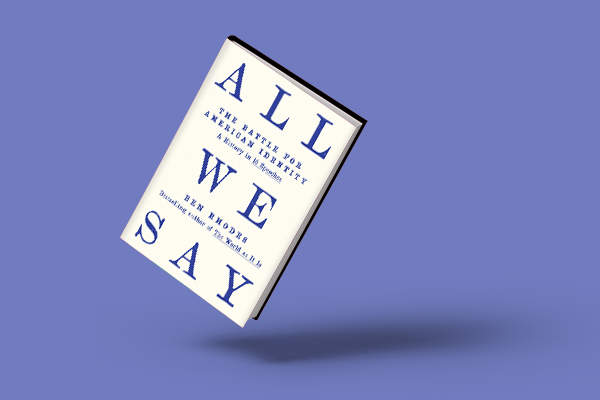
In All We Say, Ben Rhodes, a former speechwriter for President Barack Obama, examines 15 speeches that have defined and shaped the history of the United States. If you were to read the final two speeches back-to-back, Obama’s “race speech” and President Donald Trump’s second inaugural address, you’d likely experience an emotional whiplash. The first is delivered by an acclaimed modern orator, the second by someone who tends toward bombast and offensive tangents. The 2008 speech asks its listeners to remember the country’s historical sins so that it can truly become “a multiracial democracy.” The 2025 speech declares the U.S. to be “history’s greatest civilization,” even as it laments an education system that teaches children to “hate our country.”
Read in isolation, the differences between the speeches feels jarring. But placed within Rhodes’ broader narrative, spanning 250 years, the shift makes perfect, tragic sense.
The speeches in All We Say are delivered by both the iconic (Abraham Lincoln, Frederick Douglass) and the overlooked (Maria Stewart, Anna Dickinson). But more than just a discerning curator, Rhodes proves to be a sharp storyteller. What might have been a disjointed scrapbook of distinctive American voices instead unfolds as a cast of connected characters in an ongoing American story.
And that story is a highly contested one.
It’s strange reading a “book about consequential speeches at a time when they are a rarity.”
“There has always been a tug-of-war about American exceptionalism. On one side are those who see it as tied to some inherent, even divine, favor, manifested in the riches of the continent and the rightness of our founding documents,” Rhodes writes. To varying degrees, Rhodes includes Alexander Stephens, Ronald Reagan, and Trump in this category. “On the other, [there are] those who see American exceptionalism rooted in a bottom-up, disruptive, and at times revolutionary effort to forge a just and equal society on Earth; an effort that depends upon self-criticism and the revision of those founding documents.” In this camp, Rhodes slots Benjamin Franklin, Lincoln, Douglass, and Obama.
The two camps may disagree about what makes the United States exceptional, but nearly all speakers believe that it is supremely special. Red Jacket, a Seneca chief, is the standout exception of the book. In 1805, an evangelist, introduced by a representative of the U.S. government, approached the leadership of the Haudenosaunee confederacy with the goal of their Christian conversion. Red Jacket responded with an indictment of U.S. conquest and Christianity. “You have got our country, but are not satisfied; you want to force your religion upon us,” he said, deeming the U.S. “the great eater.” The only exceptional thing he noted about the U.S. was its appetite.
Red Jacket didn’t transform the heart of the evangelist that day, but it means something that his speech lives on. Today, thanks to “a combination of unbridled capitalism and unregulated technology diminish[ing] our attention spans,” we live in a time of “cruder communication,” Rhodes writes in his epilogue. Indeed, it’s strange reading a “book about consequential speeches at a time when they are a rarity.” I thought of this last Sunday as I turned off my phone before listening to my pastor’s weekly sermon. This sort of undivided attention is scarce in today’s divided United States. That’s the quiet wisdom embedded in All We Say: The future of the country depends less on who speaks than on whether enough people are still willing to listen long enough to discern which story they’re being asked to believe.

Jenna Barnett is the culture editor at Sojourners and the producer of the award-winning podcast Lead Us Not.
Did this article have an impact on you? Tell us how! Whether you’re moved to take action, have a question, or want to share a comment (good or bad), we value your feedback!