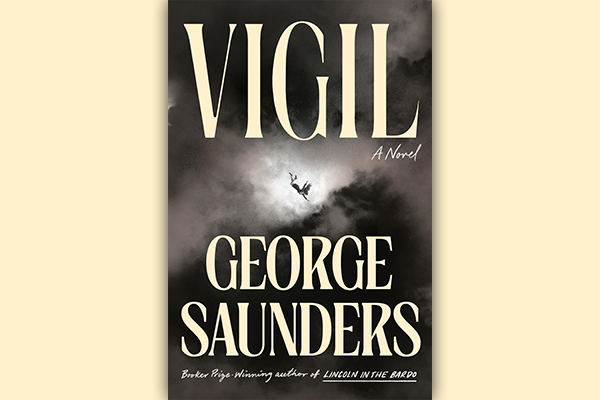
LITERATURE IS PEPPERED with powerful men who, after lives of dangerous consequence on Earth, grapple with the eternal judgment of heaven. Dante filled his inferno with the writhing wrongdoers of his day. Dickens gave us Ebenezer Scrooge, whose festive ghosts spooked him into more socialistic thinking. And who can forget the time when President Donald Trump himself publicly mused that he might not make it to heaven, after all? Literature and, every once in a rare while, life.
In his crackling new novel, Vigil, George Saunders offers another such fable for the climate crisis. Unrepentant on his death bed, oil tycoon K.J. Boone receives visitors from the past, present, and future who hope to hold him to account for his sins. Species of birds wiped out by habitat loss fly over his hospice setup; human casualties of heat waves and droughts testify. Bearing witness to the barrage is Jill, a ghost-angel charged with comforting Boone as he crosses over.
The story isn’t strictly a repackaged, greenwashed A Christmas Carol, though it contains that novella’s tonal dexterity, agilely moving between whimsical turns of phrase and earnest social commentary. Like the holiday classic, Vigil is plenty concerned with the soul of a powerful man, but its true center of gravity is Jill, a charming young woman who, compared to her charge, lived a relatively insignificant mortal life. She died at age 22 in the 1970s and now enjoys an “elevated” state of being, unbound by physical constraints as she comforts the almost-dead. But as she watches Boone fend off his critics and victims, she can’t help but ache for the world she left too soon. Upon arrival at Boone’s Dallas mansion, she quickly becomes distracted by the wedding reception taking place next door. “It was all so dear,” she thinks, mesmerized by the details, such as the gaggle of kids “spilling like a candy-colored waterfall down a stairway inside.”
For his part, Boone is confronted with visions of a planet altered by both his business and, in true Koch brothers form, the powerful public relations campaign he bankrolled to protect it: He watches as a Pennsylvania family hauls in their Christmas tree in 80-degree heat. A lawyer from the Indian state of Rajasthan finds his region flooded with “brackish former rivers in which bodies were routinely fed upon by vultures.” Meanwhile, those climate-denying scientists he funded thank him for helping them create “a more inclusive national debate on several vital issues.”
As in any morality play, some characters come across as walking talking points more than flesh-and-blood beings. At times this takes one out of the novel’s rich narrative world. But Saunders more than makes up for these moments with his painfully elegant braiding of Boone and Jill’s moral arcs.
At one point, Jill flies over a patch of dying Texas forest. “Underground, the strands of the root system ran black; the canopy above was perilously thin; the leaves of the ashes and dogwoods seemed brittle, as if they might shatter at the slightest touch.” It was true, she thought, what Boone’s enemies had said. “This lovely old place, ruined forever, maybe.” The novel is retrospective; nobody’s saving the world from the afterlife. But the power its exploration of ecological morality holds for terrestrial readers lies in its challenge for them: that fragile, tacked-on “maybe.”

Did this article have an impact on you? Tell us how! Whether you’re moved to take action, have a question, or want to share a comment (good or bad), we value your feedback!