OF COURSE IT all started right around 2016.
That year, the Christian Reformed Church in North America’s synod—an annual meeting of representatives from across regional subdivisions of the denomination in the U.S. and Canada—commissioned a document known as the Human Sexuality Report with the stated goal to “articulate a foundation-laying biblical theology of sexuality” over the course of the next five years. One hot-button issue was same-sex relationships. Up until this point, the CRC had been operating under the guidance established at the synod of 1973, which was that while same-sex attraction shouldn’t be considered sinful, acting on that attraction was.
But as laws changed—in 2005 the Civil Marriage Act made same-sex marriage legal throughout Canada, and in 2015 the U.S. Supreme Court’s decision in Obergefell v. Hodges made same-sex marriage legal throughout the United States—the CRC began to revisit its theology. Broadly, the denomination began to take a more hardline, conservative stance.
“I don’t think it’s a coincidence that in our denomination, this particular issue started to sway a certain direction in 2016,” Mike Abma, co-pastor at Woodlawn CRC in Grand Rapids, Mich., told me. “It’s part of a whole context within the broader evangelical church world that is troubling to me, and, I think, troubling to a lot of Christians.”
As the CRC hardened its theology, Neland Avenue CRC, also in Grand Rapids, was reevaluating its own position. By 2016, some members of the Neland church council were asking why LGBTQ+ church members couldn’t serve in official church roles. A few years earlier, a longtime deacon in the congregation came out as being in a same-sex relationship. Despite having been renominated several times, she received “silent censure” from the church council and eventually left the congregation. “It just didn’t feel like Neland was going to get over this hump of full inclusion,” Joel DeMoor, one of Neland’s pastors, said.
But by 2020, another woman in a same-sex marriage at Neland became a deacon candidate. This time, she was installed to the position. While the congregation still holds a mix of traditionalist and affirming positions and has not taken an official stance affirming LGBTQ+ marriage, “We definitely are here for the full participation of every member in our church, and that includes same-sex married members absolutely,” DeMoor said.
Today, Neland—and other churches like it—are no longer part of the CRC denomination. As is true in the U.S. as a whole, so in the CRC: A lot has changed in the past decade.
The CRC is far from the only denomination to undergo a messy split in recent years.
How did we get here?
THE CRC CALLS itself a “binational denomination” between the U.S. and Canada. The denomination’s U.S. headquarters is in Grand Rapids. It was founded in 1857 by Dutch immigrants to the United States, when a handful of churches in western Michigan split from what would become today’s Reformed Church in America. The CRC has maintained a strong presence in several “Dutch pockets” throughout the country, where those immigrants, including my family, settled. Of the denomination’s 37 geographic subdivisions based solely within the U.S., called classes, 5 are within the Grand Rapids metropolitan area and 12 are entirely or partially in Michigan.
The CRC is also a confessional denomination, meaning that it requires all office-bearers within the church—ministers, elders, and deacons—to subscribe to the expressions of faith found in three historic Reformed confessions: the Heidelberg Catechism, the Belgic Confession, and the Canons of Dort.
Following the completion of the Human Sexuality Report, the synod determined in 2022 that the Heidelberg Catechism Q&A 108’s prohibition on “unchastity” encompassed “adultery, premarital sex, extra-marital sex, polyamory, pornography and homosexual sex, all of which violate the Seventh Commandment.” The synod declined to single out Q&A 108 in particular as a “salvation issue” and rejected a request that the CRC declare heretical the teaching that “homosexual marriage” can have scriptural sanction. But subsequent synods in 2023 and 2024 did affirm as “confessional” the 2022 decision on the scope of “unchastity.” This reduced the cases in which people who held office in the church could take exception to specific points of church doctrine. The synod also created a harsher discipline process for ministers and congregations found to be in noncompliance.
Many more progressive churches, including Neland, tried to find a way to stay within the denomination. Nate DeJong-McCarron, a pastor at Fuller Avenue Church in Grand Rapids, and others launched the organization Better Together to convene those worried about the future of the CRC. Initially, the organization was dedicated to voicing concern over the “strict confessionalism” he and others saw taking shape in the CRC.
DeJong-McCarron emphasized that many CRC pastors and churches questioned the denomination’s approach even if they weren’t fully affirming of LGBTQ+ inclusion. Initially, he hoped that the presence of these voices might lead the denomination to reevaluate its decisions, but their efforts were largely unsuccessful. Although Better Together succeeded in raising awareness about what the denomination’s new direction might mean, the synod did not overturn its decision. In 2024, the CRC made it harder for pastors to file gravamen, a traditional way of registering dissent with specific points of church doctrine.
“When it became evident that the synod and denomination were unwilling to allow such congregations with that kind of mixed leadership or diverse leadership or even submissive leadership to remain, Better Together really stepped out beyond the institutional Christian Reformed Church,” DeJong-McCarron said.
The broader evangelical context
THE CRC IS far from the only denomination to undergo a messy split in recent years. Diana Butler Bass, a historian of American Christianity, told Sojourners that the cascade of separations from the CRC is the latest example of a pattern in the history of American Protestantism that reemerged in the 1970s and 1980s.
Beginning in 1979, a group of conservatives initiated a series of reforms to the Southern Baptist Convention, which, at the time, was the largest non-Catholic Christian denomination in the U.S. Butler Bass and others call this the “fundamentalist takeover” of the SBC. Since then, conservatives have been reasserting control over the political direction of a broad stream of Christianity in the U.S. “An interesting cluster of things seem to have sparked this reverse direction, tied up with the roles of women, our relationship to creation, how people express their sexuality and what that has to do with our human wholeness, and with race. All those came to a head in the latter part of the 20th century,” Butler Bass said.
In 1990 and 1991, hundreds of moderate churches that opposed the SBC’s conservative direction organized in Atlanta to form the Cooperative Baptist Fellowship. Initially, the CBF was a “mission agency,” but by 2003, it became an independent member of the Baptist World Alliance. Brian Foreman, the CBF’s coordinator of congregational ministries, explained that despite charting a separate path from the SBC on several theological issues, such as women’s ordination—which the CBF affirms—the CBF has worked hard to lean heavily into the tradition of being a “perfectly imperfect” place where Christians “can dissent and stay in fellowship with one another.”
But in most denominational splits, the CRC and SBC notwithstanding, it’s been theological conservatives who form their own denominations. Butler Bass pointed to the controversies around biblical interpretation in the 1920s, such as the 1925 Scopes trial about the teaching of evolution, as a precursor to more contemporary conservative movements. “The denominations were becoming more liberal, and the people who had to leave to find separate institutions or new homes were the conservatives,” she said. In the 1970s, the Presbyterian Church of America was formed by the exit of conservative members of the United Presbyterian Church in the United States of America. In the 2000s, the Anglican Church in North America was formed by the exit of theological conservatives from the Episcopal Church in the United States and the Anglican Church of Canada. And in 2022, the Global Methodist Church was created by conservative congregations leaving the United Methodist Church.
In the CRC, it was the other way around: The churches with more progressive theology now had to grapple with where they belonged.
Rethinking identity
I GREW UP in the CRC. My dad is an ordained CRC minister, although not currently pastoring a church. In my childhood, I spent time in Cadets, the CRC’s version of a youth scouting program. Historically, the CRC has cared deeply about Christian education; for college, I went to the denomination’s flagship school, Calvin University. The sharpest points in the denomination’s conflict over LGBTQ+ Christians happened while I was at Calvin; it was painful to watch an institution where I had such personal ties go through a divisive season.
“That CRC identity piece is a big deal for people,” Bryant DeKruyter, co-pastor at Woodlawn CRC, told me. “Even if they are fully affirming, progressive, [and] angry at all this stuff, [they] still struggle with the idea of leaving that denomination. It’s hard to capture that, and yet it’s a dynamic I see a lot, especially in our congregation.”
Although Woodlawn has not taken a public affirming stance, the church has begun the process of disaffiliation from the CRC, due to disagreements with the synod’s “confessional” interpretation of the denomination’s stances on human sexuality.
Other churches chose a different path in the more immediate aftermath of the 2024 synod.
Elizabeth Koning attended the synod meeting as part of the delegation from Classis Chicago South, while serving as a deacon at Hessel Park Church (then Hessel Park CRC). The church had already decided to keep its statement affirming LGBTQ+ participation publicly available. “We had made our policy knowing what it would likely mean, but I think there were still different amounts of optimism and pessimism until that actually was the act of synod,” Koning said. “For some people, it was very emotionally difficult because we have some people that grew up in the CRC, have been in the CRC for 60 years or 80 years. Then we have some people that have been at Hessel Park Church for years or decades but weren’t at a CRC church before that. There’s a variety of strength of ties to the CRC.”
I spoke with Koning as Hessel Park was going through the final stages of the formal process to disaffiliate from the denomination. The congregation held two votes, both of which church leadership decided should be consensus rather than a majority before proceeding.
The work of disaffiliating was bittersweet. The consensus process meant many hours of discussion and listening between members of the church. “We experienced a lot of local unity,” Koning said. “But the divisions with the CRC as a whole have been really painful and exhausting. Not having to do this process will open up our energy to do more to help our community.”
Also in the aftermath of the 2024 synod, DeJong-McCarron and Better Together began exploring options for how to work beyond the CRC. The group hosted a “Convening of Concerned Congregations,” with the expectation to hear from leaders from 30 or 40 congregations. Instead, DeJong-McCarron said more than 300 leaders from 118 churches showed up.
Since then, Better Together has shifted toward providing resources for pastors and training for congregations going through conflict with a broader focus than the CRC. Currently, Better Together has supported more than 150 churches across the country. Often, that support looks like tools to process grief. Fuller Avenue wrote their own psalms of lament, mirroring those found in the Bible, to chronicle the pain. It’s a practice Better Together now encourages for other congregations.
DeJong-McCarron said Better Together and his congregation at Fuller try to model theologian Paul Hiebert’s idea of a “centered-set” rather than a “bounded-set” church. For example, he said, picture an expanse of land with a lot of cows. “One way to keep the cows together on your land is to build a really good fence,” DeJong-McCarron said. “Then you know, ‘my cows are the ones inside the fence, and if there are cows outside the fence, they’re not mine, and the identity of the cow is determined by their relationship to the fence.’ A center-set approach is that there’s another way to keep cattle close, and that’s to drill a really good well.” He wants his church—and the whole Church—to stay centered around the “well” of the life and teachings of Jesus.
Still Reformed, still a church
RYAN SCHREIBER, A pastor at Grace Church in Grands Rapids, was also a delegate to the 2024 synod. Grace Church, like a handful of others in the denomination that had made public welcoming statements for LGBTQ+ Christians, was placed under “limited suspension” by the denomination.
In the aftermath of its disaffiliation process, which Grace Church completed in May 2025, Schreiber explained the sense of loss experienced by the congregation and by himself personally. “I’m 42, and my whole orientation in life seemed to depend on being Christian Reformed,” Schreiber said. “I moved around a lot growing up, from Wisconsin to Arizona to California, and each cross-country move was very disorienting for me as a child, but my parents always knew they could find a community at the local Christian Reformed Church and Christian day school. So the CRC, more than any geographic location, was my home growing up. And now for me as an adult, I have faced real grief and disintegration. I’m trying to find a new way forward.”
“We are Reformed, even though people who identified as ‘hardcore’ Reformed in the denomination hurt us.”
Grace, formerly Buckley Chapel, founded in 1949, was one of the most engaged congregations in CRC life; many former church administrators and missionaries are in its pews. “All of these people, many of these retirees, had given their lives to the denomination,” Schreiber told me. After feeling forced out, Schreiber said many members of the church felt unmoored. “So many people in our congregation are still processing: what does it mean to be Reformed? Do we actually have these theological convictions?”
Like most of the other churches whose pastors I spoke with, the congregation, which now calls itself simply Grace Church, hasn’t decided whether or not to join a different denomination yet. “We can still retain our theological convictions. We are Reformed, even though people who identified as ‘hardcore’ Reformed in the denomination hurt us.” Schreiber said.
Neland Avenue Church formally submitted its resolution to disaffiliate from the CRC in 2024; like Grace Church, it officially disaffiliated in May 2025. For a church full of people with deep ties to the denomination, doing so was a hard choice despite years of wrestling. “I’d say that the word there has been ‘grielief,’” DeMoor said. “Grief and relief—that’s how we’re feeling.”
The past several years have been “a difficult journey” for Neland, according to DeMoor. “We felt very much like ‘the church made an example of’ in the CRC, and I think pretty much 100% of churches would agree. You’ll see nobody in the minutes [of recent synods] more often than Neland.” But Neland’s past several years have also included remembrance and renewal: “We’ve talked about our Reformed roots and our Reformed confessions and reaffirmed all beliefs in those, at least in the interpretations that we all held together before new ones were made,” DeMoor said. “And in the midst of telling stories with one another we’ve also found a great sense of hope and healing.”
As Neland has shifted toward full inclusion, DeMoor says their main focus has been “making decisions together with our LGBTQ+ members, not just talking about them anymore.” He continued, “They are leading us as we consider all kinds of questions of affiliation and inclusion.”
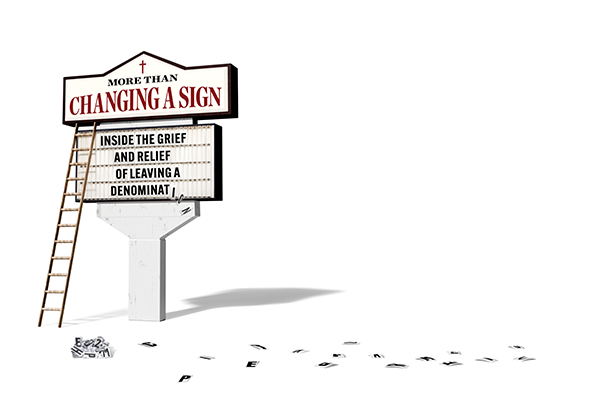
The church is still figuring out its next steps, and there have been some unexpected moments in the process. “You have to even change the church sign, right?” DeMoor explained. “And that could be a painful deal if you’ve had Christian Reformed Church on your outward-facing sign for a hundred years.” As a temporary solution, the church custodian added periods between the words on the sign. “So, that made it all correct again,” said DeMoor. “Although we’re no longer affiliated with the Christian Reformed Church in North America, we continue to be Christian, Reformed, and a church.”
Correction: This article was updated on May 11. An earlier version of this article incorrectly stated that a former deacon at Neland Avenue was asked to step down from her role; instead, her call to serve another term on the church council was withdrawn. This article was also updated on June 3 to clarify that the CRC’s report on human sexuality was not approved until the CRC’s synod meeting in 2022.


Did this article have an impact on you? Tell us how! Whether you’re moved to take action, have a question, or want to share a comment (good or bad), we value your feedback!