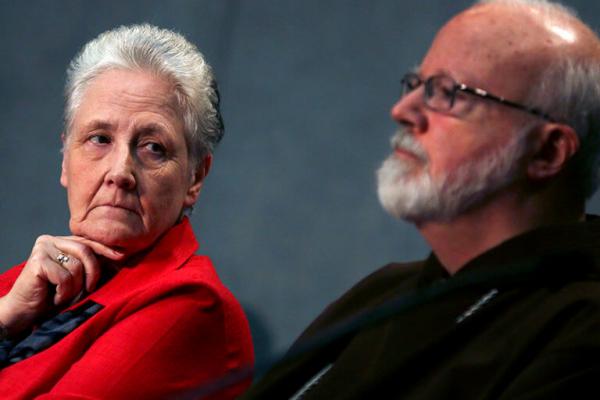
In a major setback for the pope, Collins on Mar. 1 announced that she had resigned from the Pontifical Commission for the Protection of Minors, established by the pontiff in 2013 to counter abuse in the church.
She said the pope’s decision to create the commission was a “sincere move,” but there had been “constant setbacks” from officials within the Vatican.
“There are people in the Vatican who do not want to change, or understand the need to change,” Collins said in a telephone interview from Dublin.

A day after his first speech to Congress, President Trump was still basking in unexpected praise from the public and some pundits, who saw in his delivery a man who finally came across as measured in tone and downright “presidential,” as some put it, even if his few policy prescriptions reiterated the hard line, nationalist agenda that propelled him to office.
But there is one key constituency that might not be as enamored with the address: social conservatives, whose support was arguably most critical to Trump’s election.
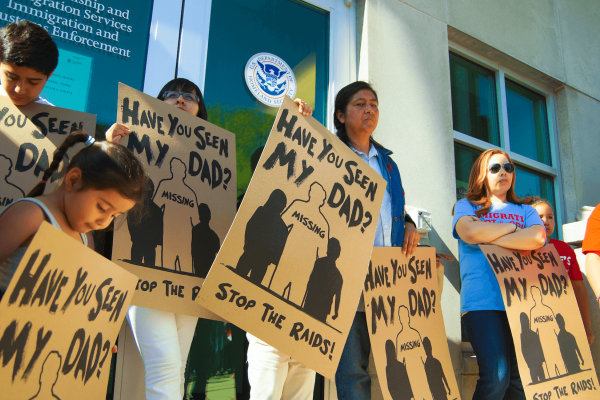
The growing momentum behind the Matthew 25 Pledge has reminded me of my old friend and mentor, Mary Glover, who helped me understand the deepest meaning of that Gospel text. She was not a theologian or formal biblical commentator, but she showed and taught me the meaning of this Scripture more than four decades ago. Matthew 25 brought me to Christ out of the student movements of my time and led me to help begin Sojourners. We moved into one of the poorest parts of Washington, D.C., in the neighborhood where Mrs. Glover lived.

In Indian American communities, we usually believe that being a certain kind of immigrant can save us. If we dress properly, no one can call us foreign. If we’re documented, no one can question our legal status. If we are highly educated, no one can accuse us of being lazy immigrants. If we (especially women) don’t go to bars, no one can accuse us of bad behavior.
We’ve convinced ourselves that if we melt into what we call American culture — into white culture — we can get by without getting killed.
The two men targeted by a racist and violent white terrorist were the quintessential “good immigrants.” But their stories of success — working at Garmin, receiving Masters degrees from the U.S. — did not protect them from hate. Economic status or education do not matter in the face of an extremist who equates skin color with terrorism.

We are steeped in a culture that celebrates endless work and the denial of one’s own health. Christian faith leadership demands a counter-witness. Ministry life should reflect a theology of service and commitment both to God and other people, but it should also embody healthy balance and spiritual sustainability for the long work of learning faith and reflecting God’s grace to a world hungry for it.

The neighborhood has long been home to numerous historic and not-so-historic houses of worship of nearly every size and type. Here you can find congregations of Muslims, Hebrew Israelites, AMEs, Baptists, Presbyterians, Pentecostals, and everything else in between.
So who cares if a few churches have to be razed to make Harlem “great again,” right?
I do.

According to several sources, the number 40 is used almost 150 times in the Old and New Testaments. Some examples: Jesus was tempted in the wilderness for 40 days and 40 nights. There were 40 years of wilderness-wandering for the Jewish people fleeing bondage in Egypt. Noah and his family were in the ark for 40 days and 40 nights of the flood. There were 40 days and 40 nights of fasting while Moses was on Mount Sinai. Jonah was given 40 days to convert the people of Nineveh. Saul, David, and Solomon reigned 40 years each.

President Trump, long-chided for failing to address a surge in hate crimes, began his first address to Congress by invoking Black History Month, and condemning recent threats against Jewish institutions and the shooting of Indian men in Kansas City.

To adults new to Christian practices of fasting during Lent, the idea can seem facetious — some sort of trendy way of worshipping both Jesus and our own well-defined abs. But for many, fasting has been a way of cleansing not the body but the mind. Temporary self-denial can invite us to compassion for those who are hungry not by choice, to a remembrance of the trials of Jesus, or to better appreciation of food when we do eat. But in the face of a world that already pressures many into self-denial, self-deprivation, and self-harm, the strength of the spiritual discipline of fasting cracks.
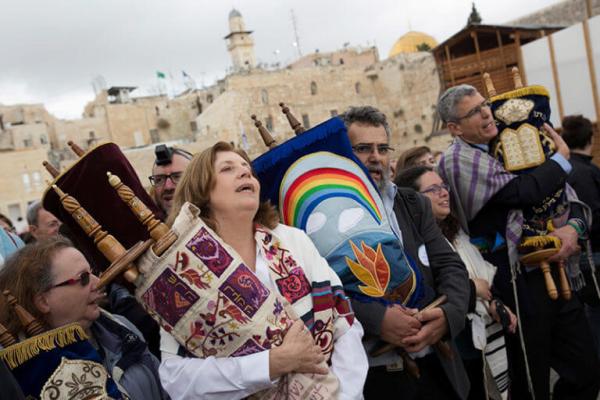
An Orthodox Jewish organization opposed to female-led prayers at the Western Wall bused in between 1,000 and 2,000 Orthodox high school girls to prevent a feminist group from praying.
Liba, an organization whose goal is to prevent pluralistic prayer at the holy site, instructed the girls to fill up the women’s section so the feminist group, Women of the Wall, could not enter to perform their monthly prayer on Feb. 27.