From its title alone, Michael Sarnoski’s The Death of Robin Hood telegraphs its ending early on, but as with most of the director’s films, the joy in watching comes from the journey of bearing witness to the unexpected ways his characters arrive at their endings.
From the start, it’s evident that this adaptation will embrace its proceedings with a bit more gravitas than, say, the 1973 animated film Robin Hood. It’s been a while since I’ve seen it, but to my recollection, the fox version of the character did not shank a child assassin multiple times in the abdomen at the start of the film. Readers with a greater attention to detail, please correct me if I’m mistaken.
Yet this is exactly how Sarnoski’s film opens, with a grizzled Hugh Jackman playing the “hero,” reimagined here as a cruel outlaw who killed for game, sport, and pleasure. While staying with his comrade, Little John (Bill Skarsgård), he’s critically injured and finds himself sent to the Priory of St. Clement, where he’s cared for by the prioress, Sister Brigid (Jodie Comer). There, he attempts to build a new life under a new name, Randolph, but wrestles with whether he is worthy of a fresh start.
I’ll confess that I was surprised when I first read that Sarnoski was deconstructing the legend of Robin Hood. When the rich are only getting richer, and the powerful continue to reshape our political system to match the version of reality they see fit, it seems in poor form to portray a character famous for redistributing wealth to the poor as a villain.
But what won me over was the way The Death of Robin Hood, now available for video on demand, challenged me to interrogate the images of icons I hold dear. There’s a version of Robin Hood I have in my head, and Sarnoski’s film is a gentle inquiry into what happens when we seek the comfort of myth over the discomfort of reality. We ought to find the humanity in our heroes as much as in our villains, and it’s worth exploring why we so easily bristle when depictions of certain characters don’t match the ideas we may hold about them.
It makes sense that someone like Sarnoski would interrogate a Robin Hood in these thematic waters. Across three films now, Sarnoski’s characters have faced a choice: perpetuate the cycles of violence they’ve inherited or choose the way of grace. Whether it’s Nicolas Cage’s chef losing his prized truffle-hunting pig in Pig or Lupita Nyong’o’s Sam grappling with a cancer diagnosis in A Quiet Place: Day One, Sarnoski loves exploring how tribulations can lead to introspection.
By subjecting them to storms, Sarnoski reveals the strengths and fault lines of their anchors. Lesser films might try to coast on delivering spectacle—or, at least, delivering the kind of bleak violence that usually accompanies revenge films like this. But Sarnoski turns this revenge thriller into something more meditative, about what it means to die well, and accept absolution even if we don’t think we’re worthy of it.
“When you try to create these heroes and these villains, that’s not going to get us anywhere,” Sarnoski told me. “All that does is allow people to utilize those stories to manipulate us, and what we have to do is sort of search inward and through empathy,care, and understanding that the people around us and we are both flawed and beautiful.”
I interviewed Sarnoski about the influence of Abbess Hildegard of Bingen on Comer’s prioress character, the film’s different presentations of prayer, and how the movie made him reflect on humanity’s tendency to deify goodness, often at our peril.
This interview has been edited for length and clarity.
Zachary Lee, Sojourners: To start, I’d love to speak about this idea of adaptation as a form of stewardship. There’s probably so much folklore to draw from with this character; I’m curious as to what went into building out this iteration?
I definitely felt a big responsibility when crafting Robin. This is a movie about the power of storytelling and how it can be used in positive and negative ways. I think the way I tend to approach it is to steep myself in research, read old ballads, and read a lot of historical stuff. What comes next is a bit hard to explain. I think that we all have a version of all of these sorts of characters that live inside of us, and it’s an accumulation of the stories that we were told, ones that hit us at certain moments in our lives. We all have Robin Hood in our heads, but no one has the same Robin Hood in their head.
So I think it’s about really looking inward and being like, “What is the version that lives inside of me? And what is the thing that feels so intimately personal to me about that version?”
For me, that ballad on Robin Hood’s death was a story that had deep personal importance to me and was one of those stories that hit me at a very important time in my life. I did a lot of inward thinking and considering what is uniquely my version of Robin Hood that I’ve lived with. That’s also how storytelling for me works in general. I like to let it be very organic. I like to find a spark that seems interesting and then just let my soul lead me a little bit.
That’s interesting to hear and, in a way, answers my next question. I remember when the film was first announced; in short, people were critiquing this adaptation because they were wondering why, in this day and age, someone would make the person who steals from the rich and gives to the poor the “bad guy.”
I get that instinct, and I think that’s a little reductive, and it’s also not what this movie’s about. When I heard those critiques, it sounded like those critics were not engaging with this film on its own terms but with their own idea of Robin Hood they have.
To be clear, I think wealth disparity is a huge concern; I don’t think trillionaires should exist, but that’s not what this movie’s getting at. This movie’s getting at “let’s explore the humans behind these things.” I think in some ways that’s what we’ve realized in recent times: we are intimately familiar with that human being who has become a trillionaire, and understanding the positives and negatives of that person and how they interact with the world is probably going to do us more help than just platitudes about all sorts of things.
There are many great lines in the film, but the one that encapsulates it is uttered by Murray Bartlett’s leper character: “We seem to have found another life.” I’d love to hear about where this line came from and how it connects to this idea that grace lets us live multiple lives.
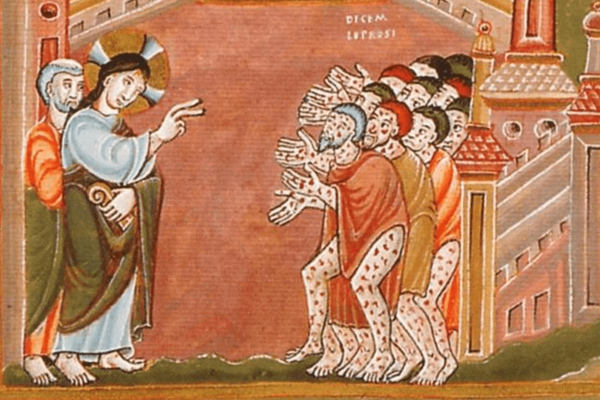
Yeah, that line came from the leper character, who was very much a gradual discovery regarding what he stood for. He’s a mysterious character; at first, he’s almost like a ghoul. Ultimately, though, the leper acts as this sort of foil to Robin. He’s the one who helps shepherd him into this world of healing and grace. The leper is the one who manages the orchard cemetery at the priory. It’s a subtle thing, but that was the thing in old monasteries: they would have these orchards that were also where they would bury their dead, and they had gravestones throughout them. I love that the leper is right at this cusp of life and death and that he found new life to shepherd growth and feed the priory. I think his character just became this kind of symbol for the acceptance of the darkness in the past and not shying away from the brutality of life.
That dovetails so well with one of my favorite exchanges between Little John and Robin, where Little John describes his wife’s hair as red like the color “of fresh blood,” to which Robin encourages him to pick a better metaphor.
“Something good, like her.”
It’s made me think about the metaphors and similes in my life I need to interrogate.
That connects in some ways with what I was trying to do with how the story ended. There was something about the ending of the ballad that struck me as surprising: that Robin would have this quiet death in a sunlit bedchamber. We know in the ballad that there are these elements: there’s Robin, a prioress, a window, a bow, and an arrow. In their own way, those are all sorts of symbols for different things in that text, and I was interrogating those a little bit and being like, “OK, what is this prioress about? She’s not just this evil nun who wants to take her vengeance.” It’s not as simple as that. You don’t slowly bloodlet someone to death for that because that’s such an intimate way to kill someone.”
READ MORE: A New Dante Movie Gets Lost In Hell
In the old story, when Robin shoots the arrow out the window, where it lands is where he told Little John to bury him. But what does that final arrow mean in the context of this story? It takes on a very different meaning in this adaptation, and I think there was something fun about taking the basic elements of this ending scene and reappropriating them. And so I knew on some level there was going to be an arrow shot out the window, but I don’t think it’s Robin shooting it, and I don’t think it means the same thing as what it means in that old story.
I’d love to talk about the throughline of “prayer” in this film. We witness on-screen prayers from Wainwright, Little John, the Prioress, and Clive Russell’s Elderfather. What I find interesting is that they’re all praying to the same God with seemingly contradictory prayer requests regarding each other. I’d love to hear about writing these prayers and what surprised you about the prayers of that time.
All of those prayers were old medieval prayers. I’ve had this book of tons of different medieval prayers from the time period, and there were prayers for so many things, prayers for forgiveness, for what characters were seeking at the time.
There was something that I found really beautiful about those who are at odds with each other and are about to go try and kill each other and are praying to the same God for the same thing. I was really moved by the movie The Virgin Spring for this film. It made me, on some level, feel like this might’ve been what it felt like to be a human soul at this time. You live in a world of so much brutality and danger, and you’re so close to a nature that feels so unforgiving and so unknown. Because of that, spirituality is the lens that gives you some peace and some understanding of the world around you.
So spirituality and brutality are two sides of the same coin through the sort of closeness to a raw nature that people living in that time, especially in a more rural area, would feel. I love the idea of praying before murdering someone; it totally makes sense, but it’s also such a crazy juxtaposition of those two ideas. So there are a lot of prayers in this movie because I wanted to communicate that the people were both right on the knife’s edge of brutality and right on the knife’s edge of transcendent spirituality.
I know that you’ve cited Hildegard of Bingen also as an influence for the prioress. I’d just love to hear if there were any specific readings or what about her work that you were drawing from.
I think I was inspired by the variety of her work and that she was a theologian writing advanced texts about God. She was writing advanced medical herbalist texts, and she was a composer. She was so ahead of her time and this sort of Renaissance woman before the Renaissance. I loved this idea of this thoughtful, intelligent, profound person, because that was one of my first ins for the prioress.
I didn’t want her to be this evil nun who kills the goodly Robin. I wanted her to be someone who is still healing, and this identity of a prioress is so important to her. She is the matriarchal steward of people who have been cast off by society, such as orphans and lepers.
What I loved about Hildegard was that she was clearly just such a vibrant person who was so curious about the world and about others and about how we can heal and help. I wanted to frame her as a really good person who, through her suffering, has found a way to help other people. Even at the end, she shares that she owes this life to Robin because if he hadn’t killed her entire family, she might never have gone down this road.
There’s a beautiful monologue that we ended up cutting from the movie that was just too long in the place that it was in the movie, but in that scene, she talks about how she came to the priory from a very dark place after her family died, and she came as someone whom the previous prioress healed and helped become the prioress. There’s sort of the dirty secret that she’s not technically a nun. She almost came under the wing of the old prioress, who saw this ability in her and helped her become a healer through her own pain. I thought that was a really beautiful idea that she’s gone through worse stuff than a lot of the people at that priory, but through that, she was able to use that pain to help other people.
This may be me being ignorant … but the scenes with the prioress in the cave, I thought she was just doing breathing exercises or meditating when, in fact, she was pleasuring herself. But what you’re saying is making me think about how including a scene like that speaks to you complicating her character.
I remember when I was first talking about the script with Jodie, I remember that was the scene where she told me she got the character. She wanted that sequence to feel almost like a prayer. That applies in some ways to Brigid’s relationship with Robin. Their relationship is not sexual, but it is familial, and it brings up all the layers of being a human being, from the fullness of sexuality and spirituality being connected.
Even in her connection to spirituality, yes, she’s using Christianity as a narrative to help people, but she’s drawing from heretical texts. If you look at the wall, it’s actually an old Mithraic temple that would’ve been built by the Romans, and that’s actually why I named the priory St. Clement, because I think it’s the Cathedral of St. Clement in Rome, and beneath that is an old Mithraic Roman temple. I like that feeling that she’s trying to tap into something sort of more primal and fundamental and spanning eons that she’s like, “Any story that can help people, I want to help people with that.”
I think one theme the film really dives into is when myth gets in the way of connection, and I think you’ve provided an interesting look at the role of charismatic leaders: when we see people do good things, we celebrate, but we’re so quick to deify. How has working on these projects, thinking about these ideas, made you think more about how to relate better to people seeing “good things?”
I think that’s the question of the human race that we’ve always been struggling with. We have these stories that help shape our understanding of the world, but I think when we villainize someone or turn someone into a hero, that’s dangerous. I think we both need to understand ourselves as flawed people and that we have to be able to forgive ourselves and the people around us for the bad things, and also know that we’re more than just the bad things and the good things that we do.
To connect back to the critique about Robin needing to be the person who is stealing from the rich to give to the poor, I think that’s an amazing idea. But if you need your Robin Hood to do that, then you’re never going to get that done. You need to look inside and look at the other people around you. The reason that Robin exists as a folkloric character is that instinct doesn’t exist in a personified way in our world. It only exists through whatever we can do as an accumulated society, and when you try to create these heroes and villains, that won’t help us get anywhere, and all that does is allow people to utilize those stories to manipulate us. What we have to do is search inward and—through empathy and care—understand that we and the people around us are both flawed and beautiful. That’s the first step to try and find some sort of equitable way of moving forward as a species.
“There are a lot of prayers in this movie because I wanted to communicate that so the people were both right on the knife’s edge of brutality and right on the knife’s edge of transcendent spirituality.” —Michael Sarnoski

Zachary Lee is a former online editorial assistant at Sojourners and part of the inaugural Sojourners Journalism Cohort. You can find him on Letterboxd @zlee729.
Did this article have an impact on you? Tell us how! Whether you’re moved to take action, have a question, or want to share a comment (good or bad), we value your feedback!