One of the stranger moviegoing experiences of my life was walking out from The Last Jedi and feeling sure I’d experienced a masterpiece. I’m not the most devoted Star Wars fan, but I thought I’d seen something special. I still do. So, you can imagine my surprise when the rest of the world was, shall we say, a little divided on The Last Jedi.
I’m not here to relitigate that whole exhausting conversation now. But while watching that movie, I felt a connection to the filmmaker, Rian Johnson. Something in the way he navigated the power of belief, the handing down of received wisdom, and the challenges of carving new paths in old traditions spoke to me. I was not surprised to later learn that Johnson had been raised in the church, and I was delighted when he decided to take that as both the theme and setting of the third Knives Out film, his wildly popular murder mystery franchise starring Daniel Craig’s Foghorn Leghorn-throated detective Benoit Blanc.
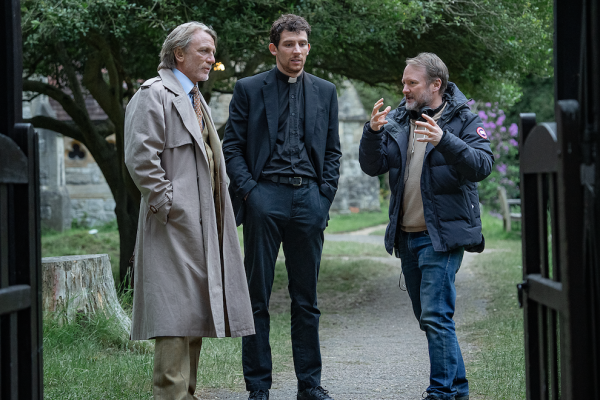
Wake Up Dead Man: A Knives Out Mystery is a spectacular puzzle, but Johnson long ago proved he knows his way around a good whodunnit. The real delight comes in Johnson’s handling of faith, as expressed by the battle for the soul of a church between John Brolin’s stern, authoritarian Monsignor Wicks and Josh O’Connor’s openhearted, empathetic Father Jud. When I walked out of the theater, I once again felt uncommonly seen by one of Johnson’s movies. I knew I’d seen something special.
I was excited to get the chance to pick Johnson’s brain about Wake Up Dead Man. We talked about his own faith journey, Protestant aesthetics versus Catholic aesthetics, and Contemporary Christian Music legend Larry Norman.
This conversation has been lightly edited for length and clarity.
Tyler Huckabee, Sojourners: You’ve talked about how Christianity played an important part in your life when you were younger, and that’s very obvious in this movie. I was curious if you think that upbringing has shaped other movies that you’ve worked on.
Rian Johnson: Every single one. This is the first movie where I’m coming at it on the surface, but every film I’ve done in some way has been about this topic.
I was a believer earlier in my life. It wasn’t just that I was raised in a religious household or brought to church. Up through my childhood and early 20s, I was deeply Christian. My relationship with Christ was how I framed the entire world. I’m not a believer anymore, but when something is that profound in your life, it carries through all those years. It shapes how you see the world, and it’s something you keep revisiting. It’s a well that you draw from. So, everything from Star Wars to Looper had a lot to do with essential Christian ideas that I grew up with. It is a bedrock foundation for me. Once a youth group kid, always a youth group kid.
Game recognize game. In Wake Up Dead Man, the characters represent a spectrum of ways people interact with Christianity. Which one of those characters was the easiest for you to relate to, and which one was the most difficult?
The reason I even had the guts to tackle this topic is because I felt like I would be able to draw from all sides of my experience with faith. That, I think, was the important starting point: Every character in this represents some fragment of my experience with faith.
Father Jud—Josh O’Connor’s character, the main character—was both the easiest and also the most difficult to write, because my conception of him: “OK, I’m gonna have a protagonist, and I’m gonna put all of the positive things that I want more in the world that were part of my experience with Christianity into a character.” So that was an easy starting point. It felt very good.
And then, though, that character is boring if he isn’t recognizable and human. It’s also a disservice to portraying a Christian if he’s not recognizable and human.
READ MORE: Wake Up Dead Man Takes Benoit Blanc to Church
When I was a Christian, there was doubt, and there was sinfulness, and there were all of those parts of being a real human being. The interaction with faith is what makes that walk real. So, forming his journey through the movie was the spine of the whole thing. He starts out very idealistic, bushy-tailed, and bright-eyed.
As Father Jud himself says: “Young, dumb, and full of Christ.”
Right. He gets that beat the hell out of him very quickly, gets lost along the way, and has to re-find his purpose. That was the majority of the work that went into the script, even beyond the puzzle-solving of the murder mystery.
Cailee Spaeny’s character was particularly heartbreaking for me, because I feel like I see that all the time: She’s a person who wants healing so badly, and Father Jud offers her a different kind of healing than she’s looking for. I found that very human and maybe the quiet lynchpin of the story.
I’m so glad you pointed that out. She’s one of my favorite characters. The fact that she’s dealing with this chronic pain that manifests in the physical need for what you’re describing: to find comfort and to find a way out of that.
There’s a line that she has later on in the movie where she says, “Can’t you just give us the answer? Isn’t that what all this is for?” That applies to the church and religion, and also to the detective and the murder mystery. That’s where those two things come together. The questions of one also drive the questions of the other in an interesting way.
You grew up Protestant. Why did you set Wake Up Dead Man in the Catholic tradition?
Part of it is that the movie is about the idea of storytelling. Part of it is just that, honestly, most of the churches I actually grew up going to look like Pottery Barns.
Same here. It’s not a very aesthetic tradition.
It is not at all! But there is nothing cooler-looking than Catholicism. Growing up as a Protestant, there was always an exotic nature to the Catholic Church.
I think also for myself—because a lot of the stuff that I’m talking about in the movie applies directly to my Protestant evangelical upbringing—setting it in the Catholic Church gave me just a little bit of distance. I could talk more directly to it without feeling like I was being quite so on the nose.
I thought you did a very good job in the movie of capturing the inherent spookiness of some Catholic art, but the movie also acknowledges that this art is a source of great meaning for a lot of characters in it.
Yeah, there’s an element of gothic horror to it. And obviously, every other horror movie that comes out these days has, you know, blood pouring out of nuns’ eyes. But then there’s also beauty in it.
Much like the fact that [filmmaker] Sergio Leone made some of the most gorgeous, evocative Westerns about America as someone who obviously grew up in a very different place, I think there might have been an aspect where growing up outside Catholicism helped when I was coming in design-wise.
You are releasing this at sort of an interesting point in American Catholicism. Are you and the cast preparing for pushback?
You never know what to expect. I know that, with this film, it was created with a thoughtful and generous spirit. I did a lot of work when I was making it to make it a multifaceted conversation as opposed to a didactic, finger-waggy thing on one side or the other. I have faith in the film itself.
And, I mean, look, having had the experience of putting a Star Wars movie in the world, which is its own, kind of [laughs], well, you know. You never know how anyone’s gonna react to it.
But I can’t say I’m nervous for pushback. I’m excited to see how people bounce off it, how they respond to it, what they take from it, what they don’t, what they like, what they don’t. The object is not to make a work of art that slides out there and no one notices. The object is to make something that gets people thinking and talking. You’re not trying to just stoke controversy at all … I think stoking conversation means that you have gotten inside people, and brought up questions within them. I think that’s the most that art can possibly do, as opposed to trying to teach a lesson or convey a point of view. If it can stoke conversation, that means it’s doing the ultimate task of art, I think.
After you have the idea of making a movie like this—that’s very personal, that gets into your history, and that comes with an interrogation of your experience and your background—does anything surprising come up? Do you find any sensitivities, wounds? Things you miss, maybe?
There’s a lot. I think the big thing is that when I started writing Father Jud, it wasn’t clicking. It wasn’t working. There was something off about it. I realized it’s because I was writing him from my perspective today. And I’m not a Christian anymore. I’m in my 50s. I have very complicated and ever-shifting feelings about faith.
And I realized, in order to write this character, I have to put myself back in the earlier place in my life when I was a believer, and I have to reconnect with the things that I genuinely believed and got from my faith in order to write him. It’s a bit like being a method actor. That ended up being this therapeutic, wonderful experience of reconnecting with this part of me, and with this part of my life.
It felt really necessary in order to get that character’s perspective right. But the whole process of writing and making a movie, that’s one of the things I feel so lucky to get to do. You are constantly having to push yourself to interrogate your own past, and to interrogate yourself in the present. If you’re doing it right, I think that’s the only sort of work that leads to the thing we talked about earlier, that actually connects with people.
This might be just a little youth group wonk trivia, but Wake Up Dead Man has, by my count, the second Larry Norman needle drop in this franchise [Editor’s Note: Larry Norman is known as the “Father of Christian Rock.”]
It does!
What was your experience with Contemporary Christian Music when you were back in your youth group days and beyond?
I discovered Larry Norman later on; a pretty wonderful discovery. Back when I was, you know, a youth group kid, my parents were listening to Phil Keaggy. There was a band called the Prayer Chain that was very big. I went to a church in Dana Point, and so there were some local Orange County bands like Black and White World.
I’ve never heard of them.
It was off the map but, for some reason, that was the CD that was in my car. I still go back to their albums sometimes. They came to our youth group one night to play a concert, and it was, like, the biggest night of our youth group life. It was amazing.
And of course, Michael W. Smith was around. I think I’m a little older than you, and so I have great nostalgia for that cloud of Christian rock at that time.
A little older or not, when you’re a youth group kid, your parents’ music is your music. So yeah, Michael W. Smith, Amy Grant, and all those artists were a big, big part of my growing up experience.
Damn, bro!
I’m gonna ask you one more question. The last song, Tom Waits’ “Come On Up To The House,” that the movie ends on, was a great way to wrap things up. Were there any other contenders for the final needle drop?
No. That was it from the very, very start. It had to be that. I love that song. I love Tom Waits and that song is so generous in spirit: “Come on up to the house!” It’s saying, put down your grievances, let’s put down all this nonsense, just come on up, and let’s be human beings together.
“Every character in this represents some fragment of my experience with faith.” —Rian Johnson

Did this article have an impact on you? Tell us how! Whether you’re moved to take action, have a question, or want to share a comment (good or bad), we value your feedback!