This article contains spoilers for Sinners.
In the final act of Ryan Coogler’s Sinners, Preacher Boy Sammie stumbles away beaten and bloodied from the newly vampire-ridden “Club Juke.” He has one objective: to make it to sunrise still a human. He is intercepted by the film’s perceived antagonist, Remmick, a centuries-old Irish vampire who is determined to turn Sammie into a vampire and, by doing so, absorb Sammie’s ability to wield ancestral connection through music.
With Remmick’s hand around his neck, Sammie, who was raised in the church, does what any desperate Christian might do when faced with a seemingly demonic entity: He begins to recite the Lord’s Prayer. Remmick, like a reflex, begins reciting the Lord’s Prayer along with him.
“Long ago, the men who stole my father’s land forced these words upon us,” Remmick says. “I hated those men, but the words still bring me comfort ... Those men lied to themselves and lied to us. They told stories of a god above and a devil below. And lies of a dominion of man over beast and earth ... We are earth and beast and god, we are connected, you and I, to everything.”
Between both individuals, an older, more bloodthirsty villain was among them—White Christian imperialism.
In January, Ryan Coogler’s Sinners made history in becoming the Oscars’ all time most-nominated film with 16 total nominations, resurfacing discourse on the film’s many merits: a deep storyline filled with layers of meaning, stellar cinematography and acting, and a breathtaking soundtrack and score. What is truly unique about this movie, however, is how it criticizes Christianity from an anti-imperialist perspective. Sinners displays the importance of resisting the false religious binaries of sacred and demonic that victims of imperialism have had forced upon them for far too long.
READ: Cinema’s Current Obsession: The Desperate Man
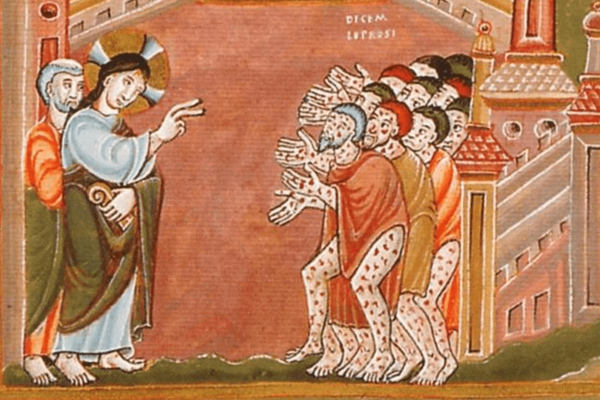
Imperialists established these binaries—good and evil, civilized and savage—by shifting the victims’ perspectives on their precolonial practices and traditions. According to the colonizers, anything not associated with White Christianity was demonic. Missionaries also weaponized this coercive colonial logic against different denominations and sects of Christianity and, as the case was with the so-called “slave Bible,” scripture itself. For many of us who grew up in Black Christian spaces, the spirituality of your belief system is based on the consistent battle between what is deemed sacred or demonic. Over time, however, these entities that were once weaponized against our ancestors in forced conversion are weaponized against young people, music, and other faith traditions. Sinners does an incredible job of displaying how these false binaries are another form of bondage, and how to become free.
Set over the course of one day in the Mississippi Delta in 1932, the film follows the journey of two twin brothers (astoundingly both played by Michael B. Jordan) and their younger cousin Preacher Boy Sammie (played by big-screen newcomer Miles Caton) as they reunite and create a juke joint for their community to enjoy.
Sinners displays the importance of resisting the false religious binaries of sacred and demonic that victims of imperialism have had forced upon them for far too long.
Annie, portrayed by Wunmi Mosaku, is one of the most important characters in the film. Her immense knowledge of the spiritual is the only reason they knew they were being attacked by vampires that evening. Annie is a purveyor of the pre-colonial practice of Root-Working, an African American spiritual practice that evolved from West African botanical knowledge. Significantly, Annie’s practices are not demonized as they so often are within our communities.
Annie’s character poses overdue questions to ponder: Why have we allowed White Christian imperialism to convince us that our own ancestors were demonic? Why do we categorize traditions derived from West African practices built on liberation, protection, and survival as demonic while other traditions—like astrology or many meditation practices—get to be “spiritual”?
Preacher Boy Sammie is acutely familiar with this colonial logic. His father is a strict pastor who believes the blues music Sammie performs is demonic, even going as far as to hide Sammie’s guitar in the church, claiming that Sammie is “dancing with the devil.”
Contrary to what his father sees as demonic, Sammie’s voice has the sacred ability to bridge the past, present, and future. That evening at the juke joint, he performs a song he wrote for his father called “I Lied to You.” “I’m full of the Blues, Holy Water too,” Sammie sings, knowing that both are holy. “I know the truth hurts, so I lied to you.” What starts as a performance soon becomes a surreal, time-bending sort of ritual. Delta Slim, a well-known bluesman portrayed by the great Delroy Lindo, had a moment of wisdom imparting to Sammie within this sequence. “Blues wasn’t forced on us like that religion. ... We brought this with us from home. It’s magic what we do—it’s sacred, and it’s big.”
The juke joint becomes populated by both ancestors—from West Africa stretching to East Asia—and those to come, all dancing to the music of their time, creating a wonderful cacophony of Blackness. Every person in the room is engulfed in the sound, and nobody is alone.
There is no denial of Sammie’s talent, roots or his belief system. While his father saw what Sammie did as demonic, Sammie only wanted to coexist in both of the “worlds” that made him who he was.
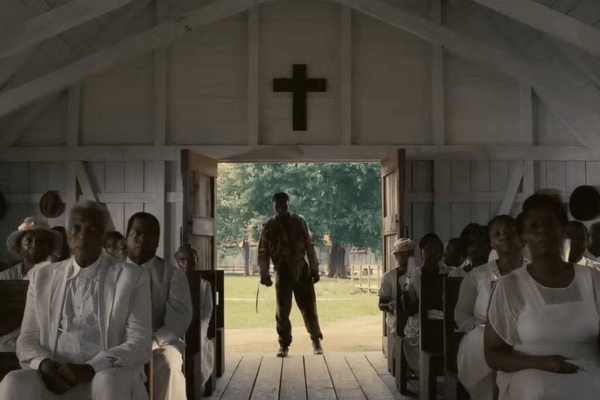
Sammie does end up making it to sunrise, just barely. He arrives at the church the next morning, needing family to comfort him, but instead, his father creates a spectacle out of his suffering for the congregation. When his father forces him to choose between the church that has not fully embraced him or the music that freed and saved him, he chooses music.
Sinners teaches us that White Christian imperialism can never provide freedom, because it was forged in bondage. But that doesn’t mean the film is “anti-Christian,” as some have argued. Rather, Sinners presents Christians with an overdue challenge. White Christian imperialism desires to eradicate independent thought and opposes questioning our lingering chains. Our path to freedom lies in breaking free from the control of those who are still in bondage. We, like Preacher Boy Sammie, need a sanctuary where our whole selves are welcome—our roots, our blues, and holy water too.

Did this article have an impact on you? Tell us how! Whether you’re moved to take action, have a question, or want to share a comment (good or bad), we value your feedback!