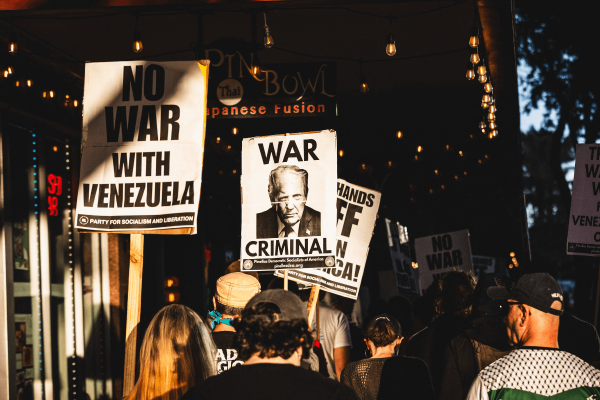
The Trump administration is blowing boats to pieces off the coast of Venezuela.
At different points this year, I’ve been left with the unsettling feeling that I don’t have the emotional bandwidth to fully process—let alone respond to—all of what’s happening. Early in the year, we all acknowledged that this overwhelmed feeling was by design, part of the Trump administration’s “flood-the-zone” strategy, intended to weaken and divide its opposition.
I’ve been wrestling with this in light of the attacks the Trump administration is orchestrating in Venezuela. On one hand, I’m perplexed at why such a costly, unlawful, and frankly evil operation isn’t garnering louder public outcry; on the other hand, I know there is so much else on people’s minds. It’s not that we don’t care about it all—from Chicago to Palestine to Sudan to so many other places where we know there’s urgent suffering—but there’s only so much outrage we can process before weariness takes over.
And yet I can’t ignore what’s happening in Venezuela. So far, more than 80 people have been murdered in strikes targeting vessels in both the Caribbean and Pacific oceans. The first time I saw images of boats being bombed, it felt as though I was watching a movie rather than actual news. As the reality set in that these images were real, I felt anguish that the Trump administration could be so callous in ordering these attacks, seemingly treating people’s lives as play pieces rather than as real people who are made in the image of God, people with families and rights under international law. I was also haunted by memories of our government’s sordid history in Latin America, engaging in covert operations and coups.
In the midst of what can often feel like overwhelming crises, I can hear Paul’s inspirational words to “not become weary in doing good, for at the proper time we will reap a harvest if we do not give up” (Galatians 6:9). These words have been set on repeat within my mind and spirit. I find both resilience and consolation in these words because they are a reminder that we may not be able to see the full impact of our actions, but that “at the proper time” they will “reap a harvest.”
I also find inspiration in the faithful witness of the early church, who so often refused to grow weary despite facing such severe repression and persecution. At a time when the Pax Romana promised to bring peace through military might, Paul offered a rival and often subversive claim that true peace comes through following the way of peacemaking in Jesus. Paul echoes the Sermon on the Mount when he urges believers to “live in harmony with one another” and to “pursue what leads to peace and to mutual edification” (Romans 12:16, 14:19). In his metaphor of the church as a human body, Paul reminds us that our lives are intertwined, for when “one part suffers, all parts suffer with it” (1 Corinthians 12:26).
The Trump administration has said little about the justification for its actions, alleging that the boat victims are “narco-terrorists” smuggling drugs into the U.S. in what they consider an “armed attack” on the U.S. They have not, however, offered any proof or enabled any review by other branches of government to verify this claim. Data from the U.S. Drug Enforcement Agency shows that no fentanyl and only about 8% of cocaine supplied to the U.S. arrives via an eastern Caribbean route originating in Venezuela; the vast majority of cocaine is produced and smuggled elsewhere in Latin America.
Drug smuggling and drug overdose in the U.S. are, of course, real and complex issues. Venezuela is led by Nicolás Maduro, a leftist autocrat who stole the nation’s last election and has increasingly become a mafia-like boss colluding with cartels. But this does not justify Trump’s claim that these people are terrorists or even that stopping the boats in Venezuela would keep people in the U.S. safer. Instead, U.S. military actions against alleged Venezuelan drug traffickers are believed to be part of an effort by members of the Trump administration to topple Maduro’s regime. As drug historian David Herzberg explained in a recent New York Times article, “to reduce the overdose crisis, we need to stop exploiting drug tragedies to serve other geopolitical agendas. It wasn’t started by villainous foreign traffickers, and there is no drug-free utopia waiting for us if we shut off one illicit supply chain.” Trump’s actions further ignore that U.S. presidents already have many legal options to address drug trafficking, including inspecting and then ultimately capturing boats suspected of drug smuggling. But the administration has opted to shoot first and ask questions later, with lethal results.
Which brings us to a second and even more critical problem: These actions are both illegal and immoral. The 1973 War Powers Act limits a president’s power to enter an armed conflict without the consent of Congress, especially conflicts that last longer than 60 days. In early October, Trump sent a memo to Congress declaring that the U.S. was in “armed conflict” with drug traffickers who it would treat as “unlawful combatants.” In November, a Trump official said the administration did not believe it needed congressional approval, even after the 60-day window expired. U.N. experts have condemned the attacks as extrajudicial executions and noted that the attacks violate international laws prohibiting armed attacks except in cases of self-defense.
Morally, I hope we are not at a place where I have to make a Christian case for why murder is wrong. And just in case it needs to be said: No, I can’t see the Jesus who gave his life up for us and said during his arrest by Roman soldiers that anyone “who lives by the sword dies by the sword” condone killing a suspected—or even convicted—drug smuggler.
As Christians, I’d hope the unjust and immoral actions being levied in the name of national defense against people in a different country were enough to provoke outrage; it should be. But as leaders like Vicki Gass have noted, Trump’s actions could very soon bring the problem much closer to home. In an email newsletter, Gass, Executive Director of the Latin America Working Group, noted:
“If President Trump can unilaterally declare war on ‘narcoterrorists’ in the Caribbean, he can use that same justification to target Americans here. In a recent meeting at Quantico, Trump urged military commanders to treat ‘dangerous cities’ like Chicago and Los Angeles as ‘training grounds’ for domestic deployments—a direct echo of his rhetoric describing a ‘war from within’—similar logic to the one the Trump administration is using for the extrajudicial killings on the high seas.”
So far, the president has not even attempted to seek congressional approval for his actions. If we are unhappy with this expansion of presidential powers, we can voice our support for measures like the War Powers Resolution, a bill in the House of Representatives that would limit a president’s power to use military force. While the measure faces steep odds in the Republican-controlled House, a growing number of Republicans are publicly challenging Trump’s expanding bombing campaign, including Sens. Rand Paul, James Lankford, and Susan Collins.
These U.S. military-sponsored killings of alleged drug smugglers matter because people’s lives are being snuffed out with impunity—full stop. As Christians, we must be clear in denouncing these killings, because as Rev. Martin Luther King Jr. so often proclaimed, “injustice anywhere is a threat to justice everywhere.”
Applying this ethic to our foreign policy, we must advocate for policies that protect the very image of God in every person in every nation; asking Congress to approve the War Powers Resolution would be a good place to start. We can be clear about why ending these killings matters: Ending the killings matters because every life is sacred and deserves dignity, including alleged drug smugglers. It matters because the killings violate international law. It matters because these killings are damaging and upending our diplomatic relationships across the region. It matters because these killings are exacerbating renegade presidential power with the dangerous misuse of our military might, further marginalizing the role of Congress in declaring war.
I fear what this portends for future illegal actions in Venezuela and beyond, including reverberating back into the U.S., if we don’t raise our voices to stop it now.
Got something to say about what you're reading? We value your feedback!