I teach Introduction to Religious Studies at a liberal arts university, and I structure the class around questions rather than answers. Each week, students have only one assignment: to post a question on the discussion board.
The exercise is designed to cultivate an environment of curiosity and open-mindedness. But it is also an attempt to repair wounds. Many students arrive carrying the assumption that questioning religion is a form of betrayal.
During my first semester as an adjunct professor, the experiment worked beautifully. The students blew me away with their depth and courage. They learned not to rush to answers or correct one another, but to linger together in uncertainty, following the dots of each question. So you can imagine my surprise when, in my second semester, I encountered a class that had an answer for everything.
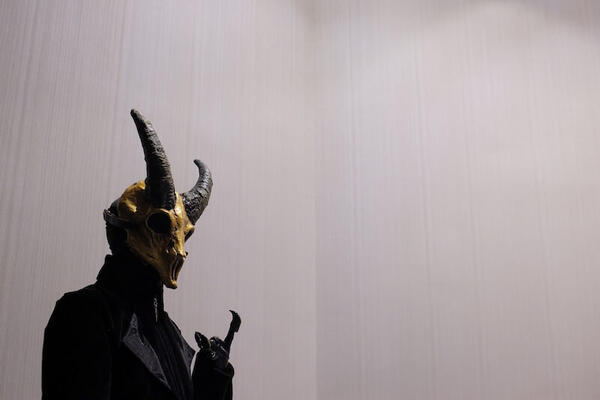
Every question I posed about suffering, violence, addiction, the existence of God, injustice, and ecological collapse was met with the same explanation: “Because the devil.”
I gently pushed back. I introduced alternative lines of thought, redirected us back to the subject of the day, and tried to keep the conversation moving, if for no other reason than to fill the class to its fully allotted time. Take it from me: “the devil” is a conversation ender.
But week after week, we found ourselves back with old Lucifer.
The students eventually sensed that I was less convinced by their explanation than they were. While I have formal theological training, I have no training in pedagogy. Still, I cling to one tenet of teaching picked up somewhere along the way: I’m not here to teach you what to think; I’m here to teach you how to think. I also assume that, to succeed at that, I am supposed to withhold my own personal convictions.
Then one day, a student asked me directly: “Professor Shannon, do you not believe in the devil?” I had a decision to make. Was I supposed to uphold my sacred pedagogical ideal of neutrality? Or should I give her honesty? “Isn’t it obvious?” I replied.
Some students seemed relieved. Perhaps my answer gave them permission to question beliefs they had inherited without ever examining them. Most, however, were disappointed—if not openly defiant. They retorted with Bible verses mentioning Satan, presenting them as airtight proof that the devil does exist. I left each class genuinely perplexed. Why does our culture so desperately want to hold on to the devil? Further, why do we seem to need devils at all?
No, I do not believe in the devil.
This places me somewhat outside the mainstream of my own tradition. I am a Christian—a Baptist, in fact (Cooperative, not Southern, for those who know the major difference). Yet I honestly do not know what most people in my denomination—or even in my personal life—believe about Satan. The subject was rarely, if ever, discussed while I was growing up, and outside of that classroom, it rarely comes up.
But perhaps it is time to start talking about it. Perhaps, in our current moment, belief in the devil is not as innocuous as I once thought.
I wonder if the attachment to the devil says less about theology than it does about psychology. One of the reasons the Bible has endured for millennia is that it repeatedly reveals patterns of human nature that we recognize in ourselves. Among these patterns is the tendency to scapegoat. To scapegoat is to single out a person or group to bear the blame for a community’s problems. From Genesis onward, human beings are portrayed as creatures of desire, envy, rivalry, and fear. Cain murders Abel. Joseph is sold by his brothers. Again and again, communities defend their own innocence by locating guilt somewhere else.
According to French thinker René Girard, this is one of humanity’s oldest strategies for maintaining order—a strategy that should have been dismantled with the crucifixion of Jesus, the scapegoat to end all scapegoats. Instead, we have spent the last 2,000 years trying to determine who was responsible for that death.
Was it the Jews? The Romans? Pontius Pilate? The product of an eternal spiritual battle in which God owed the devil a ransom and paid it with the blood of an innocent man?
Or could the crucifixion be exposing something far more unsettling: that the impulse toward violence and exclusion runs through all of us? Could it be that the crucifixion forces us to look at our own reflection? We prefer to scapegoat because it spares us the painful work of self-examination. If the source of evil lies entirely elsewhere, I do not have to admit my own participation in it. This is why binaries are so seductive.
If the source of evil lies entirely elsewhere, I do not have to admit my own participation in it. This is why binaries are so seductive.
We crave a world that fits nicely into clean categories, and the devil offers us a convenient way of divvying it up. Gospel music belongs to God; pop music to the devil. These books are safe; those books are dangerous. These people are “saved”; those people are “damned.”
READ MORE: The Devil Is Real. He Lives in Betting Apps
We do this outside of religion, too. Every generation creates its own devils. Sometimes these devils are called witches, or heretics, or communists, or “woke.” The names change, but the function remains the same: if evil lies entirely over there, we remain innocent over here.
The philosopher G.W.F. Hegel had a name for this: the “beautiful soul.” The beautiful soul belongs to the one who preserves their own purity by locating corruption outside themselves, standing in judgment over a fallen world. But here is the twist: Hegel argues that this very attitude is a form of evil. He says that the way we see the world as evil is the evil. That our refusal to admit our participation in corruption is its own sort of moral failure.
My students’ inability to imagine a world without a devil had a lot to do with the gospel temptation narratives in which Jesus dialogues with Satan in the desert. But what happens if we read the story less as a supernatural attack from an external horned creature offering temptations that bounce off Jesus like Teflon? What if, instead, we saw it more as a literary device in which Jesus faces the temptations common in every beating human heart: power, ego, domination, certainty? Rather than declaring himself above it all, he confronts these temptations directly. Many religious and spiritual traditions are tempted to begin with divisions. Pure and impure. Saved and unsaved. Light and dark. But maybe what we need in an already polarized moment is not further fracturing, but wholeness. In that vein, the true spiritual task of life is not to ask, How do I shed the darkness and become pure light? The deeper question is, How do I become whole? How do we integrate the dark and the light?
Integration does not mean celebrating or surrendering to our own capacity for cruelty. It means refusing to deny it or project it onto others.
At their best, the world’s great religious traditions have invited us not toward denial, projection, and scapegoating, but toward confession, compassion, and love—the slow, lifelong work of becoming a fully integrated human being. The question, then, is not whether the devil exists, but whether we can learn to stop needing one.

Jillian Mason Shannon is a public theologian and educator and the founder of Neotopia, a nonprofit organization that offers books, webinars, and other programming exploring the intersection of theology, philosophy, and culture. @neotopiabooks
Did this article have an impact on you? Tell us how! Whether you’re moved to take action, have a question, or want to share a comment (good or bad), we value your feedback!