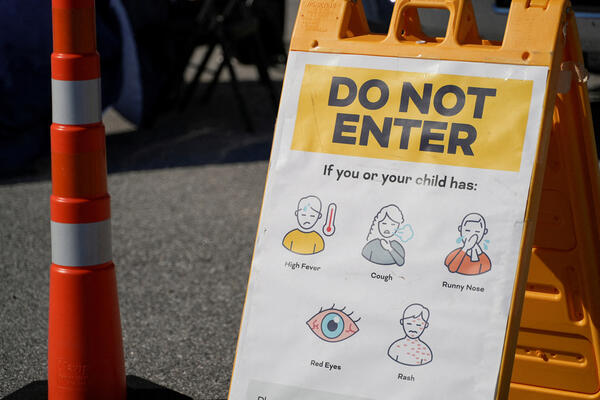
I remember a distant past, almost too faint to recall with clarity. That season, so long ago, marked by the COVID-19 pandemic, has since been eclipsed by the pressing concerns of our day. We now live with the backdrop of global shifts, political instability, war, and domestic turmoil. But when I think back on that time, one overwhelming emotion returns with acuity: a deep concern for the safety of my friends and loved ones. Unfortunately, that same fear has crept back with suffocating weight due to rising measles cases in the U.S. But this time, the demographics I am most concerned with are not the elderly or those with preexisting conditions. I am most concerned for the most vulnerable among us: our children.
Since the first documented case in South Carolina in October 2025, the state has reported 979 cases, and the numbers are rising. The surge in outbreaks threatens to reverse the Centers for Disease Control and Prevention’s declaration that measles was eliminated in the United States in 2000. At this rate, we are on the verge of losing elimination status. The moral crisis deepens with reports that two detainees in an Immigration and Customs Enforcement detention center have tested positive for measles.
READ MORE: Spread God's Love, Not Measels
Responding to this new reality will require a measure of deconstruction and reordering of expectations. This leads to what religious studies scholar Brad Onishi described in a June 2025 interview with Sojourners as a process of mourning. “To me, mourning means it’s a period of time when you transition from a world that was, to a world that is,” Onishi told Sojourners. “The world that was had a set of expectations and stories and dreams; it had a set of possibilities. But mourning means that, when a loved one passes away, you let go of those possibilities. Mourning means you have to readjust your expectations and your understanding of what is real.”
The world we once knew has passed away. We now must respond with thoughtful, reflective, and relational engagement so that our words and actions can shape a new world. Here are five constructive ways to engage with those struggling to frame the current measles crisis within the matrix of their faith.
The world we once knew has passed away. We now must respond with thoughtful, reflective, and relational engagement so that our words and actions can shape a new world.
1. Practice patient engagement
In a time when accessibility and immediacy are treated as a given, the virtue of patience is easily dismissed. In the murky waters of misinformation and disinformation, any delay can feel like negligence. Yet scripture commends the slow, measured response, and reminds us that a gentle answer can turn away wrath (Proverbs 15:1,18). Add to this what is sometimes called Brandolini’s Law—the observation that it is far easier to produce misinformation than to correct it—and the case for patient, relational dialogue becomes even stronger. Precisely because the situation feels urgent, we have all the more reason to be interpersonally attentive and careful in how we speak.
With measles spreading across the country, including places like Texas, Arizona, and South Carolina, the moment can feel urgent to the point of despair. Instead of leading with a barrage of facts and figures in an effort to correct every false claim, consider beginning with the human reality. Highlight the stories of the college students who are now infected, and of the unvaccinated infants and children in places like Colorado and New York City who are especially vulnerable. Patience is not a call to avoid hard conversations. It is an invitation to lead with compassion, to become a storyteller, and to keep the most affected at the center of how we respond.
2. Treat information consumption as discipleship
We have all watched friends and family fall into conspiracy thinking, and vaccines are a common target of conspiratorial claims. Conspiracies circulate that vaccinations contain fetal cells, aluminum salts, and thimerosal, and spread quickly on social media, blogs, and meme culture. The question is not only whether a particular claim is true or false, but how our habits of attention are forming us. How we scroll, who we trust as “experts,” what we share, and what we dismiss are all spiritually formative practices. It is about recognizing that our patterns of consumption are shaping our fears, loves, and capacity to discern what is real.
Because we are connected to one another through family, friendship, and church life, the goal is not to berate people or “win” debates about vaccine hesitancy. Begin instead with questions. Ask how they arrived at their conclusions. Listen for the experiences beneath the arguments—their fears, their stories, and the pressures of parenting in a world that often feels unstable and dangerous. That posture does not abandon truth, but creates space for it to be received. From there, we can reframe the conversation, one that treats public health as an opportunity to practice neighbor-love, even in a context of distrust and disagreement.
3. Reframe medicine as a gift
Another way to address vaccine hesitancy is to help others develop a Christian imagination that receives medicine, science, and knowledge as gifts to be stewarded, echoing Augustine’s claim that all truth is God’s truth. This means actively disrupting the fear-based story that treats reflexive suspicion toward institutions of learning and public health as honorable.
At the same time, we should acknowledge the real history that has shaped distrust. In the United States, public trust was shattered by the Tuskegee Experiment, contraceptive trials in Puerto Rico, and the long record of violence, displacement, and dehumanization of marginalized peoples. Powerful institutions in government, tech, and pharma have inflicted real harm, and there is no shortage of reasons to be wary. But it does not follow that everything they do is harmful, or that every health guideline is an evil plot.
READ MORE: What Lent Asks of Christians Rethinking Trump
It is also worth naming what is easy to take for granted. We live in an era of medical knowledge and disease prevention that earlier generations could hardly imagine. These advances can be received with gratitude, as part of the grace that God has allowed to unfold through human creativity and study.
4. Resist vilifying people who have been led astray
Here is where I draw my firmest boundary in conversation with others. Boundaries matter, and what they look like will depend on the situation and the relationship. Here, I want to strongly urge us to resist the temptation to portray people who become ill as villains or as somehow deserving of their sickness.
We must keep the most vulnerable among us at the center. Dividing the world into heroes (those who vote Democrat) and villains (those who vote Republican) is reductive. That reduction can feel clarifying, but it is often corrosive and becomes an excuse to blame regular, everyday people for vaccine conspiracies instead of placing the responsibility on elected officials, social media influencers, and media outlets that stand to profit from opposing scientific research. Our current moment is increasingly susceptible to authoritarian politics, where institutions and communities frame themselves as victims when confronted with their erroneous beliefs or bad behavior.
In resisting the temptation to vilify those who have been led astray, we remember Jesus’ words that all the law and the prophets hang on love of God and love of neighbor (Matthew 22:37–40). In practice, this means that we defend the vulnerable, the sick, and the oppressed with clarity and courage, refusing to let political affiliations, culture-war instincts, or people’s embrace of misinformation dull our attention to anyone’s suffering.
5. Emphasize communal responsibility
We must be willing to say that we share a common life and a common vulnerability. We are in the same boat. In other words, this is not an “us-versus-them” battle, but a “we” problem. This does not mean everyone bears the same culpability, but it does mean we belong to one another, and we can only respond well if we problem-solve together as a community. Vaccines and herd immunity are not merely private choices, but function socially. These measures protect, or expose, not only individuals, but entire networks of neighbors.
We should also be honest about how our political and theological commitments shape our posture toward public health. Research during the pandemic suggested that Christian nationalist commitments influenced vaccine behavior, and that white evangelicals and Republicans were more opposed than other groups to school vaccine requirements. That posture carries consequences, especially for those with the least agency and the greatest risk. Rather than treating vaccine hesitancy within the framework of partisan identity, we should name it as a communal challenge. This is an area where we can partner across differences, refuse simplistic narratives, and help one another develop wiser habits of discernment.
After we mourn the struggles and disorientation of our present moment, we can look to a new horizon. My hope is that Christian communities will be on the front lines of protecting the vulnerable, receiving medicine with gratitude as a gift from God, and cultivating bulwarks of discernment that resist conspiracy thinking and fear-driven storytelling. Arm in arm, we can learn to love our neighbors in ways that are concrete, costly, and faithful.

Rubin James Yi McClain is an opinion writer for the 2026 Sojourners Journalism Cohort.
Did this article have an impact on you? Tell us how! Whether you’re moved to take action, have a question, or want to share a comment (good or bad), we value your feedback!