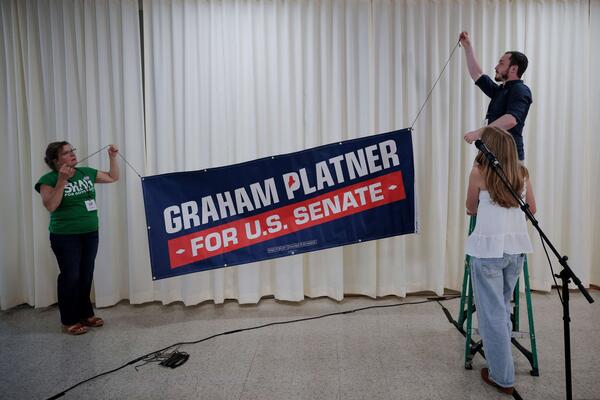
Following credible accusations of rape and sexual assault, former Maine Democratic Senate nominee Graham Platner withdrew from the race. The Maine Democratic Party has until July 27 to choose a replacement.
Many people, including me, believed that Democrats should have figured out long ago that Platner was unfit for office. Yet Platner was buoyed through numerous scandals thanks to his claims that he had changed, and his insistence that his past words and actions did not define him. Platner was a veteran who discussed past struggles with PTSD and addiction. He catered to people’s love of a redemption arc.
And while he’s an atheist himself, Platner also leveraged America’s very Protestant belief that the internal experience of transformation or goodness is more important than what one has done, or even than what one is doing. Contra many American and Protestant Christian shibboleths, symbols and acts of bigotry are not primarily important for what they reveal about the state of a perpetrator’s heart and soul. They are important because they harm the people toward whom they are directed. Sometimes that harm is as direct as assault and rape. Sometimes it is the more subtle message that you and your concerns and your identity do not matter, and that you either need to accept that or face harassment, exile, or worse.
This is particularly true when discussing issues of racism and bigotry. For example, Trump ally and televangelist Robert Jeffress insisted in 2020 that racism could only be “cured” through a “changed heart.” But when you focus on individual hearts and personal sin as the engine that causes evil in the world, rather than on people’s actions and structures, you leave bad actors with a lot of leeway to obfuscate bad actions with vociferous good intentions.
The divide between what’s on the outside and what’s on the inside was particularly glaring in Platner’s case. Eight months ago, in October, the press discovered that he had made a string of racist, sexist, and homophobic social media posts between 2013 and 2021. In October 2025, Platner revealed on a podcast appearance that he had a Nazi Totenkopf tattoo on his chest.
To some of us, it seemed like when your candidate reveals he has a Nazi tattoo, it is time to find another candidate. As many Democrats have noted, the party is fighting Trumpism—a dangerous, fascist, far-right movement, much as the Nazis were a dangerous, fascist, far-right movement. The party that is supposedly fighting fascists should have zero tolerance for Nazi iconography.
Yet many of Platner’s supporters, and Platner himself, insisted the tattoo should not be a dealbreaker. Platner said that he was “Not a secret Nazi,” and claimed he did not understand what the tattoo was when he got it. He covered up the symbol and claimed he no longer believed the ugly things he said on Reddit.
In response, Maine state Democratic Rep. Valli Geiger insisted that Platner “deserves grace.” “If we allow the Graham Platners of the world to be taken down,” the subhead of Geiger’s article says, “we’re telling every combat veteran, and every other person who lost their way for a while, that there’s no way back.”
I very much believe that people can change and make amends for past harms. There are former neo-Nazis and white supremacists who work to deradicalize people who are still in the scene. These ex-white supremacists often talk about the importance of empathy and how the prospect of acceptance and forgiveness can help people leave hate behind.
However, there is a big difference between telling someone that you believe they can change and telling someone who is running for political office—who was forced to cover up a Nazi tattoo to continue his bid to be elected—that they should be a senator if they express formulaic contrition.
When marginalized people hear and see how a political party is supporting someone who only recently got a Nazi tattoo covered up, many of them are going to feel that they are either in danger or unwelcome in that party. There are a couple of ways to respond to these concerns. People can repudiate the symbol and the leader, and look around for other people to carry their (non-Nazi) banner. Or they can tell the marginalized people that the person in question is a good guy, and everyone should just get over it.
The second option can quickly escalate to abuse and harassment, as people insist that the marginalized people are overly sensitive, aren’t really discriminated against, should stay in their subordinate place, or are part of a nefarious “globalist” conspiracy against authentic Americans, working people, Mainers, or whoever.
This is not some sort of accidental dynamic. Nazi symbols are meant to intimidate and terrorize marginalized people, including Jews, LGBTQ+ people, and nonwhite people. This iconography is intended to do harm in the world. And that harm occurs regardless of the intent of the person holding the symbol, standing near the symbol, or who has the symbol tattooed on them.
This very thing happened in Platner’s campaign. After Platner finally exited the race, Maine Rabbi Bill Siemers told The Times of Israel that Platner and his followers repeatedly insinuated that the pro-Israel lobbying group American Israel Public Affairs Committee was responsible for his scandals. He said those claims had been chilling for his congregation. “That he made it as far as he did, and was popular, that still happened, and the Jewish community is still going to have to deal with that,” he said. “It makes us wonder how they look at us.” (Some have claimed that criticizing Israel, or saying that it is committing genocide, as Platner did, is antisemitic. Given the position of many genocide scholars, I do not agree. But that is all the more reason that people who condemn genocide should have zero tolerance for Nazi iconography.)
As more negatives came out—Platner used a slur for people with disabilities in an interview, he admitted to cheating on his wife—his supporters escalated from saying his sins should be forgiven to insisting that his sins maybe made him a better person than his critics. Writer Ken Klippenstein, for example, exulted following the revelations that Platner cheated on his wife, writing that the Maine politician was defeating his “smoothgroin” critics. That’s an insult intended to portray Platner skeptics as unmanly, desexualized, and lacking in vigorous gender normativity. It’s unapologetically homophobic and misogynistic.
Journalist Marisa Kabas writes about how painful, alienating, and silencing it was to watch politicians, journalists, and organizations she considered to be allies defend Platner despite revelations of misogynist bile, admissions of adultery, accusations of domestic violence, and finally, rape. “I regret listening to the inconsequential male voices in my head instead of my own, which was overcome with anger and sadness at being asked to excuse another humiliation for women,” she wrote.
READ MORE: Here’s How Your Church Can Help Survivors of Domestic Violence
Platner may or may not hold a range of bigoted beliefs. But bigotry is not merely something that resides in people’s hearts; it is ultimately something that people do to one another in the real world. When Platner insisted that he should be judged by what was in his heart, not by the Nazi tattoo, he was not just making a statement about his internal state. He was taking action in the world to delegitimize and marginalize Jews, nonwhite people, disabled people, women, and all other marginalized people.
Platner may or may not hold a range of bigoted beliefs. But bigotry is not merely something that resides in people’s hearts; it is ultimately something that people do to one another in the real world.
A community that shrugs at Nazi tattoos is a coalition that is going to enforce Nazi hierarchies, because the thing that Nazi symbols do in the world is enforce Nazi hierarchies. Nazi symbols have power because of their social meaning—and they have this power regardless of a person’s intent. Just as a Confederate flag enforces white supremacy even if you insist you are displaying it to show “heritage and not hate,” a Nazi tattoo also enforces white supremacy—even if you insist it doesn’t because you didn’t know its meaning, or because you covered it up when it became a political liability. The way for Platner to reject Nazi ideology was not to say, “I have changed in my heart and soul.” The way for him to reject it would have been for him to bow out of the race so that people who’ve never had Nazi tattoos to begin with could’ve run for office.
But Platner did not do this, and eventually his lies and cruelties caught up to him. We could have saved a lot of time, and a lot of pain—not least for the survivors who came forward—if we had understood that a redemption which involves harming others day after day is not actually redemption, regardless of whether you are a secret Nazi in your heart.

Noah Berlatsky (he/him) is a freelance writer in Chicago. His poetry collection Not Akhmatova (Ben Yehuda Press) addresses the Jewish diaspora. His newsletter is Everything Is Horrible.
Did this article have an impact on you? Tell us how! Whether you’re moved to take action, have a question, or want to share a comment (good or bad), we value your feedback!