I’m at the point where I’m a bit at a loss for what to say about Palestine. It has been three years since the attack on Israel on October 7, 2023, when Hamas killed more than 1,100 Israelis and abducted another 251 people.
That date also marks the beginning of the genocide in Gaza, which continues despite the ceasefire. More than 70,000 Palestinians have been killed by the state of Israel. Palestinians are losing faith in nonviolent resistance, and I honestly can’t blame them. Settlers and their allies in government are determined to annex the entire West Bank, and Israeli politicians are openly imagining a world where Palestinians are no longer in Palestine. The word “bleak” does not even begin to describe the situation in Israel/Palestine—a situation that is only made worse by the U.S. continuing to provide military aid to Israel. Perhaps “catastrophe” is a better word.
And while I am deeply disturbed at witnessing this catastrophe from afar, I am largely doing so from the comfort of my own home. Instead of more of my own words, Sojourners intentionally asked those more directly impacted by Oct. 7 and its ensuing carnage what words they would use to describe the past three years. Sojourners asked respondents a series of questions via email, and then edited those responses for length and clarity. Below are the responses of theologians, artists, poets, and policy researchers.
Maybe you, too, feel you’ve run out of words when it comes to Israel/Palestine, but thankfully, others still have much to say.
These responses have been edited for length and clarity.
Sojourners: With settler violence rising in the West Bank, what can people who are not in Palestine do to support Palestinians and their allies?
Azmera Hammouri-Davis, Creator of Break The Boxes and womanist theologian: For people in the U.S. looking to support Palestinians, we can keep speaking out against the normalization of occupation and genocide, support Palestinian artists and activists, and pressure our legislators to stop using our taxes to fund weapons that kill Palestinians or anyone else.
READ: What Does It Mean To Say ‘Jesus Is Palestinian’?
Rev. Munther Isaac, Christian theologian and pastor at the Evangelical Lutheran Church in Ramallah: The first thing we ask of people outside Palestine is to speak truthfully about what is happening. We must stop pretending that this is simply a “conflict” between two equal sides and recognize the reality of settler colonialism and an ongoing attempt to uproot Palestinians from their land. People must also recognize that this reality is enabled by governments, political decisions, and taxpayers’ money. We therefore ask people—especially faith leaders—to make their voices heard and demand that elected officials act justly, uphold international law, and protect the vulnerable.
What does it mean to be a Palestinian committed to nonviolent resistance?
Rev. Munther Isaac: Nonviolent resistance is not unique to Palestinian Christians. Palestinians, including the people of Gaza, have repeatedly pursued forms of nonviolent resistance, and too often the world has failed them. As Palestinian Christians, we speak of “creative resistance”—resistance in the logic of love, as the Kairos Palestine document describes it. We resist evil with good. Today, perseverance itself is resistance: praying, harvesting our olives, planting trees, remaining on our land. When others seek to uproot us, staying rooted becomes resistance. Yet we refuse revenge and hatred. We insist that evil cannot drive out evil, and that the violence of the oppressor must ultimately be confronted and uprooted.
Lamma Mansour, Palestinian Christian writer and social policy scholar from Nazareth: It means refusing to reproduce the dehumanization that is at the heart of the injustice we fight against. This does not mean being silent or passive. Nonviolent, creative resistance with love as its logic (in the words of Kairos Palestine I) is an active force that tells the truth, seeks accountability, and works toward healing.
What from your religious tradition will you be reflecting on during the third anniversary of the Hamas attacks on Oct. 7 and the start of the genocide in Gaza?
Omar Haramy, executive director of Sabeel: Jesus was born under occupation and killed by an empire on a cross, a method Rome used against those it branded an enemy of the state. I cannot reflect on Oct. 7 without remembering that I follow the Prince of Peace, who was once condemned as a terrorist.
Anyone who is being honest about Oct. 7 must acknowledge that it changed everything—for Israelis and Palestinians, for the region and the world. Israelis will never feel the same after the most violent day in their history. And Palestinians will never feel the same after enduring genocide and the destruction of Gaza. Yet in other ways, nothing has changed, and that is the sad truth.
Israel holds its election at the end of October. The campaigns still ignore Gaza’s ruins and the occupation, which they seldom even define. They still deny that Palestinian citizens of Israel live as second-class citizens. That was true on Oct. 6, and it is true today.
Palestinian politicians are no better: divided, with corrupt and opaque leadership and an exhausted civil society. Many of us retreat into survival, hoping only to wake up tomorrow and feed our families. Fear has made us captives of our daily bread.
But the prophets did not whisper, and neither did the real Jesus—not the one invented in bestsellers or in sermons that are disconnected from reality.
My faith is connected to my reality, and reality says: This is not normal; a genocide has taken place. Name the problem. Analyze it honestly. Refuse despair, and overcome it. The cross is never the final word. Resurrection people do not wait for permission to hope. We become part of the solution. We are untouchable to the elite, but we light the way for the oppressed.
Shaul Magid, Harvard Divinity School professor of modern Jewish studies in residence and co-editor of the forthcoming book, Jewish Anti-Zionism: A Historical Anthology: How does one move beyond trauma? Answers to this question are often proffered, but the answers typically only serve as a salve for an unhealed wound. Vengeance is an instinctual response that scripture itself acknowledges. And so, scripture offers us the “cities of refuge” (Numbers 35:9-15), places where those who would be victims of vengeance because of an accidental death could be protected from the human inclination for justice through “blood-redemption.”
In the case of the Hamas attacks on Oct. 7 and the ensuing bombardment of Gaza by Israel, “cities of refuge” would not apply to these murderous acts. When vengeance comes through collective punishment of the innocent, the justice of “blood-redemption” becomes murder.
When vengeance is unleashed, its borders become permeable, hate of the other is invariably internalized, and violence no longer abides by any set of rules. The power of vengeance is the poison that unleashes the brutality that lies deep inside the human condition—a vengeance that disguises itself as justice.
READ: The Noose Has Tightened in Palestine
Lamma Mansour: I am returning to the psalms and finding a kind of kinship in them. They have given me language to express my pain and anger in the face of enduring injustice and the absence of accountability. As Palestinian life continues to be systematically targeted and erased across the land, finding ways to articulate grief and fear in the presence of God has become indispensable. Lament psalms offer a way of speaking honestly and candidly with God—a space in which anger and pain can be sanctified rather than suppressed or glazed over.
Zev Mishell, co-editor of the forthcoming book, Jewish Anti-Zionism: A Historical Anthology: Where do we find the words to commemorate a day that inaugurated so much death and destruction? Over the past three years, millions have suffered in the Gaza genocide and in wars across the Middle East. Though perhaps I understand some of the political and historical forces that brought us here, I refuse to let go of this sense that this must not and should not be happening. What does it mean to be a human in a world where genocide is possible? What are my responsibilities in being Jewish when this happens in our name?
On the third anniversary of this fateful day, as the genocide continues and so many still suffer, it feels absolutely critical to honor and insist on the sacredness of all human life, especially of Palestinians in Gaza and the West Bank. The lives of over 70,000 people killed matter. The lives of the millions of people still struggling and praying for an end to this bloodshed matter.
In the third chapter of the Book of Eicha (Lamentations), a book traditionally recited on the Jewish day of mourning known as Tisha B’Av, an unnamed character interrupts the sequence of horrific images to say: perhaps there is hope. In the uncertainty of whether to hope at all, I find courage in the possibility that there might be hope and a duty to make it real. May we all continue joining together in our recommitment to making this hope a reality.
Where do you find the energy to continue imagining a new future?
Azmera Hammouri-Davis: My commitment to imagining a future comes from my ancestors. My maternal grandfather, a Palestinian refugee, worked as a business owner to provide a future for his family. My dad’s grandparents were Black Americans who escaped white supremacist terror in the American South in the 1920s. They refused to let the spirit of oppression prevail in their lives. They knew that God does not want anyone to be oppressed. I have a responsibility to hope, so I can help create a brighter future for the next generation. The future belongs to us. Period. No amount of hatred can stop that.
When I was in college learning about my Palestinian heritage, I started a movement called Break The Boxes to challenge the racial stereotypes and stigmas that divide and dehumanize the other. Through spoken word poetry, arts, and education, we advocate for social change through the healing power of the arts.
READ: ‘American Doctor’ Takes You Inside the Interfaith Fight to Save Palestinian Lives
Shaul Magid: What gives me hope is that the descent of both sides into the very darkest corners of the human psyche can shock us as human beings—both Jew and Palestinian—into recognizing that in moments like these there are only losers.
The survival of the body can also be the death of the soul. Perhaps this realization can only come once we are exhausted from our trauma, enabling us to step back from the precipice of losing our religion and losing ourselves.
Dima Zaghal, Palestinian American interdisciplinary artist based in Chicago: After three years of witnessing unending massacres in Gaza, alongside decades of continued Israeli settlement expansion in the West Bank, military violence, home demolitions, and the daily stripping of Palestinian dignity, it is not always easy to maintain hope of a better tomorrow, yet I (we) do.
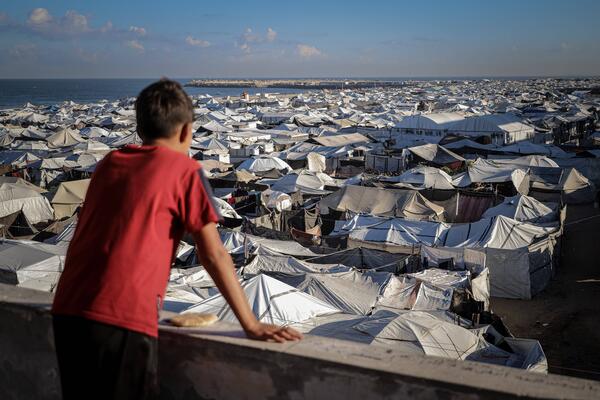
I believe this is not by choice, but rather inheritance. It is every Palestinian child in Gaza who plays and paints birds and eagerly attends kindergarten—now inside a tent—that gives me hope. It’s the flower that insists on growing out of rubble. It is the memory of my grandparents who did everything to protect and feed their children, amid military curfews and guns pointed at them. Or the mother who cries for the family she has lost, and still somehow finds the faith to utter Alhamdulilah—praise be to God. It is artists like the beloved and late Sliman Mansour, who lived a lifetime under occupation and yet, only a year before his passing, prophesied that he would die “one year before the liberation.”
My own artistic practice allows me to imagine what we carry forward and preserve as Palestinians and how we ensure our stories do not fall away to the past but remain present and ongoing, seen and responded to. The endless beauty and strength of my people give me the heart to envision a better future, not as a dream, but a collective responsibility to uphold, so that our children (of the world) may know peace and justice.
The endless beauty and strength of my people give me the heart to envision a better future, not as a dream, but a collective responsibility to uphold, so that our children (of the world) may know peace and justice.
-Dima Zaghal
My parents always taught me to keep looking forward. In my mother’s memoir, Love Life and Press on With Peace, Safa Hamed writes, “I learned to love life from my dad, and I learned to press on from my mom. Each one of us needs these two ingredients to go through life when it is kind to us, and also when it is not so kind. I continue to love life and press on as a Palestinian woman journeying through life, lighting a candle for peace.”

Did this article have an impact on you? Tell us how! Whether you’re moved to take action, have a question, or want to share a comment (good or bad), we value your feedback!