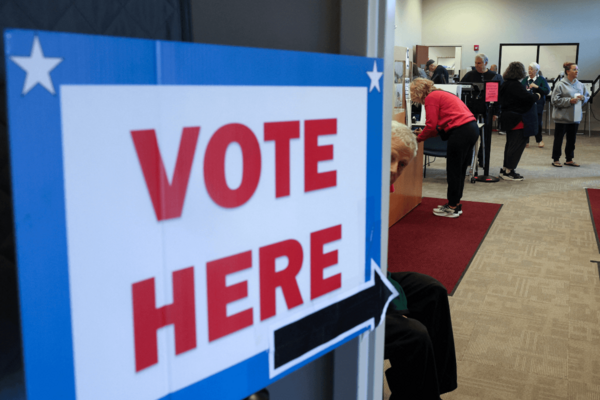
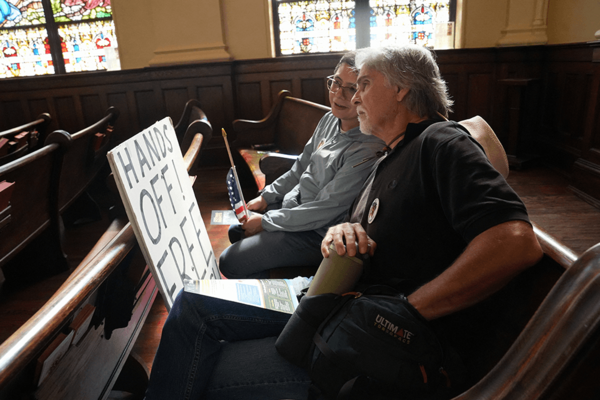
Long before voters headed to the polls on Election Day, faith leaders across the country had been working to build relationships with the election officials and volunteers working to make voting safe and secure.
The city of Hamtramck, Mich., has been a site of numerous election contestations in the last year: a tightly contested mayoral race that has an ongoing lawsuit, allegations of ballot harvesting, and the firing of the previous city clerk for partisan displays. For all of these reasons, Nomi Joyrich knew it would be important to serve as a poll challenger—a person credentialed to monitor elections for irregularities.
There was another element, though, that concerned Joyrich’s friends: the contentious Senate race, where U.S. support for Israel and accusations of antisemitism have all elevated the temperature of the Wolverine State. Hamtramck has a large Muslim population, and Joyrich was dismayed to hear so many friends concerned for her safety.
“I was kind of stunned at how many of my Jewish friends were saying, ‘I can’t believe you're going to go to Hamtramck … don't wear your Magen David,” she said.
Joyrich was confident though. She belongs to the Reform movement in Judaism; she’s the child of Holocaust survivors; and she said her work is guided by the phrase tikkun olam, which means “repairing the world.” As Michigan director of Jews for a Secular Democracy, her work includes protecting “the fundamentals of democracy.”
Often, that means very basic voter education: not who to vote for, but how to register, how to vote, what’s on the ballot, and how to find information about candidates or ballot propositions. She’s run ID clinics and helped people living in shelters with registering and voting. She meets with Michigan election officials, known in Michigan as city clerks, and runs a robust poll-challenging operation, gathering scores of volunteers to serve as nonpartisan election challengers.
She wore her grandmother’s Magen David.
At the election site, she found nothing but a warm welcome and professionalism. She built relationships with the new city clerk and his staff and watched as they trained poll workers.
“The city clerk of Hamtramck came up to meet me, made sure that he could answer any questions that I had, gave me his personal phone number,” she said. “The election workers were all very, very cooperative, very kind, very thorough.”
Joyrich is one of a number of faith leaders working to rebuild trust in elections by connecting their communities directly with the officials and volunteers who run them. These direct experiences with the people running elections are a major part of trust-building, she said.
“If I ever know anybody who’s skeptical about the security of elections, I try and get them to come to these meetings with me,” she said. “Almost always, when people see the election equipment tested, they walk away very reassured about the voting system in Michigan.”
‘Elections are run by our neighbors’
According to the Public Religion Research Institute’s 2026 American Values Survey, which polled respondents in August and September, only 17% of Americans say they have a “great deal” of confidence in elections. Forty-four percent of respondents said they have “little” or “none at all.”
READ MORE: OK, We Voted. Now What?
For Scott Rasmussen, director of democracy initiatives for national nonprofit Interfaith America, a major reason for this is that people forget elections happen right in their own neighborhoods.
“Our elections are run by our neighbors. They’re run by people who live in our communities,” Rasmussen said of county clerks, recorders, and other local officials. “And a lot of the actual election administration is run by volunteers—people who aren’t even paid but who are doing this because they think it’s important … We vote locally. The elections and ballots are counted locally.”
His organization sees building election confidence as building confidence in neighbors. Joyrich’s experience is just one example of that work. Joyrich has a working relationship with Interfaith America, including as a recipient of a Faith in Elections Playbook grant in 2024.
“Elections provide a concentrated moment to practice pluralism,” Rasmussen told Sojourners. They’re also an opportunity for faith leaders to use their civic and moral authority to provide accountability, support, and appreciation for civil servants.
“In the last several [election] cycles, some of these officials have come under particular pressure about how they’re administering the elections, how the count’s going, how the certification is going,” Rasmussen said. “We wanted to create an opportunity for faith leaders or civic leaders in communities to go and visit and meet with their election officials to talk about what are the concerns in their communities.”
Interfaith America updated the Faith in Elections Playbook, a toolkit that civic leaders are using to help faith communities engage in election work. Among other activities, the playbook and Interfaith America offer support for meeting with election officials.
By meeting with election officials, faith leaders said people are able to learn how elections should operate and ask officials about their plans for if Election Day doesn’t go as expected. They’re also able to build relationships that strengthen volunteer election work.
Firsthand information
Jane Andersen has seen the value of getting involved in elections and meeting her election officials for multiple election cycles now. Andersen, Arizona political director for Mormon Women for Ethical Government and a Vote is Sacred fellow with Interfaith America, watched in 2020 as “Sharpiegate” unfolded.
As election results were tabulated and news media predicted Joe Biden’s victory in the state, Republican officials and others falsely claimed that Sharpies were being handed out to invalidate Republican votes in Maricopa County. Hundreds of pro-Trump protesters gathered outside a Maricopa counting center to protest.
As election officials worked to dispel misinformation, MWEG turned to one of its members who had served as a poll worker at the location where the controversy began.
“We had boots on the ground, a firsthand experience,” Andersen said. “We did an interview with that poll worker … just for her to explain exactly what happened and the instruction that was given and how this actually wasn’t a controversy.”
The interview went viral, and Andersen points to it as an example of the impact that people of faith can have in building confidence in the election process. In the lead-up to the 2026 midterm elections, MWEG has continued that work among its politically diverse membership, helping numerous women volunteer as poll workers or poll chaplains.
Rasmussen said that while people often think of the contentious, divisive nature of elections, that divisiveness is a hidden opportunity to build strength across difference.
“Yes, elections are polarizing and divisive—by nature, that's what they are,” he said. “But that gives us an opportunity to work together and to find the common ground that we can to strengthen elections, to strengthen the election processes, and to strengthen the confidence that people feel in voting and participating.”
Andersen sees that cross-partisan collaboration regularly. She has been a part of MWEG since its early days as a forum on Facebook in 2017–18. The organization, which operates independently from The Church of Jesus Christ of Latter-day Saints, has since grown to 10,000 members across the U.S. As Arizona political director, Andersen has done a lot of work to educate Latter-day Saint women on the political process in her state.
She told Sojourners that the women in her cohort aren’t usually “election deniers,” who question the outright integrity of elections or the legitimacy of the 2020 election. But some do have questions about government practices and concerns about corruption in the government. Even those who are confident in the process sometimes wish they had more firsthand knowledge. They tell Andersen: “I would love to just have in my back pocket, ‘I've met with the secretary of state, and this is how this process works.’”
So MWEG organized those meetings. So far, they’ve met with Arizona Secretary of State Adrian Fontes, Pima County Recorder Gabriella Cázares-Kelly, and Maricopa County Elections Director Scott Jarrett. They toured the Maricopa County Tabulation and Elections Center—headquarters for the fourth-largest county in the U.S., with more than 4.5 million residents. Members brought their concerns and had them answered by officials.
“We’re very worried about intimidation at the polls,” Andersen said.
In particular, several women asked about the possibility of Immigration and Customs Enforcement showing up at the polls. Experts say the presence of federal agents or military personnel is barred by federal law, despite President Donald Trump’s comments that he would do “anything necessary to make sure we have honest elections.” The Trump administration has said it doesn’t plan to patrol polling sites, but the Associated Press reported that the Department of Homeland Security said agents could go if serving a warrant or responding to a threat.
Andersen’s group asked Fontes and Cázares-Kelly about their plans for ICE and were surprised to hear that while officials had plans for the possibility, it wasn’t the top concern.
“They said, ‘We have great relationships with local law enforcement, and we feel like this is not going to be an issue,’” Andersen said. “I think there’s concern that talking about it being an issue actually gives the possibility of this happening more credence and actually creates more fear than they felt comfortable with.”
Relationship building
In Southfield, Mich., the new city clerk, Gabi Grossbard, is running his first general election. Grossbard was elected in 2025, amid controversy surrounding his support of “Make America Great Again” Republicans, his participation in a lawsuit to disqualify votes in Michigan counties in 2020, and some of his comments on the Jan. 6 insurrection.
Joyrich said Grossbard doesn’t want to be known as an “election denier” and that he “very actively wants to have relationships with the community and develop trust in the community.”
She met with Grossbard soon after his election. She learned before meeting that Grossbard is an Orthodox Jew and has an adult autistic child, so to get off on the right foot, she brought snacks from a kosher bakery that is also a training center for autistic adults. “It also happens to be a phenomenal bakery,” she added.
After that meeting, Grossbard worked closely with Joyrich and her colleagues in the election protection space. She said he’s asked for and incorporated their feedback, traded cell numbers and offered an “open-door” policy for his office, and even invited them to be challengers during the August primary election.
“He wanted us to both point out any problems to him and also be able to talk about it on social media to say that things went smoothly,” she said. “And they did go smoothly.”
“We wanted to create an opportunity for faith leaders or civic leaders in communities to go and visit and meet with their election officials to talk about what are the concerns in their communities.” —Scott Rasmussen, Interfaith America

Did this article have an impact on you? Tell us how! Whether you’re moved to take action, have a question, or want to share a comment (good or bad), we value your feedback!