I remember the first time I asked Mary to pray for me. It was at the height of the George Floyd protests in June 2020. I was living on the South Side of Chicago, and I had just finished parking my car when our next-door neighbor emerged from his home. My neighbor decorated his home with a Confederate flag and images of white Jesus. At the sight of my car, which I had accidentally parked on the wrong side of the street, he called me the n-word.
I had never felt so unsafe.
I rushed inside and collapsed onto the floor of my Chicago apartment, using the living room couch as a shield. But instead of praying directly to God—which is what I had been taught to do as a Protestant—I turned to God’s mother, Mary.
Mind you, I grew up in war-torn Mindanao, Philippines—a place shaped by long histories of violence under multiple colonizers. I was brought up in the ruins of war: feeling a constant fear of armed clashes, getting caught with friends amid the detonation of explosives, and enduring repeated inspections at military checkpoints whenever my family and I returned home from our travels.
These childhood moments belong to the broader structural reality of colonialism in the Philippines. During the era of Philippine nation-building in the early 20th century—following Spanish and American colonial rule—Mindanao was absorbed into a Philippine state that centralized its power, government, and authority in the sprawling globopolis of Metro Manila. Such a reality produced ongoing conflict between the emerging Philippine nation-state and two groups struggling for sovereignty in Mindanao: Indigenous Moro communities and communist insurgents.
I was born in that world. I grew up in that world. I lived in that world.
But when my next-door neighbor called me a racist name, it was the most unsafe I had ever felt. I was terrified for my life. It terrified me more than the gunfire that punctuated my childhood, or the encroachment of military forces into the villages where I spent so many of my early years.
In that moment of desperation, I asked Mary for help. And I have continued to ask her to intercede for me and my loved ones in times of vulnerability. In my lifetime, there has not been a more vulnerable moment than the one we currently face, as President Donald Trump continues to expand and entrench his authoritarian rule and U.S. military dominance.
Marian liberation theology
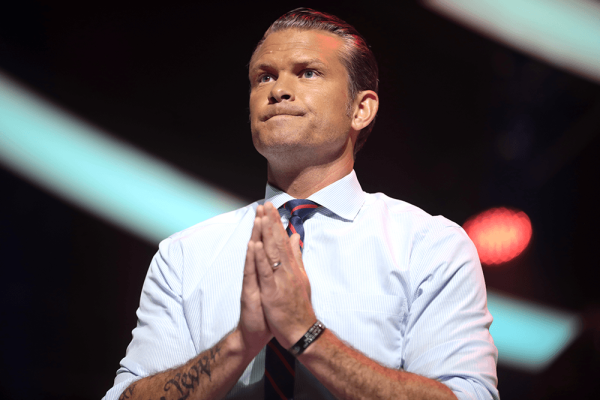
In March 2025, Trump’s “Secretary of War” Pete Hegseth arrived on Philippine soil to secure military alliances with a nation-state that continues to allow neocolonial relations with the U.S. to persist. The military technologies that the Philippine government receives through such alliances have been used in operations against political dissidents to terrorize local villages and murder civilians. Some of these operations have taken place on Mindanao, which continues to be colonized by the U.S.-Philippine alliance. Indeed, this is the legacy of U.S. imperialism in the Philippines, and one embedded within the structure of global U.S. militarism as represented by Hegseth and his so-called “Department of War.”
This is the same Hegseth who is currently facing bipartisan scrutiny for allegedly committing war crimes when ordering strikes on Venezuelan boats on September 2, which the Trump administration claimed were smuggling drugs. According to a November report from The Washington Post, two people familiar with the operation claim that a second strike on survivors was ordered by Hegseth, ensuring that there would be no survivors. Hegseth is quoted as giving the order to “kill everybody.”
When news like this begins to overwhelm me, I turn toward an icon of Mary hanging on my dining room wall. In the image, she cradles her infant son Jesus with a serene gaze; her posture radiates calm. Her image stood in stark contrast to that of Hegseth’s—the embodiment of U.S. militarism in the Philippines that continues to underwrite the oppression of people whose lives and struggles shaped my own childhood.
When I see Hegseth, I’m reminded of my racist neighbor. They aren’t the same person, of course, but the parallels are hard to ignore. Both cling to symbols of Christofascism and both lean on a kind of white masculine aggression that depends on degrading and destroying those they imagine to be “lesser than.”
Frankly, both men make my skin crawl.
But unlike Hegseth or my white supremacist neighbor, Mary brings faith to my spirit. Mary has long inspired the struggle against colonial and racial violence. Religious images of Mary are part of a long history of anti-colonial struggle in the Philippines, especially in contexts of severe poverty or fascist violence.
READ: Is the Epstein Controversy an Apocalyptic Moment for the MAGA Movement?
I grew up witnessing these images of Mary held up during mass protests or set up as altars in the homes of radical Catholics. And even among the Moro people, who are predominantly Muslim, Mary is crucial for their spiritual and social lives, being referred to 34 times in the Quran as well as identified as God’s chosen “over all women of the world” (Al-Imran 3:42-43).
Filipina scholar Jamina Vesta M. Jugo argues that Marian devotion remains “relevant” and “constructive” for liberation struggles among the oppressed in the Philippines—especially women who endure multiple layers of marginalization. Some of my own family and friends held a deep love for Mary. Many devoted their lives to her, seeking her intercession as they pursued both spiritual and material resilience amid grinding socioeconomic duress.
My Marian devotion
With that history threaded through my own childhood, I have found myself turning to Mary for my own spiritual resilience. Although I’m Protestant, Mary has become crucial to my faith.
And while outlets like The Atlantic have critically referred to Hegseth as a “holy warrior,” Mary stands as a living testament that Hegseth’s God is a false god. More precisely, Mary reveals that the true God was born an infant, nursed, and cradled by her in the slums of first-century Bethlehem.
Mary reveals that God has a mother—that God, in the infant Jesus, is wholly dependent on her for his very life. As Theotokos, the “Mother of God,” she unmasks the false image of Hegseth’s domineering, militarized deity and bears witness instead to who God truly is.
Thinking back to that moment in Chicago, when I first prayed to Mary, it struck me that Jesus would have never existed without Mary’s simple, courageous consent: “May your word to me be fulfilled” (Luke 1:38). If my Christian faith rests on God becoming flesh for the sake of the world, then I owe much to Mary—not only for bearing Jesus, but for nursing him, raising him, teaching him, guiding him, and staying by him all the way to the cross.
Mary is far more central to the Christian faith than many of us—especially in Protestantism—are willing to admit.
I’ve come to see Mary as crucial to the very unfolding of God’s mission to reconcile all things. Put plainly: God needed Mary. Without her, the incarnation simply wouldn’t have happened. God needed her to become God’s mother—to rock Jesus to sleep, to help him burp after meals, to give him baths, and to tend to his most ordinary, bodily needs. If we speak of God’s power and glory, we remember that the divine being Mary held was a child who was not self-sufficient. God’s power was found in a splendorous weakness, a vulnerability that depended completely on the care of another. And this dependence wasn’t an embarrassment to God’s nature—it was the very shape God chose to take when entering the world. As theologian Paul Dafydd Jones reminds us, “God gives up thoroughgoing control over God’s being,” handing the fate of God’s own life over to Mary.
We need Mary this Advent
It is Advent, but it feels obscene to be merry while Christianity is used to support U.S. militarism. On Dec. 16—the week before Christmas—eight more people were killed extrajudicially in the eastern Pacific Ocean at the direction of Hegseth. Since the attacks began in September, the death toll now exceeds 90.
There is nothing accidental about this violence. Hegseth’s iron fist belongs to a broader white authoritarian regime—one that sanctifies the normativity of whiteness. What I encountered in 2020 was only the surface expression of a longer history of racial domination that has systematically exploited and murdered those whom the Martinican psychiatrist and writer Frantz Fanon described as “the wretched of the earth.”
But Mary offers us a truer picture: God is an infant, dozing in a feeding trough at the outskirts of first-century Palestine.
Because of the God whom Mary uniquely witnesses to, I cannot let my particular Protestant upbringing hold me back from cultivating a form of devotion to her. Even Martin Luther, the fountainhead of Protestantism, insisted that “it needs to be pondered in the heart what it means [for Mary] to be the Mother of God.” Because I was also shaped by a deeply Marian tradition—one woven through the struggles of oppressed peoples in Mindanao, Philippines—I’m convinced more than ever that Christians need Mary now.
We need Mary because she witnesses to a God whose glory shows up in vulnerability, a God whose power is found in powerlessness. This God is an infant who unsettles every false image that casts God as a tyrant rather than the son of Mary.
We need Mary because she witnesses to a God whose glory shows up in vulnerability, a God whose power is found in powerlessness.

Yanan (or Abdul) is a theologian from the Philippines. He writes about Christian radical politics, and his writing has appeared in BitterSweet Monthly, Interfaith America, the Institute for Christian Socialism, and other outlets.
Did this article have an impact on you? Tell us how! Whether you’re moved to take action, have a question, or want to share a comment (good or bad), we value your feedback!