
Rev. Kyndall Rae Rothaus is the author of Thy Queendom Come: Breaking Free from Patriarchy to Save Your Soul (2021) and Preacher Breath (2015). She is a preacher, poet, feminist theologian, queer woman, storyteller, soul companion, and the co-founder of Nevertheless She Preached.
After eight years working as a Senior Pastor, Kyndall left institutional church work to found her own practice as a spiritual director, working with individuals to heal from religious trauma and re-imagine their spirituality. Kyndall is also the proud adoptive mom of two rambunctious toddlers and two highly extraverted pets. You can learn more about her onher website, kyndallraerothaus.com, or follow her on Instagram @KyndallRaeRothaus.
Posts By This Author
The Upside-Down Kin-Dom
October reflections on scripture from the ‘Revised Common Lectionary,’ Cycle A.
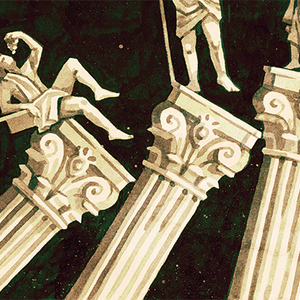
SOME TRADITIONAL INTERPRETATIONS of parables that I grew up with leave me wanting. In particular, I can’t abide a God who is depicted as a vengeful king or a landowner with slaves—and I don’t think I’m wrong to feel uncomfortable here. What if the problem is not with the parables themselves, but with the way we have historically read them? Perhaps some of Jesus’ parables are less allegory and more Grapes of Wrath exposé.
Perhaps by exposing the brokenness of systems, Jesus is suggesting this: The kingdom—kin-dom—of God is not a mere improvement on the systems we serve today but a full reversal. (The systems should serve humanity, not the other way around!) God’s vision is fundamentally relational and always concerned with the well-being of the most vulnerable. Imagine it. What if kings were more like gardeners than landlords and cities were true refuges and parties were for everyone?
Reading the Bible faithfully has economic, physical, and political ramifications that ought not be reduced to a meaning that is “spiritual” only. This month’s scripture texts invite us to contemplate how radical it really is to love your neighbor. It can be uncomfortable to reread some of these texts through a liberation lens, but I believe it is the kind of discomfort that leads to transformation. Let’s explore these texts with fresh eyes, open minds, and receptive hearts, willing to hold the discomfort and willing to be reshaped by the word of God.
Beautiful, Messy Human Forgiveness
September reflections on scripture from the ‘Revised Common Lectionary,’ Cycle A.
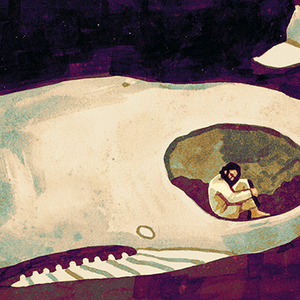
FORGIVENESS CAN BE a profoundly beautiful act. And I never talk about it without offering some critical disclaimers because I know all too often forgiveness has been misused to keep victims and survivors silent and oppressed. Forgiveness is not about allowing abuse or mistreatment to continue. It is not about excusing bad behavior or insisting that you remain in relationship with the systems or person harming you. Forgiveness is fundamentally about liberation—liberation of self, and when appropriate, liberation of the repentant party.
These passages engage the theme of forgiveness, and I encourage every preacher to handle these texts with care using a lens of liberation. Preach in such a way that you are never sending a victim back to her abuser. Preach in a way that sets the people free. Make forgiveness the thing of beauty it is capable of being, not another trap for the downtrodden. How? Perhaps by letting the texts be as complex as our actual human lives—full of nuance and heartache, consequence and hope.
Our job is not to resolve the tension but to carry it well. Yes, Joseph forgives his brothers. But he messes with them a bit first. It’s not that black and white, and neither are our lives. Yes, Jesus surrenders himself to death, and it’s brave, noble, and profound. He also rises from the dead and seems to know he would. He wasn’t surrendering to his enemies so much as entrusting himself to a God who could bring resurrection from death. That distinction matters. Forgiveness can be beautiful, but it is rarely simple.
God Is Holding On
August reflections on scripture from the Revised Common Lectionary, Cycle A.
I DON’T KNOW about you, but I’m having a tough time. I look around and so much is broken that I don’t know how to fix. To make matters worse, your personal life never gives you a break just because the world is falling apart, which hardly seems fair. It’s always something, and it’s just too much for one person to hold.
We are not the first to feel this way. I found inspiration in the characters from our lectionary texts this month. They faced great challenges, too, and surely felt the same despair and fear we do. They navigated uncertainty, conflict, and circumstances beyond their control. And yet, it turns out God didn’t need them to be perfectly faithful or unshakingly stable.
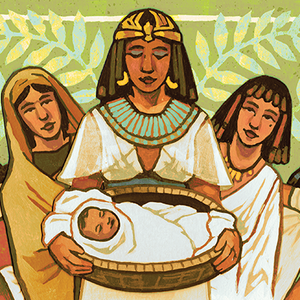
When Peter gets scared and starts to sink, Jesus pulls him back up. When Moses’ life is threatened at birth, six women participate in his rescue (and it takes all of them). Peter questions Jesus to his face because he does not understand. Jesus corrects him without kicking him off the team. The heroes of these stories and of our faith are brave and also human—just like us. God is not upset about our human limitations. God sticks it out with us. Maybe faith isn’t about holding everything together. Maybe it’s about trusting that we are being held, even when we’re not sure we can hold on.
The Practice of Micro-Joy
July reflections on scripture from the Revised Common Lectionary, Cycle A.
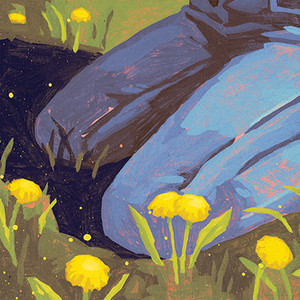
A FRIEND RECENTLY shared with me her practice of micro joy—pausing to appreciate the small things—and I can’t stop thinking about that word “micro.” When things are so very wrong on a macro level, it can be easy to neglect altogether the seemingly small stuff.
But what if the small stuff is actually the big stuff? Maybe connecting with my daughter by getting down on her level is resistance. Taking time to admire the sunset is prayer. Inviting my neighbor over for coffee is the work. I don’t suggest burying our heads in the sand about the big injustices to focus only on the here and now. I simply mean that the daily little practices and gestures contribute to a healthier soil in which liberation can sprout. These small acts prepare the ground—and that work matters.
Not all kingdom work is big or flashy or causes a system overhaul. But the little choices have ripple effects and something as tiny as a mustard seed can grow a tree. A little bit of grace, a little bit of courage, a little bit of hope, a little bit of prayer, a little bit of love can go a long way toward reorganizing the system so that everyone’s potential gets planted in equal soil.
Mary Oliver’s words keep playing on repeat in my head, “I don’t know exactly what a prayer is. I do know how to pay attention, how to fall down into the grass, how to kneel down in the grass.”
When Our Faith Forgets People
June reflections on scripture from the ‘Revised Common Lectionary,’ Cycle A.
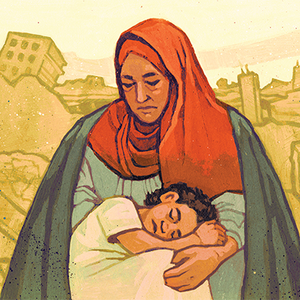
As Christian nationalism continues to plague the United States, I find myself asking the question: Who pays the price when faith separates itself from humanity? History is clear. It is the children. The mothers. The women. The foreigners. The outsiders. The marginalized.
Who reaps the reward when we reconnect faith to the unlimited compassion of Jesus? All of us. All of us. All of us.
Never in my lifetime has it felt as critical as it feels right now to make Christianity Christ-like again. Critical, as in people are dying. Critical, as in babies are starving. Critical, as in we are losing our very souls.
Are We Guardians of the Gate?
May reflections on scripture from the Revised Common Lectionary, Cycle A.

As we move from Easter through Pentecost, we witness the Spirit of God very much alive and showing up, often where we least expect. Taken together, these reflections pay attention to the ways God keeps speaking and the ways we are tempted to silence, dismiss, or police those appearances.
My daughter and I recently watched Zootopia 2. The utopia created there starts to show its cracks as Judy Hopps uncovers the truth about how reptiles were forcefully erased and pushed out of the land. A daring adventure and reclamation ensues, all because Judy, a rabbit, is willing to listen to a snake—the very animal everyone has villainized. I was reminded of the movie as I read these lectionary passages, because what happens to our own scriptural story if we listen to Stephen, to Mary, to Eldad and Medad, to Hannah? What happens if we stop gatekeeping who gets to have a voice? Where might we uncover God if we were no longer covering up those we have deemed unworthy?
Again and again in scripture (and in life), humans find it easier to preserve order than to risk disruption, easier to protect authority than to make room for revelation. But these lectionary texts bear witness to a Spirit who does not wait for permission but breaks through barriers in order to be heard.
In the Wake of Resurrection
April reflections on scripture from the Revised Common Lectionary, Cycle A.
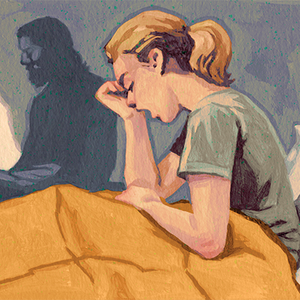
Even a resurrection doesn’t eradicate suffering. People still weep and doubt and worry and fear. Friends still have to say goodbye. There are misunderstandings and missteps. There are valleys full of shadows. There are enemies. There are needs. Life keeps on “life-ing”—a fact that shouldn’t surprise us when we remember that life is alive, not dead.
Even so, in case you were tempted to believe Easter is the “happily ever after” of the Christian story, the texts in this Easter season will remind us that Easter wasn’t an ending but a beginning. There are trials yet to come. These passages aren’t only a reminder that crap will continue to happen. They are also a reminder that God is there with us in it.
God Holds Our Wobbly Faith
March reflections on scripture from the ‘Revised Common Lectionary,’ Cycle A.
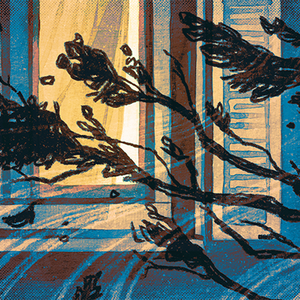
IF YOU ASKED ME how strong my faith feels, especially these days, I might tell you that I feel as strong as the leaves and twigs of a tree in a windstorm. But if you asked me what I’m connected to, I might tell you that my tiny twigs of faith are tied to a pretty solid trunk of community rooted in rich soil.
I’m sorely tempted, every day, to live in my leaf energy and cry. To “twig out” in terror. But I’m trying to remember that this faith thing is not a solitary endeavor, that because of you we have a trunk, that because of our ancestors we have roots. I’m trying to remember that even when the storm rages on, it will take a lot more than high wind to knock us flat.
Watch for the Morning Star
February reflections on scripture from the Revised Common Lectionary, Cycle A.
I’M GOING TO be real with you. I experienced a good bit of religious trauma in my ultra-evangelical, fundamentalist upbringing, and I’ve spent decades healing. What has shocked me, though, is the harm I have experienced and witnessed inside progressive faith circles—places where, in theory, we shared theology and values. It turns out people of any persuasion can fall prey to the temptation of superficiality rather than depth, performance rather than sincerity. It was a rude wake-up call, but hopefully the kind of disillusionment that keeps a gal genuine.
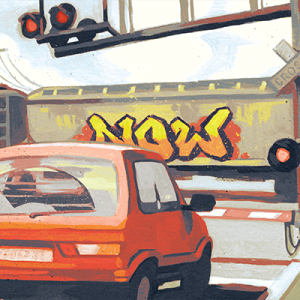
February’s texts draw us into humble evaluation of where we are and challenge us to a depth of commitment that can’t be faked or flaunted or rushed. Imagine you’re driving somewhere in a big hurry when (with the worst luck!) you’re forced to stop for a passing train. You impatiently tap on the steering wheel until you look up and notice that each passing boxcar is painted with a word. “Take. A. Breath,” say the train cars, “Go. Ahead. You. Have. Time. The. Lesson. Is. Now. Not. At. Your. Destination. Now.”
So, you take a deep breath. And then another. Because what else are you going to do? The train is no longer wasting your time. It’s become your teacher. My prayer is that these reflections function like those imaginary train cars, slowing you down just when you were running on urgency.
Waiting on the World To Change
January reflections on scripture from the Revised Common Lectionary, Cycle A.
THE SEASON OF Advent is over, but the season of our waiting is not. There is still so much we long to see brought to fruition. Every morning’s news confirms the ache. We are pining for so much to be made right in a world that has gone so wrong. Christmas may have marked the end of Advent, but the liturgical year has only just begun. In other words, Christ has been born, but there is still a lot of story to be played out. What a great reminder as we head into yet another year that looks bleak at the outset: This story we are living in isn’t done yet. There is more to come, and some of it is very good news.
Just as it will take time for the Christ child to grow into the savior the world needs him to be, in every era of human history, the growth of justice takes time. Recognizing the slow pace at which the kin-dom of God unfolds does not mean we lie down on our backs and abdicate responsibility, but it does mean we have hope as we both labor and rest. No matter how dismal it may look out there, justice is on its way.
January’s readings take us into conversation with texts aching for justice and longing for homecoming, helping us sense when to listen and when to speak, when to hold still and when to move. We are encouraged to be tender with each other as we wait, to hold on tight to hope, and when the moment calls, to act with conviction.
How Did ‘Pastor’s Wife’ Become a Job Title?
Beth Allison Barr’s ‘Becoming the Pastor’s Wife’ details just how very untrue the story we’re often told about women in church leadership is.
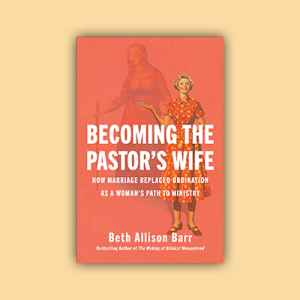
Becoming the Pastor's Wife: How Marriage Replaced Ordination as a Woman's Path to Ministry, by Beth Alison Barr
AS AN ORDAINED female minister, I was somewhat hesitant picking up Beth Allison Barr’s Becoming the Pastor’s Wife; it sounded like a story I have gone to great lengths to leave behind. Her work indeed transported me back to my days within the complementarian Southern Baptist Church, a time when I continually received messaging that, as a woman, my status was secondary to men.
Sometimes though, revisiting the pain can help to heal and integrate the wound. Barr, a professor of history, proves to be a worthy healer. I already knew that the story we’re often told about women in church leadership (i.e., they never serve as pastors) simply isn’t true, even in Southern Baptist history. What I didn’t know was just how very untrue.
Barr begins by identifying biblical church leaders such as Prisca, Junia, and Phoebe, then explores women in medieval Christianity, highlighting, for example, the impressive leadership of Milburga, a Benedictine abbess, who Barr argues functioned “like a bishop, which is why depictions of her include a crozier.”
Barr also winds her way through Southern Baptist history, making it irrevocably clear just how many leadership roles women have played in the church, including preaching, teaching, and pastoring.
Mary Magdalene’s Bad Reputation
The disciples couldn’t handle that a woman received Christ’s favor. And apparently neither can history.
Illustration by Mary Haasdyk
IN THE OPENING scene of Cecil B. DeMille’s 1927 silent film The King of Kings, a scantily clad but opulently accessorized Mary Magdalene reclines on a lush chaise lounge, caressing a cheetah. She’s an upper-class prostitute, and she learns that Judas, one of her clients, has left her to follow a carpenter. Furious, Mary demands, “Harness my zebras—gift of the Nubian King! This Carpenter shall learn that he cannot hold a man from Mary Magdalene!”
Before she mounts her chariot, someone wagers a purse of gold that she won’t be able to take Judas back from Jesus, because Jesus has magical power to heal the blind. Mary scoffs in reply, “I take thy wager—I have blinded more men than He hath ever healed!”
An angry, haughty Mary finds Jesus, but when he looks at her, she is shaken and steps back. Jesus begins to heal her of seven demons, which emerge one by one from her body like ghosts. After the demons have departed, Mary looks down at her partially naked body, picks up her cloak to cover her skin and hair, then kneels at Jesus’ feet. He pats her head, as if patting a child, and looks away, speaking not to her, but to a man beside him.
I had enjoyed Mary Magdalene’s exotic transportation via zebras, her fury at being scorned, her verbal sparring with the men who doubt her ability to win Judas back. But as I watched the “demons” drain out of her, I felt her life draining too. Now docile and meek, she responds to healing by clothing herself more modestly. The viewer, I take it, is supposed to feel amazed at her transformation. Instead, I felt horror, like I was watching Christianity’s centuries-long suppression of women captured in a 20-second clip, with Mary Magdalene standing in for all of us. The film was silent, but I could hear it speaking to women loud and clear: “Cover up. Lower your eyes. Kneel. Repent. Leave your body and your sexuality behind. Submit. That’s a good girl. You are allowed to belong now.”
Centuries of obsession
WHILE CHEETAHS AND zebras and Judas as Mary’s patron were new adornments to the Mary Magdalene story, the rest of the film’s portrayal was consistent with how Mary has been painted in popular culture for the last 1,500 years: Mary, the prostitute and sinner, turned repentant.
In the earliest accounts, Mary Magdalene is never called a prostitute. Luke 8 says she was healed of demons, but nothing is mentioned about her line of work. It is not until 591 C.E. that Pope Gregory I preaches a sermon calling Mary Magdalene a prostitute, and the misidentification has stuck.
What Does the Bible Say About Women in Ministry?
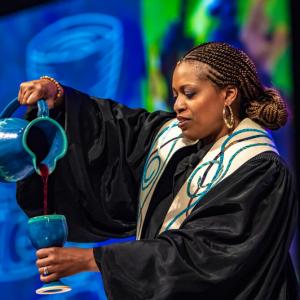
Rev. Denise Anderson pours the cup of Communion during the 223rd GA of the Presbyterian Church (USA).
The Bible has more to say about women in leadership positions than we are often led to believe, and with the exception of that pesky little 1 Timothy passage, the biblical narrative about women leaders is overwhelmingly positive. Let’s take a look at 10 examples.
Bathsheba Tells Her Story

And it is with that hope that we continue to pray all our days, and with the passing of time, we begin to feel our hope is not in vain. We do not know where this assurance comes from. We do not know how or when, but we feel it, know it deep within that someday, somehow God will send a very different kind of king. We can only pray the world will be ready to receive him. He will be a man willing to be ruined on behalf of the people. If only the people will respond in like courage. Amen.
The Bent-Over Woman

If women had an equal voice in the church our conversation about sex in the church would dramatically shift to a focus on confronting violence and aggression. If women had equal voice the church wouldn’t be so reluctant to confront the prevalence of violent pornography.
Gladness Instead of Mourning

There is an unexpected reversal in our country: we are listening to women and powerful, abusive men are falling from glory. It feels to me like God’s love for justice is breaking in. Merry Christmas, y’all. This is what holy reversal looks like, and it is messy and it is uncomfortable and confusing and praise God, the status quo can never return.