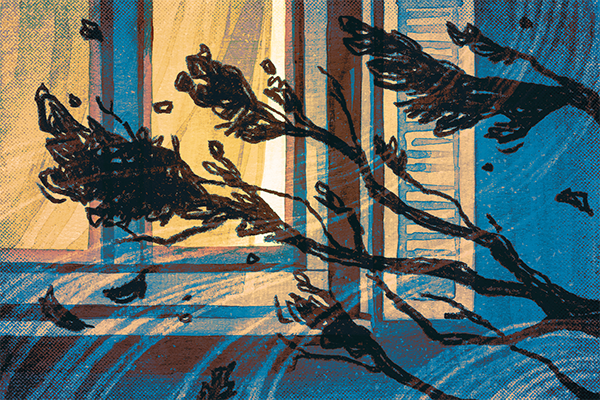
IF YOU ASKED ME how strong my faith feels, especially these days, I might tell you that I feel as strong as the leaves and twigs of a tree in a windstorm. But if you asked me what I’m connected to, I might tell you that my tiny twigs of faith are tied to a pretty solid trunk of community rooted in rich soil.
I’m sorely tempted, every day, to live in my leaf energy and cry. To “twig out” in terror. But I’m trying to remember that this faith thing is not a solitary endeavor, that because of you we have a trunk, that because of our ancestors we have roots. I’m trying to remember that even when the storm rages on, it will take a lot more than high wind to knock us flat.
The lectionary texts for this month struck me as being all about faith—but not “faith” in the pious, performative, or perfectionistic ways we may have been taught to think of it. This is a faith that is real and human and full of doubt and grief and exhaustion.
The faith I am talking about shakes in the wind. It is faith that gets battered and bruised but somehow stays rooted. Or gets tested and fails, then rises. Faith that is curious, not certain. Faith that is storm-worn and tender. No posturing or pretense, just quiet, stubborn hope. Available and accessible to every last one of us, but wholly dependent on others to keep the faith beside you.
March 1
Our Wobbly Faith
Genesis 12:1-4a; Psalm 121; Romans 4:1-5, 13-17; John 3:1-17
IF ALL YOU had were these readings, you might assume Abraham was a pillar of faith. But just verses after our Genesis 12 story where he departs his home at God’s command, Abram (he doesn’t receive the name Abraham until Genesis 17) grows paranoid. Afraid he’ll be killed, he passes his wife off as his sister and offers her for Pharaoh’s taking. Later Abram forces himself on Hagar to try to jump-start God’s promise for an heir, then later expels Hagar and their son, Ishmael. For the “father of our faith,” Abram is not much of a family man. The women in Abram’s orbit repeatedly bear the consequences of his shaky faith, and I am not his biggest fan. But I can relate to his fear and his desperation to see God’s promises come to fruition at last.
I want my doubts to make me tender, not ruthless.
I want to believe with the psalmist that the Lord “will keep [us] from all harm” (verse 7). I do. But my faith, like Abram’s, wobbles. Abram tries to steady his faith with control and abuse. Faith is not the absence of fear, but fear isn’t an excuse to be a bully. I want my doubts to make me tender, not ruthless. I think here of Nicodemus, full of questions and doubts. He is skeptical, but willing to entertain a second birth. In the end, he’s there to catch Jesus’ torn body and wrap it in burial clothes. His shaky faith leads him toward the body, not away from it. The problem is never our doubts; it’s the direction we let them take us.
March 8
People Are Thirsty
Exodus 17:1-7; Psalm 95; Romans 5:1-11; John 4:5-42
THESE PEOPLE IN Exodus 17 have seen God part the Red Sea and lead them to freedom, but they doubt that God can quench their thirst. I understand Moses’ frustration with their grumbling. “And he called the place Massah and Meribah” (verse 7), meaning contention and testing. (Grumpy or not, God gives them water anyway.)
When Jesus asks the woman at the well for a drink of water in John’s gospel, she is astonished that he is talking to her, a Samaritan. (I presume she gives him water anyway.) Jesus speaks to her of “living water” (verse 11) that does not run out, and while that seems wild and hard to believe, she engages him in earnest discussion.
Her posture is decidedly different from the hardened hearts of those at Meribah and Massah. She is open and conversational rather than closed and combative. We are not told her name, but I call her Millâ (Hebrew for “speech”), partly because this is the longest recorded conversation Jesus has with anyone. But also because she feels so free to voice her thoughts and her questions. And because she turns right around and becomes an evangelist (successfully so).
In her commentary on this passage, Karoline Lewis says, “The woman at the well shows us that faith is about dialogue, about growth and change. It is not about having all the answers.” I am thirsty to live among people who are curious. Certainty is like drought, and it’s killing us.
March 15
God of the Unexpected
1 Samuel 16:1-13; Psalm 23; Ephesians 5:8-14; John 9:1-41
BEFORE DAVID WAS KING, he was a nobody, the eighth of eight sons. For the Frozen fans out there, you can imagine David as the “Prince Hans” of the Hebrews, but without the “prince” part. Before Samuel came along and anointed him with oil, no one would have guessed David to be God’s first pick. His own father didn’t even think to call him in from the fields while his brothers paraded before Samuel as would-be kings. “I don’t see as mortals see,” God whispered in Samuel’s ear as one fine brother after the other didn’t make the cut.
When Jesus heals on the Sabbath a man born blind, some (not all) Pharisees are convinced Jesus has sinned because they think he violated Sabbath laws. They can’t handle the surprise and must interrogate everyone they can find as a result. But Jesus doesn’t see religious disciplines the way mortals see them, and his perspective alters the meaning of words, such as “sinner.” I love this God, full of surprises.
Two of my favorite social media creators are “Matthew & Paul.” Paul is blind and loves being pranked because pranks make him feel included rather than infantilized. His husband, Matthew, gleefully obliges. Paul takes so much delight in being surprised. Listen. God wants to “prepare a table for you in the presence of your enemies” (Psalm 23:5). You can criticize the napkin choice, or you can savor the unexpected feast.
March 22
God of the Impossible
Ezekiel 37:1-14; Psalm 130; Romans 8:6-11; John 11:1-45
“MORTAL, THESE BONES are the whole house of Israel. They say, ‘Our bones are dried up, and our hope is lost; we are cut off completely’” (Ezekiel 37:11). But prophet, you must not say what the people say. You must speak a different word than the words them dry bones say. Preacher, I know some days your tongue feels as dry as bone, and in those dry spells, I beseech of you to listen. Listen long and hard until you hear the bones begin to rattle and feel the conviction to predict the return of flesh and breath. And when you cannot hear even the hint of a rattle, much less believe in resurrection? Go ahead and complain to your God in the spirit of John 11:21: “Lord, if you had just been here, there would not have been death.”
God will stop everything and cry with you, and to your surprise, God’s tears will wet your tongue. You will drag your aching, tired, lifeless bones back into the pulpit and your people will feel breath in their lungs again, you miracle worker, you. Can these bones live?
Yes.
Entering Holy Week is never for the faint of heart.
March 29
People of the Impossible
Isaiah 50:4-9a; Psalm 118:1-2,19-29; Philippians 2:5-11; Matthew 21:1-11
IMAGINE IF a poor man, a brown man, a rabble-rouser as he’s known in some parts, showed up in Washington, D.C., today and a large crowd followed, hailing him as king. Imagine how our current president might respond or retaliate. What would become of the brown man? What would happen to him, and where would he be sent? And what of his followers? Would they keep following, no matter what fate awaits?
Entering Holy Week is never for the faint of heart—but this year, in particular, I hope it lands as far more than an ancient story. This is a story for today as we decide who we are going to call king and to what lengths we will go to follow that one.
It gets bleaaaaaak before it gets better, y’all. In the text and in real life. But for just a moment, I invite you to suspend your knowledge of what comes next—the death and destruction you know is coming. Just for a moment, be in the parade. Be in the happy, hopeful throng with your sights set on the arrival of salvation, of relief, at last. Soak in the presence of that Palestinian savior come to show us the way to peace and to love and to justice. And then get ready to cling tight to him, come what may.
Rev. Kyndall Rae Rothaus is a preacher, spiritual director, co-founder of Nevertheless She Preached, and author of Thy Queendom Come: Breaking Free from the Patriarchy to Save Your Soul.
Did this article have an impact on you? Tell us how! Whether you’re moved to take action, have a question, or want to share a comment (good or bad), we value your feedback!