THE LAST NUCLEAR weapons accord, which caps the world’s two biggest nuclear arsenals, expires in February. Signed in 2010, the New START treaty is the final remaining between the U.S. and Russia to limit nuclear weapons. Absent new constraints, the two sides will likely increase the number of deployed nuclear weapons. And thus begins a new acceleration of the nuclear arms race.
In late October, President Donald Trump added fuel to the fire by ordering the resumption of U.S. nuclear testing. Such a step prompts other nations to do the same—indeed, in early November, Vladimir Putin ordered Russian officials to submit plans for “retaliatory” nuclear tests—and reverses one of the signature achievements of the disarmament movement, a de facto nuclear test ban that has lasted more than 30 years.
As participants in the antinuclear weapons movement of the 1980s, we are dismayed to see the gains of that era reversed.
It’s time to take a close look at the current nuclear threat, the history of religious leadership in the 1980s to bring the world back from the nuclear brink, and specific actions to stop the current nuclear buildup and apply pressure for the reduction and elimination of all nuclear weapons.
Bad ideas have recently resurfaced in the nation’s capital. Leading Democrats and Republicans alike endorse what nuclear policy analyst Joseph Cirincione calls the “third nuclear build up now underway,” with an estimated cost over 30 years of $2 trillion and rising. This dangerous new Washington consensus is promoted by nuclear hawks, funded by nuclear weapons makers, and supported by leadership at the Pentagon, and it includes proposals for missiles capable of carrying multiple warheads, more “tactical” nuclear-capable weapons in Europe, and Trump’s threatened return to nuclear testing.
A massive threat
FOR THOSE WHO didn’t grow up on a steady Cold War diet of “duck and cover” drills and deterrence propaganda, it is worth a reminder of what a nuclear weapon can do. Nuclear weapons are the most destructive, inhumane, and indiscriminate weapons ever created. One large bomb detonated over a city could kill millions of people instantly. Following the initial blast, genetically damaging and cancer-causing radioactive fallout spreads among those exposed and into their future generations. “The use of tens or hundreds of nuclear bombs would disrupt the global climate, causing widespread famine,” reports the International Campaign to Abolish Nuclear Weapons.
The global nuclear warhead inventory surpassed roughly 70,000 in the 1980s and has been reduced to below 13,000 today, but the downward trend has stalled and will turn upward again if steps are not taken to stop the madness. We need these weapons to go extinct.
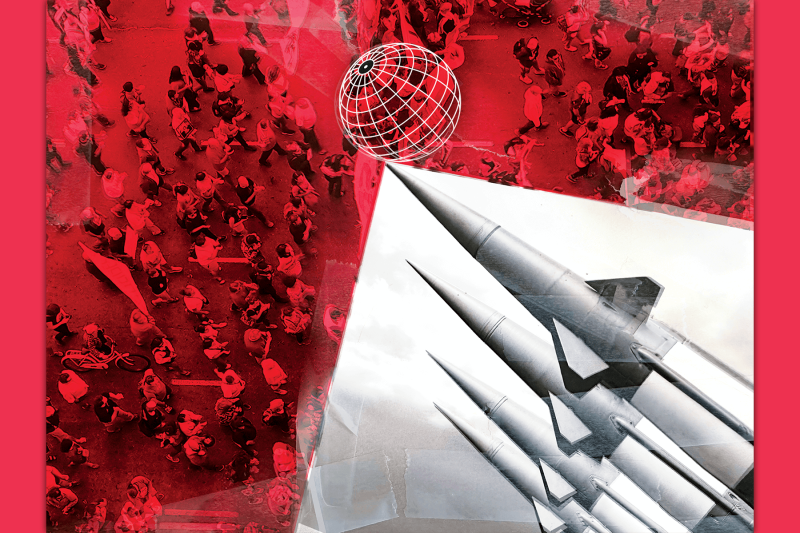
The United States is engaged in a massive program to rebuild and upgrade its entire nuclear arsenal. By the 2030s, five Air Force bases in the U.S. will host nuclear-weapon-carrying bombers for the first time since the 1990s. Russia is upgrading its missile systems and has issued nuclear threats to support its aggression in Ukraine. China’s warhead inventory has expanded to 600, but most of China’s nuclear bombs are in storage, with only about 24 warheads currently combat-ready. North Korea is expanding its nuclear bomb program. India and Pakistan each have more than 170 nuclear weapons. In August, Pakistan’s army chief, Field Marshal Asim Munir, issued an explicit threat to use nuclear weapons against India. Israel has attacked Iran to block its uranium enrichment program but remains silent about its own estimated arsenal of 80 nuclear bombs.
The newest models of hypersonic missiles capable of carrying nuclear payloads are much faster than earlier versions. The U.S. Dark Eagle missiles, made operational this year, travel more than five times the speed of sound. An international false alarm or mistake could start a nuclear war before anyone realizes what’s happening.
janfebnukesfeatureB (1).png
A movement too popular to ignore
GIVEN THE IMMENSITY of the nuclear buildup, some may conclude that little can be done to stop the weapons juggernaut. But we know that success is possible even in the most arduous circumstances.
Between 1965 and 1985, the world faced an enormous nuclear threat, with the U.S. and the Soviet Union deploying tens of thousands of nuclear weapons and constantly building more. Even in that environment, activists and social movements were able to force the Reagan administration to change its policies and negotiate for nuclear disarmament.
The U.S. religious community led a great wave of protest and social mobilization against the rising threat of nuclear war. Faith-based activists helped create the Nuclear Weapons Freeze Campaign and sponsored countless national and locally based programs for disarmament. These efforts were part of the massive disarmament movements of the 1980s that created a political climate conducive to arms reduction and curtailed nuclear testing. This extensive movement set in motion a process of U.S.-Soviet negotiation that slashed nuclear weapons levels by more than 80%.
The “nuclear freeze” proposal was at the heart of the 1980s disarmament movement. In 1979, during the SALT II nuclear weapons talks, Republican Sen. Mark Hatfield introduced legislation to “freeze” nuclear weapons levels. That December, arms control researcher Randall Forsberg gave a groundbreaking speech, “A Call to Halt the Nuclear Arms Race,” suggesting that the antinuclear movement push both the U.S. and the Soviet Union toward a ban on nuclear weapons development. Hatfield’s amendment never came to a vote, but it caught the attention of others. Hatfield’s former legislative aide Wes Granberg-Michaelson had become managing editor of The Post-American (predecessor to Sojourners magazine). Magazine editor and co-founder Jim Wallis shared the idea with Randy Kehler of the Traprock Peace Center in western Massachusetts. Kehler and others placed the nuclear freeze proposition on the ballot in local electoral districts in 1980. The resolution was approved overwhelmingly in districts that voted for Ronald Reagan.
Organizers around the country picked up the idea. In 1982, the freeze proposition appeared on the ballot in 10 states and dozens of major cities. More than 18 million citizens voted on the freeze that year, with 60% in favor—the largest referendum on a single issue in U.S. history. On June 12, 1982, a million people rallied in New York’s Central Park to freeze and reverse the nuclear arms race. Five 1983 polls found an average of 72% support for the freeze, according to arms control expert William Schneider Jr. The concept was eagerly embraced by citizens who were alarmed by an accelerating arms race and the increased risk of nuclear war. The freeze directed its appeal to the Soviet Union as well as the United States, thus challenging the logic of the Cold War and deflecting charges that the movement was pro-Soviet.
Reagan’s White House initially attacked the freeze proposal, but the movement was too popular to ignore. The president was forced to respond and toned down his bellicose rhetoric. Nuclear saber-rattling gave way to messages of moderation and support for arms control. The change was an example of the power of protest.
An international false alarm or mistake could start a nuclear war before anyone realizes what’s happening.
“A direct affront to our Christian beliefs”
NEARLY EVERY FAITH group in the U.S. endorsed the freeze campaign. Many issued congregational and denominational statements on its behalf. The 1983 pastoral statement of the U.S. Conference of Catholic Bishops, “The Challenge of Peace: God’s Promise and Our Response,” was particularly influential. The Reagan White House set up a high-level task force to criticize the emerging draft of the pastoral and asked Pope John Paul II to intervene with the U.S. bishops. The attempt was in vain since the pope was strongly opposed to nuclear weapons and advocated for their elimination. The bishops’ statement was a clear and unequivocal rebuke to administration policy and a major boost for the cause of disarmament. While the pastoral did not explicitly endorse the freeze proposition being considered in Congress at the time, it used the same language to call for “immediate bilateral verifiable agreements to halt the testing, production, and deployment of new nuclear weapons systems”—a freeze by another name.
Most Protestant churches went further than the Catholic bishops in condemning the very existence of nuclear weapons. Two Lutheran denominations passed resolutions urging the elimination of nuclear weapons. The executive ministers of the American Baptist Churches termed the existence of nuclear weapons “a direct affront to our Christian beliefs.” Even famed evangelist Billy Graham framed nuclear weapons as a moral crisis that “demands the attention of every Christian.” Graham told Sojourners in a 1979 interview, “I cannot see any way in which nuclear war could be branded as being God’s will. Such warfare, if it ever happens, will come because of the greed and pride and covetousness of the human heart.”
In 1986, the United Methodist Church offered one of the most far-reaching condemnations of nuclear policy. “In Defense of Creation” opposed any purpose for nuclear weapons and rejected the very concept of nuclear deterrence, adding, “Justice is forsaken in the squandering of the arms race while a holocaust of hunger, malnutrition, disease, and violent death is destroying the world’s poorest peoples.”
The Jewish community also raised its voice for peace during the 1980s. The Union of American Hebrew Congregations was the most active. Led by Rabbis Alexander Schindler and David Saperstein, UAHC actively participated in the nuclear freeze movement and organized educational forums in synagogues and community groups around the country.
In the years that followed, Reagan signed the Intermediate-Range Nuclear Forces Treaty and his successor, George H.W. Bush, signed the START I and START II treaties. By the early 1990s, the U.S. and Soviet Union had stopped the testing and deployment of new nuclear weapons. They both substantially reduced their nuclear arsenals and ended the arms race.
janfebnukefeatureC (1).png
Linking movements
DUE TO THE successes of the nuclear freeze movement, nuclear weapons have faded from the consciousness of many Americans. Today, the major movements against nuclear weapons are carried on outside the United States. Media coverage of the U.S. nuclear program has been limited. Key organizations such as Back from the Brink, the Arms Control Association, Win Without War, the Bulletin of the Atomic Scientists, and the International Campaign to Abolish Nuclear Weapons are addressing the rising nuclear threat. But citizen participation is less than what is needed for political impact.
The greatest challenge for antinuclear activism today is the urgency of other issues. The rapidly warming climate, like the danger of nuclear weapons, poses an existential threat. Both require a global response, and the two are inextricably linked. As political scientist Neta C. Crawford has documented, the Pentagon is the single largest institutional energy consumer and producer of greenhouse gases in the world. U.S. military strategy and military deployments have largely focused on securing access to fossil fuel resources.
In the United States, we face an existential threat to our democracy. Activism today, including the successful “Hands Off,” anti-ICE, and “No Kings” mobilizations, is focused primarily on rising authoritarianism and the impacts of cuts in social spending and health care funding, often without making connections to wider issues of militarism.
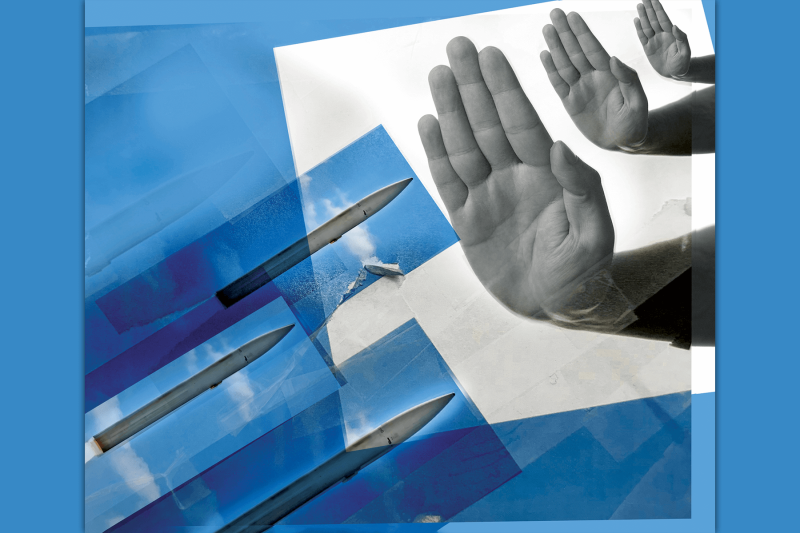
Building a broader movement against the nuclear danger will depend on linking opposition to nuclear weapons with the mobilizations for social justice and defense of democracy. This will require dialogue and mutual support among a range of movements. No movement will be expected to put aside its primary concern, but hopefully bonds of trust and reciprocity will make it possible for organizations working on parallel issues to weigh in on nuclear issues at key moments. This means including peace issues in their talking points and educating their members on how nuclear dangers relate to the other threats we face.
Opportunities for cooperation will grow as huge increases in nuclear weapons spending come at the expense of urgently needed social programs. A case in point is the recently announced 29% increase in the proposed fiscal 2026 budget for the nuclear warhead complex, while the new federal budget bill slashes funding for Medicaid and other social programs.
Dylan Spaulding, a senior scientist in the global security program at the Union of Concerned Scientists, sees a reason for hope. “Paradoxically, the resurgence of threat may be the catalyst for renewed recognition and resistance,” wrote Spaulding. “There is hope, perhaps, that a new anti-nuclear movement can borrow from climate action and nonviolent social justice movements that are gaining traction with younger activists.”
Stopping the nuclear arms race
THE AGENDA FOR reversing the arms race includes building support across several pillars of society. In July 2025, the Arms Control Association and Win Without War launched a new “Appeal to Halt and Reverse the Arms Race.” The appeal draws lessons from the nuclear freeze movement by offering a simple, focused objective: For nuclear states, especially the U.S., Russia, and China, to stop building nuclear bombs and upgraded weapons systems and to negotiate for renewed arms reduction leading to nuclear abolition. Sen. Edward Markey has introduced a resolution for U.S. leadership to halt and reverse the nuclear arms race (S. Res. 323), and Markey and Rep. Dina Titus have introduced new legislation to prohibit nuclear explosive testing. This has now become a priority.
More urgent in the near term is the need for an executive agreement by the U.S. and Russia to avoid exceeding the limits of the New START agreement, which expires on Feb. 5, and negotiation of a new treaty. In September, Putin offered to voluntarily maintain the limits on deployed strategic nuclear weapons. “Russia is prepared to continue observing the treaty’s central quantitative restrictions for one year after Feb. 5, 2026,” Putin said. In early October, Trump said that Putin’s offer “sounds like a good idea” to him, but as of this writing, the U.S. has not formally responded to the Kremlin’s proposal.
The only option for maintaining the limits in the near term is a mutual pledge not to exceed the limits established under New START and to begin negotiations for a new treaty to reduce nuclear weapons. That small but important step could interrupt the current global nuclear arms race and make space for more fundamental changes, up to and including the elimination of nuclear weapons altogether. But this ambitious goal cannot be achieved without the active involvement of faith communities.
Editors' Note: Sojourners is an endorser of the “Appeal to Halt and Reverse the Arms Race.”
David Cortright, a visiting scholar at Cornell University and professor emeritus at Notre Dame’s Keough School of Global Affairs, was co-director of SANE/Freeze.

William D. Hartung is a senior research fellow at the Quincy Institute for Responsible Statecraft.

Got something to say about what you're reading? We value your feedback!