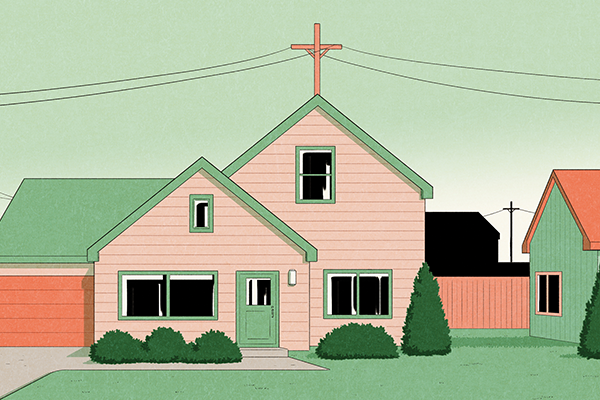
I’M IN HIGH SCHOOL, standing on the football field when my teammate asks me, “How do you have any friends?” It’s a question I’ve prepared for, so, with perfect rhythm, I respond, “I thought we were friends?”
I struggle to answer what it was like to be homeschooled. Not because I can’t describe my own life, but because there are so many variables that make each homeschool experience unique. For decades, the only thing all homeschoolers had in common was how little others knew about our lives. Case in point: My friend could ask me how I made friends at one of the many places where I made friends. I played sports at the local public school, but I also made friends in my homeschool sports, theater, and politics co-ops; in book clubs and talent shows; and at church.
In Dixie Dillon Lane’s new history of homeschooling in the U.S., she deftly narrates the evolution of homeschooling from an illegal and underground practice to a normal part of our education landscape. Skipping School: A History of American Homeschooling and How It Went Mainstream is thoroughly researched and well written. (Full disclosure: Eerdmans, which published Skipping School, is the publisher of my forthcoming book.)
Lane, a homeschooling mother and historian, brings both sets of expertise to her study of the last 70 years of home education. Lane provides a book that is academically responsible, analytically useful, and still recognizable to most homeschoolers. Skipping School is alive with stories and characters that felt like they belonged in my yearbook. My favorite character is Skylar, a homeschool student who accompanies her friend to the public high school only to find that her friend’s teachers don’t believe Skylar is homeschooled. Rather than argue, she shadows her friend for a few classes before hopping over a fence to return home.
Skipping School doesn’t claim to be a comprehensive history, arguing that “no history of such a diverse practice can be definitive … there are only ‘histories’ of homeschooling.” For those with the impression that homeschooling is exclusively for Christian fundamentalists, Lane helpfully records the homeschoolers with diverse motivations and tactics—“hippy, avant-garde homeschoolers”; Black homeschoolers making their house a “hub” for their neighbors; and parents wanting “artsy, Catholic” education for their kids but lacking access to a Catholic version of a Waldorf school. These groups were pivotal to homeschool development between the 1950s and the 1970s.
hippie parents, Catholic parents, Black parents, and more sought to homeschool their kids.
Less helpful is Skipping School ’s treatment of conservative-to-fundamentalist Christians—especially their role in the expansion of homeschooling between 1980 and 2000. When Lane introduces the Home School Legal Defense Association, for example, its religious mission is relegated to a parenthetical: “The organization grew steadily and across political and religious boundaries (though dominated by conservative Christians).”
That domination, whether in HSLDA or organizations such as the Christian Home Educators Association of California, ought to have a prominent role in any history of homeschooling. Forgive the sports metaphor, but a history of the Los Angeles Lakers would only be technically correct to say, “From 2000–02, the roster led the team to three championships (though dominated by Shaq and Kobe).”
Skipping School is aware of the “heyday of white evangelical homeschooling,” but wishes to emphasize how hippie parents, Catholic parents, Black parents, and more sought education outside of public and private schools.
Lane analyzes religious fundamentalism to critique other homeschooling scholarship. She addresses the claim that Michael and Debi Pearl’s To Train Up a Child, which advocates abusive corporal punishment, was popular among homeschoolers. Even if movement leaders distributed the book, she writes, there’s no other “evidence that the book is any more popular among homeschoolers than among other authoritarian Christian families.”
Lane, who I spoke with for this review, told me we shouldn’t assume the values and motivations of fundamentalists trickled down to every homeschool parent. It can be hard for those raised around fundamentalist homeschooling to recognize how different another homeschooling lifestyle might be. I concur with Lane that many homeschool parents—even conservative Christians—aren’t in line with the fundamentalist beliefs or abusive practices promoted by some movement leaders.
But other homeschool parents miss the effects of ever-present fundamentalism on their children. A family may be egalitarian, but when their teenage daughter begins puberty, she may be handed I Kissed Dating Goodbye (author Joshua Harris’ family were homeschool leaders). A boy interested in politics may find himself in TeenPact, learning to “understand the political process,” but also to “defend the Christian faith.”
Skipping School spends little time on the new millennium’s growing body of criticism from homeschool alumni. For example, homeschool students have advocated for their peers, shined light on abuse, and formed organizations. The late Ryan Stollar, an advocate for homeschooled children, for example, was home-educated in California. His mother led co-ops and wrote homeschool textbooks.
Skipping School would be stronger if it asked how fundamentalist leadership of homeschool organizations affected that diverse body of homeschool families, not just dismissing the more provocative assertions of other scholars. What does it mean that HSLDA—the primary body dedicated exclusively to protecting homeschooling’s legality—is a Christian organization dedicated to conservative political power? When the bulk of homeschooling organizations operate from a religious missional base, how does it affect those other homeschoolers Lane illuminates?
As tired as homeschool parents and alumni are of the assumption that all of us are fundamentalists, religion cannot be at the margins of a history of homeschooling as a movement in the U.S.
Early in Skipping School, Lane highlights the “common thread” that connects the benefits and motivators parents find in homeschooling: “high parental influence—or even total control—over education.” How one feels about parental involvement in education is likely to shape how one feels about homeschooling. Should a parent in Texas have the right to pull their transgender son out of a public school? Should a parent to autistic children have the right to craft curricula that match learning needs? We must ask these questions alongside: Should the law allow a Christian fundamentalist to refuse to teach the science of evolution to their children?
Homeschooling can be hard to study. Lane helpfully introduces readers to the sociologist’s category of “hidden populations.” But we have enough rigorous data to know that homeschoolers are diverse in demographics and motivations. About 6% of K-12 students are homeschooled—and that population is growing in size and diversity. Angela R. Watson, director of the Johns Hopkins Homeschool Research Lab, wrote in August that, “across economic, civic, mental-health and religious measures, no single profile describes homeschooled adults. Outcomes vary ... just as they do for graduates of any other kind of school.”
Despite being weak where it ought to be strongest, I find Skipping School a welcome addition to the catalog of homeschool scholarship. It shares a richer variety of homeschooling experiences than I often see. Still, I hope that rich picture will not obscure the influence and power of religious fundamentalism among homeschooling communities.

Did this article have an impact on you? Tell us how! Whether you’re moved to take action, have a question, or want to share a comment (good or bad), we value your feedback!