Opinion

Across the country, thousands of men and women wake before dawn, put on a neck gaiter, sunglasses, and a baseball cap, and drive to work to separate families. They do this in the name of “law and order,” a phrase that sounds sturdy enough to be moral, and vague enough to hide what it requires. Under the current administration, that looks like intensified immigration crackdowns and scapegoating immigrants as the source of the country’s problems. It’s part of a long American tradition of fusing public safety rhetoric with racist and xenophobic policies. “Law and order” has always depended on certain people carrying out actions the rest of the public prefers to ignore.

On Feb. 15, Israel’s Cabinet approved a measure that would allow the state to exert more control over the occupied West Bank. The measure makes it easier for settlers to occupy Palestinian territory.
Last spring, I traveled to Sebastia, an ancient Palestinian village outside Nablus in the occupied Palestinian West Bank. It is among the oldest continuously inhabited places in the region. Beginning over 5,000 years ago during the second Iron Age, the residents of Sebastia have lived through the ancient Roman, Byzantine, and Ottoman eras. Sebastia is home to significant religious sites for Muslims, Jews, and Christians, including a Byzantine church and mosque said to be the burial site of St. John the Baptist, also known as the Prophet Yahya.

As for-profit technology platforms grow, they increasingly transform into representations of what Catholic theologian, philosopher, and critic Ivan Illich referred to as “radical monopolies”—an inescapable infrastructure that dominates every aspect of social organization.
Up against the machinations of platform capitalism, people are conditioned to embrace the faulty idea that their intrinsic value comes from how well they can meld into the profit margins of corporate algorithms operated by the likes of Meta, X, Reddit, and others. Brandon Rickabaugh, writing for the Center for Christianity and Public Life, describes this process of melding as “[t]he liturgy of mechanization, of depersonalization,” where demand for scalability and monetization online outweighs the practice of virtues like patience and generosity.
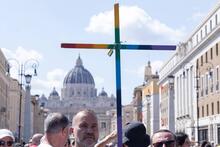
Queer liberation theology has largely been ignored in many Catholic circles. It’s often treated as something external to the church, disconnected from Catholic history, or framed as a political identity that is incompatible with one’s identity in Christ. This has a lot to do with the Catholic voices that are deemed trustworthy and authoritative (especially on social media). Today, these voices dictate what questions we’re allowed to ask, and which sexual experiences are considered theologically orthodox (hint: the straight ones).
But as I recently wrote for National Catholic Reporter, queer liberation theology can help the Catholic church remember itself, recovering a tradition of radical solidarity that transcends our culture wars.

I’ve been listening to Solomon Ray’s music on and off for the past few weeks. Ray, for those unaware, is an artificially generated “Mississippi-made soul singer” created by self-proclaimed “TPUSA contributor” Christopher “Topher” Townsend topping the Christian and Gospel charts.

After I saw that President Donald Trump had ordered attacks on Iran, I thought about the passage in 1 Samuel in which the Israelite elders get fed up with being run by a series of judges and ask for a king. The prophet Samuel, after praying over the matter, urges them to rethink the request, reciting a laundry list of all the things a king will do to the people.
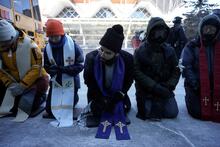
It might seem like the mission to abolish Immigration and Customs Enforcement is unique, but there are important parallels between this movement and the 19th-century fight to abolish slavery. As we seek to follow the gospel and make a new world, it is worth turning to abolitionists from the 19th century as we look for examples of how to win the fight against tyranny and wickedness, even if it takes longer than our lifetime.
The Fugitive Slave Act of 1850 required U.S. marshals in free states to capture people who were attempting to liberate themselves from slavery. While the act was meant to assuage the Southern malcontent at the admission of California as a free state in the same year, it prompted widespread protests in Northern cities from abolitionists who sought to prevent the enforcement of what they saw as a fundamentally evil law.
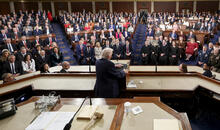
I thought about skipping President Trump’s State of the Union address, but out of a sense of civic duty—or perhaps misplaced hope—I watched it anyway. In what became the longest such address in U.S. history, Trump’s joint address to Congress devolved from political theater into vicious partisan baiting and derision.

I remember a distant past, almost too faint to recall with clarity. That season, so long ago, marked by the COVID-19 pandemic, has since been eclipsed by the pressing concerns of our day. We now live with the backdrop of global shifts, political instability, war, and domestic turmoil. But when I think back on that time, one overwhelming emotion returns with acuity: a deep concern for the safety of my friends and loved ones. Unfortunately, that same fear has crept back with suffocating weight due to rising measles cases in the U.S. But this time, the demographics I am most concerned with are not the elderly or those with preexisting conditions. I am most concerned for the most vulnerable among us: our children.
Since the first documented case in South Carolina in October 2025, the state has reported 979 cases, and the numbers are rising. The surge in outbreaks threatens to reverse the Centers for Disease Control and Prevention’s declaration that measles was eliminated in the United States in 2000. At this rate, we are on the verge of losing elimination status. The moral crisis deepens with reports that two detainees in an Immigration and Customs Enforcement detention center have tested positive for measles.

I’ve dedicated a major part of my life and career to the cause of foreign aid, so it was heartbreaking to see it scorned and set back by the Trump administration. And yet, this heartbreak pales in comparison to the needless suffering loss of life and careers caused by the administration’s reckless and cruel dismantling of the U.S. Agency for International Development and evisceration of foreign aid.
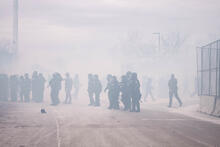
In response to the crisis of mass deportation, faith leaders and clergy are taking a moral stand. Whether it’s clergy protesting in Minnesota or faith-based mutual aid networks dedicated to assisting immigrant communities, people of faith are fighting against injustice. What comes next? What demands can Christian leaders make to shape our collective response beyond immediate protest and protection?
A framework for real justice going forward has three parts: Abolishing Immigration and Customs Enforcement and related agencies; welcoming immigrants through immigration law that includes rather than excludes; and participating in truth and reconciliation work, which may take various forms—including national or local truth commissions.

Millions of American Christians attend church on Ash Wednesday, and the gesture of marking our foreheads with ashes is formally known as the imposition of ashes. An imposition is a burden or demand. Those ashes are meant not only to be a reminder of our own mortality but also of what faith demands of us in Lent. Among those things is repentance.
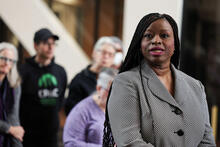
On Jan. 22, federal authorities arrested at least two organizers linked to a nonviolent protest inside Cities Church in St. Paul, Minn., that interrupted services at a congregation where one of the pastors doubles as the acting director of the Immigration and Customs Enforcement St. Paul field office.
Celebrating the arrests, Attorney General Pam Bondi vowed through a post on X: “WE WILL PROTECT OUR HOUSES OF WORSHIP 🙏🏻”.
Rev. Nekima Levy Armstrong, a Minneapolis activist and ordained minister, was one of the organizers arrested. Referring to ICE, she told the Canadian Broadcasting Corporation on Feb. 4 that “They have been physically brutalizing people, dragging people from their homes, kicking down people’s doors, coming into people’s homes with big guns, arresting people unjustly, even U.S. citizens, and people who are here legally.” She added, “To have someone serving as a pastor who is also overseeing these agents is unconscionable, unacceptable, and antithetical to the Christian faith.”
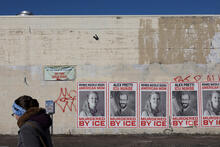
In Minneapolis, the places where Renee Nicole Macklin Good and Alex Pretti were killed by federal immigration agents have become sacred ground. People have returned to those sites with candles, signs, prayers, and grief. As far as community members are concerned, these memorials serve to remember those killed and what they stood for.

If things ever do go belly up, and we nuke ourselves into oblivion, I’m sure the Golden Rule will survive.
Part of my certainty is thanks to the retro-futuristic, darkly absurd, post-apocalyptic TV series Fallout. As a huge fan of the role-playing video games that the series is based on, I was skeptical that the show could live up to the legacy of the games; it surpassed my expectations. Fallout is brimming with stellar performances, superb writing, and deft political commentary that is relevant without being preachy. All eight episodes of Season Two are now streaming on Amazon Prime Video, which, given the series’ anti-corporate and anti-capitalist overtones, is rather strange.
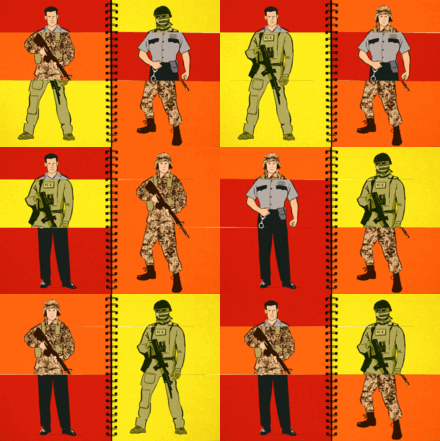
The only time I heard my father speak Spanish was in prayer. Before dinner, he thanked God for the food we received and for our presence to each other in the language of his home country. He still does.
We lived in Minnesota from 1993 to 1999, and on wintry nights, when the wind chill might dip so low that Fahrenheit equaled Celsius, our meal was blessed with words that seemed out of place and yet essential to who we were—as prayer should.
At the time, the infrastructure of immigrant communities in Minnesota was only beginning to develop. The number of families from Southeast Asia and Somalia was just starting to increase; it was still far from the critical mass that would make possible civic and cultural organizations, restaurants, and stores, let alone political power. In my school, I recall no other families from Latin America. The local Mexican restaurant was Taco John’s.

Chaos fills the streets as families are separated by force, and mothers cry out as their children are taken from them. To exert control and maintain power, a ruler orders agents to detain people off the street. Those the ruler labels as “subversive” are treated as a threat to his reign. The violence is indiscriminate and unrelenting. It does not matter who gets hurt, as long as the ruler stays on the throne.
If your mind went directly to President Donald Trump or the news of Immigration and Customs Enforcement agents shooting and killing two Minnesota residents—mom and poet Renee Nicole Macklin Good, and intensive care nurse Alex Pretti—you are not alone. But in this case, I am talking about Herod and his order to kill the children in Bethlehem and its surrounding region (Matthew 2:16). While the parallels are not identical, the shared logic of unrestrained state power is unmistakable.

What does it mean to bear witness? This past Friday, bearing witness felt close to frostbite. It meant weathering subzero temperatures in Minneapolis, with an even colder windchill biting my face. My body braced against the bitter cold, but my spirit was on fire. Along with hundreds of other faith leaders from around the country, I’d dropped everything to respond to a call from the city’s clergy to see firsthand how the administration’s increasingly aggressive and unlawful mass deportation efforts were impacting their community.
Clergy who arrived on Thursday attended trainings from a local interfaith group and monitored neighborhoods for signs of Immigration and Customs Enforcement agents. On Friday, I joined an interfaith prayer service at Temple Israel while ISAIAH, a different local organizing group, led nearly a hundred faith leaders in civil disobedience against airlines that contract with ICE. We later joined tens of thousands of people in the ICE OUT of Minnesota march and a general strike supported by Minnesota unions, progressive faith leaders and community activists. I was inspired to see nearly the entire city—schools, restaurants, businesses—closed down in solidarity with the protests. One of my favorite signs, made by the Minneapolis group Multifaith Antiracism, Change & Healing, echoed Micah 6:8: “Do justice, Love mercy, Get ICE Out.”
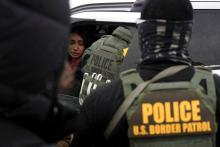
2025 was hard. For more reasons than we can count, the collective, personal, social, and systemic weight of tragedy, death, frustration, and hopelessness has left many weary in the dawning light of this new year—at least, I feel weary. Already in 2026, we have witnessed a masked Immigration and Customs Enforcement agent needlessly kill Renee Nicole Macklin Good. In Venezuela, the U.S. engages in an imperial war and openly admits its intentions to occupy the country. I cannot bear another year of genocide, ICE raids, complacent and inactive leaders, artificial intelligence deepfakes, social media toxicity, and trying to convince people that fascism is wrong.

Last week, White House press secretary Karoline Leavitt threw a performative tantrum when asked about the Immigration and Customs Enforcement agent who shot and killed Renee Nicole Macklin Good in Minneapolis. During a lengthy and frankly exhausting tirade in which she berated The Hill reporter Niall Stanage as “a leftwing hack,” Leavitt unloaded with some rhetoric about the crimes of undocumented immigrants.
“I bet you never even read about Laken Riley or Jocelyn Nungaray or all of the innocent Americans who were killed at the hand of illegal aliens in this country,” she said. “And the brave men and women of ICE are doing everything in their power to remove those heinous individuals and make our communities safer.”